Folium of Descartes
Algebraic curve
From Wikipedia, the free encyclopedia
In geometry, the folium of Descartes (from Latin folium 'leaf') is an algebraic curve defined by the implicit equation . It is named after the mathematician and philosopher René Descartes.


History
The curve was first proposed and studied in 1638 by René Descartes,[1] who was interested in classifying curves by the degrees of their algebraic equations.[2]: 314 Its claim to fame lies in an incident in the development of calculus. Descartes challenged Pierre de Fermat to find the tangent line to the curve at an arbitrary point, since Fermat had recently discovered a method for finding tangent lines. Fermat solved the problem easily, something Descartes was unable to do.[3]: 101 Since the invention of calculus, the slope of the tangent line can be found easily using implicit differentiation.[4]: 209–11
Graphing the curve
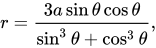
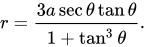
The folium of Descartes can be expressed in polar coordinates aswhich is plotted on the left. This is equivalent to[4]: 687
Another technique is to write and solve for and in terms of . This yields the rational parametric equations:[5]


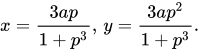
We can see that the parameter is related to the position on the curve as follows:
- corresponds to , : the right, lower, "wing".
- corresponds to , : the left, upper "wing".
- corresponds to , : the loop of the curve.


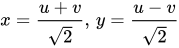
Another way of plotting the function can be derived from symmetry over . The symmetry can be seen directly from its equation (x and y can be interchanged). By applying rotation of 45° clockwise for example, one can plot the function symmetric over rotated x axis.


This operation is equivalent to a substitution:and yieldsPlotting in the Cartesian system of gives the folium rotated by 45° and therefore symmetric by -axis.


Properties
It forms a loop in the first quadrant with a double point at the origin and has asymptoteIt is symmetrical about the line . As such, the curve and this line intersect at the origin and at the point


Implicit differentiation gives the formula for the slope of the tangent line to this curve to be[4]

with poles and value 0 or at the origin.


Using either one of the polar representations above, the area of the interior of the loop is found to be . Moreover, the area between the "wings" of the curve and its slanted asymptote is also [1]


Relationship to the trisectrix of Maclaurin

The folium of Descartes is related to the trisectrix of Maclaurin by affine transformation. To see this, start with the equationand change variables to find the equation in a coordinate system rotated 45 degrees. This amounts to setting

In the plane the equation is
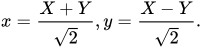


If we stretch the curve in the direction by a factor of this becomeswhich is the equation of the trisectrix of Maclaurin.



