P-adically closed field
Type of field in mathematics
From Wikipedia, the free encyclopedia
In mathematics, a p-adically closed field is a field that enjoys a closure property that is a close analogue for p-adic fields to what real closure is to the real field. They were introduced by James Ax and Simon B. Kochen in 1965.[1]
Definition
Let be the field of rational numbers and be its usual -adic valuation (with ). If is a (not necessarily algebraic) extension field of , itself equipped with a valuation , we say that is formally p-adic when the following conditions are satisfied:


- extends (that is, for all ),
- the residue field of coincides with the residue field of (the residue field being the quotient of the valuation ring by its maximal ideal ),
- the smallest positive value of coincides with the smallest positive value of (namely 1, since was assumed to be normalized): in other words, a uniformizer for remains a uniformizer for .




Note that the value group of may be larger than that of since it may contain infinitely large elements over the latter.
Thus the formally -adic fields can be viewed as an analogue of the formally real fields.
For example, the field of Gaussian rationals, if equipped with the valuation given by (and ) is formally 5-adic (the place of the rationals splits in two places of the Gaussian rationals since factors over the residue field with 5 elements, and is one of these places). The field of 5-adic numbers (which contains both the rationals and the Gaussian rationals embedded as per the place ) is also formally 5-adic. On the other hand, the field of Gaussian rationals is not formally 3-adic for any valuation, because the only valuation on it which extends the 3-adic valuation is given by and its residue field has 9 elements.

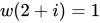
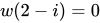


When is formally -adic but that there does not exist any proper algebraic formally -adic extension of , then is said to be p-adically closed. For example, the field of -adic numbers is -adically closed, and so is the algebraic closure of the rationals inside it (the field of -adic algebraic numbers).
If is -adically closed, then[2]
- there is a unique valuation on which makes -adically closed (so it is legitimate to say that , rather than the pair , is -adically closed),
- is Henselian with respect to this place (that is, its valuation ring is so),
- the valuation ring of is exactly the image of the Kochen operator (see below),
- the value group of is an extension by (the value group of ) of a divisible group, with the lexicographical order.

The first statement is an analogue of the fact that the order of a real-closed field is uniquely determined by the algebraic structure.
The definitions given above can be copied to a more general context: if is a field equipped with a valuation such that
- the residue field of is finite (call its cardinality and its characteristic),
- the value group of admits a smallest positive element (call it 1, and say is a uniformizer, i.e. ),
- has finite absolute ramification, i.e., is finite (that is, a finite multiple of ),


then we can speak of formally -adic fields (or -adic if is the ideal corresponding to ) and -adically complete fields. These hypotheses are notably satisfied for the field of rationals, with the prime number having valuation 1.


The Kochen operator
If is a field equipped with a valuation satisfying the hypothesis and with the notations introduced in the previous paragraph, define the Kochen operator by
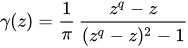
(when ). It is easy to check that always has non-negative valuation. The Kochen operator can be thought of as a -adic (or -adic) analogue of the square function in the real case.


An extension field of is formally -adic if and only if does not belong to the subring generated over the value ring of by the image of the Kochen operator on . This is an analogue of the statement that a field is formally real when is not a sum of squares.


First-order theory
The first-order theory of -adically closed fields (here we are restricting ourselves to the -adic case, i.e., is the field of rationals and is the -adic valuation) is complete and model complete, and if we slightly enrich the language it admits quantifier elimination. Thus, one can define -adically closed fields as those whose first-order theory is elementarily equivalent to that of .
