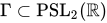
Let  be a closed hyperbolic surface and let
  be a Fuchsian group so that
  is a Fuchsian model for . Let
 and endow this set with the topology of pointwise convergence (sometimes called "algebraic convergence"). In this particular case this topology can most easily be defined as follows: the group is finitely generated since it is isomorphic to the fundamental group of . Let
  be a generating set: then any
  is determined by the elements
  and so we can identify
  with a subset of
  by the map
  . Then we give it the subspace topology.
The Nielsen isomorphism theorem (this is not standard terminology and this result is not directly related to the Dehn–Nielsen theorem) then has the following statement:
For any there exists a self-homeomorphism (in fact a quasiconformal map)  of the upper half-plane
  such that
  for all
  .
.
The proof is very simple: choose an homeomorphism 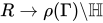 and lift it to the hyperbolic plane. Taking a diffeomorphism yields quasi-conformal map since is compact.
This result can be seen as the equivalence between two models for Teichmüller space of : the set of discrete faithful representations of the fundamental group  into
into  modulo conjugacy and the set of marked Riemann surfaces
  where
where  is a quasiconformal homeomorphism modulo a natural equivalence relation.