G/M/1 queue
From Wikipedia, the free encyclopedia
In queueing theory, a discipline within the mathematical theory of probability, the G/M/1 queue represents the queue length in a system where interarrival times have a general (meaning arbitrary) distribution and service times for each job have an exponential distribution.[1] The system is described in Kendall's notation where the G denotes a general distribution, M the exponential distribution for service times and the 1 that the model has a single server.
The arrivals of a G/M/1 queue are given by a renewal process. It is an extension of an M/M/1 queue, where this renewal process must specifically be a Poisson process (so that interarrival times have exponential distribution).
Models of this type can be solved by considering one of two M/G/1 queue dual systems, one proposed by Ramaswami and one by Bright.[2]
Let be a queue with arrival times that have interarrival distribution A. Define the size of the queue immediately before the nth arrival by the process . This is a discrete-time Markov chain with stochastic matrix:


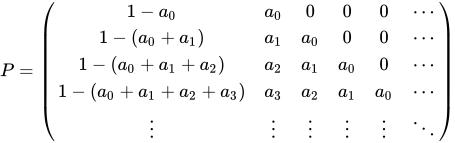
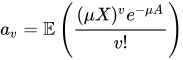
where .[3]: 427–428
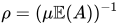
The Markov chain has a stationary distribution if and only if the traffic intensity is less than 1, in which case the unique such distribution is the geometric distribution with probability of failure, where is the smallest root of the equation .[3]: 428



In this case, under the assumption that the queue is first-in first-out (FIFO), a customer's waiting time W is distributed by:[3]: 430

