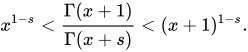
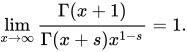
A survey of inequalities for ratios of gamma functions was written by Qi.[3]
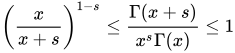
The proof by logarithmic convexity gives the stronger upper bound
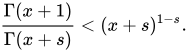
Gautschi's original paper proved a different, stronger upper bound,

where  is the digamma function. Neither of these upper bounds is always stronger than the other.[4]
Kershaw proved two tighter inequalities. Again assuming that  and
and  ,[5]
,[5]
![{\displaystyle {\begin{aligned}\left(x+{\frac {s}{2}}\right)^{1-s}&<{\frac {\Gamma (x+1)}{\Gamma (x+s)}}<\left[x-{\frac {1}{2}}+\left(s+{\frac {1}{4}}\right)^{1/2}\right]^{1-s},\\\exp \left((1-s)\psi (x+s^{1/2})\right)&<{\frac {\Gamma (x+1)}{\Gamma (x+s)}}<\exp \left((1-s)\psi \left(x+{\frac {1}{2}}(s+1)\right)\right).\end{aligned}}}](https://wikimedia.org/api/rest_v1/media/math/render/svg/25cad8e7f3a8ed6e6dfb5fe708a1ed633afd2c7c)
Gautschi's inequality is specific to a quotient of gamma functions evaluated at two real numbers having a small difference. However, there are extensions to other situations. If  and
and  are positive real numbers, then the convexity of leads to the inequality:[6]

For , this leads to the estimates

A related but weaker inequality can be easily derived from the mean value theorem and the monotonicity of .[7]
A more explicit inequality valid for a wider class of arguments is due to Kečkić and Vasić, who proved that if  , then:[8]

In particular, for , we have:

Guo, Qi, and Srivastava proved a similar-looking inequality, valid for all  :[9]
:[9]

For , this leads to: