Gangneung
City in Gangwon, South Korea
From Wikipedia, the free encyclopedia
Gangneung (Korean: 강릉; Korean pronunciation: [kaŋ.nɯŋ]) is a municipal city in the South Korean state of Gangwon, located on the east coast of South Korea. It has a population of 213,658 (as of 2017).[2] Gangneung is the economic centre of the Yeongdong region of Gangwon State. It has many tourist attractions, such as Jeongdongjin, a very popular area for watching the sunrise, and Gyeongpo Beach. The city hosted all the ice events for the 2018 Winter Olympics and the 2024 Winter Youth Olympics.[3]

 South Korea
Gangneung
강릉시 | |
|---|---|
| Korean transcription(s) | |
| • Hangul | 강릉시 |
| • Hanja | 江陵市 |
| • Revised Romanization | Gangneung-si |
| • McCune–Reischauer | Kangnŭng-si |
 Flag  Emblem of Gangneung | |
 Location in South Korea | |
| Coordinates: 37°45′10″N 128°53′30″E | |
| Country | South Korea |
| State |  Gangwon Gangwon |
| First official recorded | 129 BC |
| City established | September 1, 1955 |
| As merger with Myeongju area | January 1, 1995 |
| Administrative divisions | 1 eup, 7 myeon, 13 dong |
| Government | |
| • Mayor | Kim Hong-gyu |
| Area | |
• Total | 1,040 km2 (400 sq mi) |
| Population (September 2024[1]) | |
• Total | 208,161 |
| • Density | 200/km2 (518/sq mi) |
| • Dialect | Gangwon |
| Area code | +82-33 |
| Climate | Cfa |


History
Gangneung was the home of the Yemaek people in ancient times and became the land of Wiman Joseon in 129 BC. In 128 BC, Nam Ryeo, the army officer of Yaekam, punished Wujang of Wiman Korea and became the territory of the Han dynasty. In the 14th year of Goguryeo Muchheon (313), it entered Goguryeo territory.[4]
In 639, Silla occupied this place and ruled it as a 'Sogyeong' (소경). In 658, King Moo-yeong abolished the Sogyeong and made an arsenal to send the todok, because it was adjacent to Malgal. In 757, it was renamed Sungju and restored it in 776.[5]
It was renamed Myungju again during the Goryeo period, and it was under the jurisdiction the north of Chuncheon in the 14th year of Sungjong (995). It separated the Hamgyeong-do from the Gangeung and called it Gangneung-do, but it has always been the center of administration and military. At the beginning of the Joseon Dynasty, it called to Hwadangdo and Wonchundo and rename Gangneung by the name of Gangwon Province in the 5th year of King Sejong (1423).[6]
Some areas have been incorporated into Yangyang since 1945, and Gangneung City was established in 1995 as the areas of Gangneung and Myeongju merged.[7]
On 18 September 1996 a North Korean submarine ran aground near Gangneung in an attempted infiltration mission, spurring a 49-day manhunt for the escaped passengers. For more details, refer to the 1996 Gangneung submarine infiltration incident.[8]
Symbols of Gangneung
The flag of the city shows a red sun in the centre and blue wave in front, on a white background. The sun represents the sunrise, the wave the sea. The flower of the city is the crepe myrtle, the tree of the city is the pine tree, its bird the swan. The animal of Gangneung is the tiger.[9]
Geography
Gangneung is located to the east of the Taebaek Mountains, which is the considered the 'waist' of the Korean peninsula. To the east is Sea of Japan, and to the west are the inner side of Hongcheon County, the Pyeongchang County's Jinbu-myeon and the Daegwallyeong-myeon respectively. The southern side is connected to Donghae and the Jeongseon County's critical side. The north side is adjacent to Yangyang County Hyunbuk-myeon and Hyunnam-myeon.[10]
The total area of Gangneung is about 1,040.4 km2 (401.7 sq mi) as of the end of 2015, which accounts for 6.2% of Gangwon State's 16,873 km2 (6,515 sq mi). 80.4% of the area of Gangneung, 837.36 km2 (323.31 sq mi), is forestland.[11]
Climate
Gangneung experiences a humid subtropical climate (Köppen: Cfa) with cool to cold winters and hot, humid summers. Since Gangneung is a coastal city, it has generally milder winters and relatively cooler summers than the rest of Korea. It is bordered by mountains to the west and the sea to the east.[12]
| Climate data for Gangneung (1991–2020 normals, extremes 1911–present) | |||||||||||||
|---|---|---|---|---|---|---|---|---|---|---|---|---|---|
| Month | Jan | Feb | Mar | Apr | May | Jun | Jul | Aug | Sep | Oct | Nov | Dec | Year |
| Record high °C (°F) | 18.7 (65.7) |
21.4 (70.5) |
27.1 (80.8) |
33.6 (92.5) |
35.5 (95.9) |
37.0 (98.6) |
39.4 (102.9) |
38.9 (102.0) |
35.8 (96.4) |
32.8 (91.0) |
29.1 (84.4) |
21.8 (71.2) |
39.4 (102.9) |
| Mean daily maximum °C (°F) | 5.3 (41.5) |
7.1 (44.8) |
11.7 (53.1) |
17.9 (64.2) |
22.7 (72.9) |
25.4 (77.7) |
28.1 (82.6) |
28.6 (83.5) |
24.6 (76.3) |
20.3 (68.5) |
14.0 (57.2) |
7.7 (45.9) |
17.8 (64.0) |
| Daily mean °C (°F) | 0.9 (33.6) |
2.7 (36.9) |
7.0 (44.6) |
13.1 (55.6) |
17.9 (64.2) |
21.3 (70.3) |
24.7 (76.5) |
25.0 (77.0) |
20.5 (68.9) |
15.6 (60.1) |
9.5 (49.1) |
3.3 (37.9) |
13.5 (56.3) |
| Mean daily minimum °C (°F) | −2.7 (27.1) |
−1.3 (29.7) |
2.6 (36.7) |
8.2 (46.8) |
13.3 (55.9) |
17.5 (63.5) |
21.6 (70.9) |
21.9 (71.4) |
17.0 (62.6) |
11.5 (52.7) |
5.6 (42.1) |
−0.5 (31.1) |
9.6 (49.3) |
| Record low °C (°F) | −20.2 (−4.4) |
−15.9 (3.4) |
−11.7 (10.9) |
−3.5 (25.7) |
−0.8 (30.6) |
6.0 (42.8) |
11.3 (52.3) |
13.7 (56.7) |
6.3 (43.3) |
−1.9 (28.6) |
−9.3 (15.3) |
−15.3 (4.5) |
−20.2 (−4.4) |
| Average precipitation mm (inches) | 47.9 (1.89) |
48.0 (1.89) |
65.1 (2.56) |
81.9 (3.22) |
79.2 (3.12) |
118.5 (4.67) |
250.2 (9.85) |
292.9 (11.53) |
229.3 (9.03) |
113.9 (4.48) |
81.1 (3.19) |
36.9 (1.45) |
1,444.9 (56.89) |
| Average precipitation days (≥ 0.1 mm) | 6.2 | 5.7 | 8.8 | 8.9 | 9.1 | 10.8 | 16.0 | 16.4 | 11.8 | 7.8 | 7.3 | 4.6 | 113.4 |
| Average snowy days | 6.0 | 6.0 | 4.3 | 0.3 | 0.0 | 0.0 | 0.0 | 0.0 | 0.0 | 0.0 | 0.9 | 2.9 | 20.2 |
| Average relative humidity (%) | 46.8 | 49.2 | 52.8 | 52.2 | 59.3 | 69.3 | 74.7 | 76.4 | 73.0 | 61.5 | 52.7 | 45.6 | 59.5 |
| Mean monthly sunshine hours | 190.2 | 182.2 | 199.3 | 209.6 | 218.7 | 176.9 | 148.9 | 151.3 | 162.1 | 192.5 | 175.2 | 189.7 | 2,196.6 |
| Percentage possible sunshine | 60.0 | 56.7 | 50.3 | 51.6 | 47.5 | 37.3 | 30.8 | 35.1 | 42.1 | 54.1 | 55.9 | 61.5 | 47.3 |
| Source: Korea Meteorological Administration (snow and percent sunshine 1981–2010)[13][14][15] | |||||||||||||
Administrative divisions
The district includes one town (eup), seven townships (myeon), 13 neighborhoods (dong).[16]
| Name | Korean name | Area(km2) | Population | Households | Map |
|---|---|---|---|---|---|
| Jumunjin-eup | 주문진읍 | 60.52 | 19,299 | 9,098 |  |
| Seongsan-myeon | 성산면 | 80.28 | 3,305 | 1,488 | |
| Wangsan-myeon | 왕산면 | 245.28 | 1,682 | 881 | |
| Gujeong-myeon | 구정면 | 42.72 | 3,990 | 1,661 | |
| Gangdong-myeon | 강동면 | 112.48 | 5,090 | 2,435 | |
| Okgye-myeon | 옥계면 | 148.83 | 4,452 | 2,039 | |
| Sacheon-myeon | 사천면 | 70.89 | 4,255 | 1,971 | |
| Yeongok-myeon | 연곡면 | 202.45 | 6,920 | 3,090 | |
| Hongjae-dong | 홍제동 | 3.76 | 8,678 | 3,601 |  |
| Jungang-dong | 중앙동 | 0.99 | 6,447 | 3,281 | |
| Okcheon-dong | 옥천동 | 0.58 | 4,246 | 2,162 | |
| Gyo 1-dong | 교1동 | 2.73 | 29,995 | 11,122 | |
| Gyo 2-dong | 교2동 | 2.57 | 9,723 | 4,078 | |
| Ponam 1-dong | 포남1동 | 1.3 | 12,057 | 5,213 | |
| Ponam 2-dong | 포남2동 | 2.58 | 16,694 | 6,727 | |
| Chodang-dong | 초당동 | 2.89 | 5,921 | 2,413 | |
| Songjeong-dong | 송정동 | 3.45 | 7,561 | 2,838 | |
| Naegok-dong | 내곡동 | 4.96 | 11,970 | 5,066 | |
| Gangnam-dong | 강남동 | 16.09 | 21,515 | 8,450 | |
| Seongdeok-dong | 성덕동 | 11.41 | 29,357 | 11,043 | |
| Gyeongpo-dong | 경포동 | 23.02 | 4,829 | 2,234 | |
| Gangneung-si | 강릉시 | 1,040 | 217,986 | 90,891 | |
Nature and tourism
Beaches

There are 20 beaches such as Anmok Beach, Gyeongpo Beach and Gangmun Beach.[17] Jeongdongjin Beach is a popular place to visit in the New Year because the first sunrise is important in Korean culture.[18] The TV series Sandglass was taken on the beach.[19]
Jeongdong-Simgok Badabuchae Trail is a 2.86km trail where visitors can observe the coastal terrace formed 23 million years ago.[20]
Gyeongpo Lake

Gyeongpo Lake is the second largest lagoon in the east coast. Its size has shrunk due to continuous development since the early 20th century. It is a habitat for ducks, cormorants and egrets and migratory birds such as swans are also spotted here.[21]
Culture
Heritage

There are a total of 136 cultural properties in Gangneung. Among them, there are 40 state-designated heritages and 60 province-designated heritages.[22]
- Main Gate of Imyeonggwan is the front gate of an official inn built in the Goryeo period. It is the only national treasure in Gangneung.[23]
- Ojukheon is the birthplace of Shin Saimdang and Yi I. It was designated as treasure No. 165 because it is one of the oldest buildings in Korea.[24]
- Gyeongpodae is a pavilion located north of Gyeongpo lake. Built in the Goryeo dynasty, it was designated as treasure No. 2046.[25]
- Gulsansa was founded by Beomil in 851. The site of the temple was designated as historic site No. 448.[26]
- Imdangdong Catholic Church, which was constructed in 1955, was designated as registered cultural heritage No. 457.[27]
| Total | State-designated heritage | Province-designated heritage | Cultural heritage material | ||||||||||||
| Total | National Treasure | Treasure | Historic Site | Natural monuments | Intangible Cultural Property | Scenic Site | National Folklore Cultural Heritage | Registered cultural heritage | Total | Tangible Cultural Heritage | Intangible Cultural Heritage | Monument | Registered cultural heritage | ||
| 136 | 40 | 1 | 21 | 3 | 6 | 1 | 4 | 2 | 2 | 60 | 40 | 6 | 13 | 1 | 36 |
Festivals
Gangneung Danoje is the oldest festival in South Korea and the biggest in the east coast.[28] It was designated as the National Intangible Cultural Heritage in 1967 and Masterpieces of the Oral and Intangible Heritage of Humanity by UNESCO in 2005.[29] It is a combination of several commemoration rites and traditional plays, with the highlight being the traditional Gwanno Mask Dance.
There are several modern festivals in the region. The International Junior Art Festival, which began in 2002, showcases performances of international youth and provides a program on Korean culture.[30] Gyeongpo Rock Festival offers indie bands a stage for their performances.[31] Gangneung Coffee Festival, which began in 2009, is an annual coffee-tasting festival in which a variety of coffee vendors showcase their drinks.[32]
Food
Gangneung is famous for Chodang dubu, ongsimi, mulhoe, jangkalguksu, tea ceremony and hangwa.[33] Chodang dubu, local food of Chodang village, uses seawater instead of bittern.[34]
Anmok Coffee Street, which started to form in the 1990s, is where Gangneung Coffee Festival is held.[35] Park I-choo, CEO of Bohemian Park I-Choo Coffee, is thought to have contributed greatly to the formation of the street.[36]
Museums
There are 10 museums in Gangneung.[37] Gangneung City Museum exhibits relics that show the history and culture of Gangneung.[38] Daegwallyeong Museum exhibits traditional art.[39] Hwanhui Cup Museum (Fantapia M) is South Korea's first cup museum.[40]
Transportation
In Gangneung, Donghae Expressway connects Incheon to Gangneung and Yeongdong Expressway connects Yangyang County and Donghae. The national highway is National Route 7 (part of Asian Highway Route 6) and it connects Goseong County to Busan. It takes about 2 hours and 30 minutes to Seoul by road.
The Yeongdong Line passes Yeongju to Gangneung. Before 2006, Saemaeul-ho stopped at Jeongdongjin station and Gangneung station and it took 5.5 hours at Cheongnyangni station, but now only Mugunghwa-ho is stopped, it takes 6 hours to drive. In 2017, Gyeonggang Line was opened and Gangneung station was designated as an essential-stop station. The time between Gangneung station and Cheongnyangni station has been reduced from the existing 6 hours to the minimum of 114 minutes after KTX operation.
It was operated by Gangneung Airport for air traffic, but passed the passenger transportation right to Yangyang International Airport in 2002 and closed its service as an airport.[41]
Roads
Yeongdong Expressway passed city west to east, Donghae Expressway passed through the city from south to north. National Route 6, 7, 35, 59 passed through city.
Trains
KTX-Sancheon is essential stop Jinbu and Gangneung station. On 2018 Winter Olympics period, increased frequency of KTX.[42]

 Yeongdong Line Yeongdong Line |
Mangsang ↔ Okkye ↔ Jeongdongjin ↔ Anin↔ Gangneung | |||||||||||||
|---|---|---|---|---|---|---|---|---|---|---|---|---|---|---|
| Gyeonggang Line |
Jinbu ↔ Gangneung | |||||||||||||
Buses
Local transit operators connect communities in the city divided three regions. This is managed by Gangneung City Office and the operation is carried out by each transportation company.[43]
Gangneung Intercity Bus Terminal operates the intercity bus[44] and operates six Express Bus line in the Gangneung Express Bus Terminal, the largest terminal in Gangwon State.[45]
Taxi
A total of 589 units in Gangneung are operating taxi licenses. The basic fare of Gangneung taxi is 2,800 won for 2 km. After that, 100 won will be charged for 152m from 2 km to 6 km, and 200 won will be charged for 152m after 6 km. but Jumunjin area, Gangdong-meon, Okgye area are designated as exceptional areas to 45% extra charge.[46]
Sea transport
Gangneung Port Passenger Terminal of Gangneung Harbor handles the Gangneung-Ulneung passenger ship.[47]
Sports
Football
Gangneung is the home of the K3 League football club FC Gangneung and is one of the two cities where K League football team Gangwon FC plays its home matches. Since 1976, Gangneung Jeil High School and Gangneung Junior high school soccer team rivalry Derby, which is held every day in the Dano Festival, have become popular.
The Daemyung Killer Whales were active in Asia League Ice Hockey[48] from 2016 to 2020.
2018 Winter Olympics
The city 'Gangneung Coastal Cluster' was the venue for the indoor sports of the 2018 Winter Olympics and Paralympics in Pyeongchang. All these facilities, except for the Gangneung Curling Centre, were built for the Olympics.
- Gangneung Olympic Park
- Gangneung Hockey Centre – Ice Hockey (Olympics and Paralympics)
- Gangneung Curling Centre – Curling (Olympics and Paralympics)
- Gangneung Oval – Speed skating
- Gangneung Ice Arena – Short track speed skating and Figure skating
- Kwandong Hockey Centre - Ice Hockey (Olympics)
The city also hosted an Olympic Village for the athletes and a media village.
Image gallery
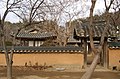 The birth house of Heo Nanseolheon, a famous Korean poet of the 17th century.
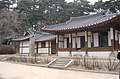 The birthplace of Yi I.
 Seongyojang, a country house built and owned by a prominent yangban family in Gangneung. Built in the 19th century.
 A closer view at Seongyojang.


Sister cities


Notable people
- Choi Kyu-Ha, former president of South Korea
- Edward Young-min Kwon, celebrity chef
- Yeon Woo-jin, actor
- JR (NU'EST), idol
- Yezi (Fiestar), idol
- Kim Seo-hyung, actress
- Jeon Yeo-bin, actress
- Sin Saimdang, a Korean artist, writer, calligraphist, and poet.
- Kim Bo-sung, a South Korean actor
- Yi I, a Korean philosopher and writer
- Choi Han-bit, model, actress, singer and idol
- Cha Hyung-won, living national treasure

