Hering's Paradox
From Wikipedia, the free encyclopedia
Hering's paradox describes a physical experiment in the field of electromagnetism that seems to contradict Maxwell's equations in general, and Faraday's Law of Induction and the flux rule in particular. In his study on the subject, Carl Hering concluded in 1908 that the usual statement of Faraday's Law (at the turn of the century) was imperfect and that it required to be modified in order to become universal.[1] Since then, Hering's paradox has been used repeatedly in physics didactics to demonstrate the application of Faraday's Law of Induction,[2][3][4][5] and it can be considered to be completely understood within the theory of classical electrodynamics. Grabinski criticizes, however, that most of the presentations in introductory textbooks were problematical. Either, Faraday's Law was misinterpreted in a way that leads to confusion, or solely such frames of reference were chosen that avoid the need of an explanation.[6] In the following, Hering's paradox is first shown experimentally in a video and -- in a similar way as suggested by Grabinski -- it is shown, that when carefully treated with full mathematical consistency, the experiment does not contradict Faraday's Law of Induction. Finally, the typical pitfalls of applying Faraday's Law are mentioned.
The experiment is shown in the video on the right side. In the experiment, a slotted iron core is used, where a coil fed with a direct current generates a constant magnetic field in the core and in its slot.
Two different experiments are carried out in parallel:
- *In the lower part, an ordinary conductor loop is passed through the slot of the iron core. As there is a magnetic field in this slot, a voltage is generated at the ends of the conductor loop, which is amplified and displayed in the lower oscilloscope image.
- *A modified conductor loop is realized in the upper part. The conductor loop is split at one point and the split ends are fitted with a metal wheel. During the experiment, the metal wheels move around the magnetic core and exert a certain contact pressure on each other and on the core, respectively. As the magnetic core is electrically conductive, there is always an electrical connection between the wheels and therefore between the separated ends of the loop. The oscilloscope does not show any voltage despite the otherwise identical conditions as in the first experiment.
In both experiments, the same change in magnetic flux occurs at the same time. However, the oscilloscope only shows a voltage in one experiment, although one would expect the same induced voltage to be present in both experiments. This unexpected result is called Hering's paradox,[7][8][9][10] named after Carl Hering.
Explanation
Moving wires/oscilloscope, magnet at rest
The easiest way to understand the outcome of the experiment is to view it from the rest frame of the magnet, i. e. the magnet is at rest, and the oscilloscope and the wires are at motion. In this frame of reference, there is no reason for a voltage to arise, because the set-up consists of a magnet at rest and some wires moving in a field free space around the magnet, which scratch the magnet a little.
To conclude, there is
- * no change of the magnetic field anywhere (
) and thus no current-driving force
on the charges
in the circuit due to rest induction,
- * and those parts of the circuit having charges being at motion (
) are not exposed to a magnetic field (
) and vice versa, so that there is no magnetic force
on the charges
Moving magnet, wires/oscilloscope at rest

While the perspective from the rest frame of the magnet causes no difficulties in understanding, this is not the case when viewed from a frame of reference in which the oscilloscope[11] and the cables are at rest and an electrically conductive permanent magnet moves into a conductor loop at a speed of 

An essential step of solving the paradox is the realization that the inside of the conductive moving magnet is not field-free, but that a non-zero electric field strength 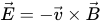

The equation 


Finally, the following electric field strengths result for the various sections of the conductor loop:
Section  (conductor) (conductor) | Section (magnet) | Section  (conductor) (conductor) | Section  (oscilloscope) (oscilloscope) |
|---|---|---|---|
 |  | | |
To check whether the outcome of the experiment is compatible with Maxwell's equations, we first write down the Maxwell Faraday equation in integral notation:

Here 


Considering the electrical field strengths shown in the table, the left side of the Maxwell Faraday equation can be written as:

The minus sign is due to the fact that the direction of integration is opposite to the direction of the electric field strength (
To calculate the right-hand side of the equation, we state that within the time 


The right and left sides of the equation are obviously identical. This shows that Hering's paradox is in perfect agreement with the Maxwell Faraday equation.
Note that the speed of the boundary curve 

Pitfalls
The difficulties in understanding Hering's paradox and similar problems are usually based on three misunderstandings:
- (1) the lack of distinction between the velocity of the boundary curve and the velocity of a conductor present at the location of the boundary curve,
- (2) the uncertainty as to whether the term
- (3) ignoring the fact that in an ideal conductor moving in a magnetic field with flux density
, there is a non-zero electric field strength
If these points are consistently considered, Hering's paradox turns out to be in perfect agreement to Faraday's law of induction (given by the Maxwell Faraday equation) viewed from any frame of reference whatsoever. Furthermore, the difficulties in understanding the (thought) experiments described in the chapter "Exceptions to the flow rule" in the "Feynman Lectures" are due to the same misunderstandings.
References
- ↑ C. Hering, "An imperfection in the usual statement of the fundamental law of electromagnetic induction," in Proceedings of the American Institute of Electrical Engineers, vol. 27, no. 3, pp. 339-349, March 1908, doi: 10.1109/PAIEE.1908.6742001
- ↑ Günther Lehner: Elektromagnetische Feldtheorie für Ingenieure und Physiker, 8. edition, Chapter 6.2, Springer/Vieweg, ISBN 978-3-662-56642-8
- ↑ Kirk T. McDonald: Hering's Flux-Linkage Paradox, Oct. 8, 2019, Joseph Henry Laboratories, Princeton University, Princeton, NJ
- ↑ A. Lózez-Ramos et al: Conditions for the validity of faraday's law of induction and their experimental confirmation, European Journal of Physics, 29 (2008), p. 1069-1076, doi:10.1088/0143-0807/29/5/018
- ↑ G. I. Cohn, "Electromagnetic induction," in Electrical Engineering, vol. 68, no. 5, pp. 441-447, May 1949, doi: 10.1109/EE.1949.6444777.
- ↑ Hartmut Grabinski (1997), "Der Heringsche Versuch: Mythen und Fakten", Electrical Engineering, 80 (5), Springer: 285–290, doi:10.1007/BF01370965, retrieved 2024-07-02
- ↑ Proc. Am. J. E. F., März 1908, S. 339.
- ↑ El. World. Nr. 11, 14. März 1908, S. 558.
- ↑ The Electrician. 3. April 1908, S. 946.
- ↑ Hartmut Grabinski (1997), "Der Heringsche Versuch: Mythen und Fakten", Electrical Engineering, 80 (5), Springer: 285–290, doi:10.1007/BF01370965, retrieved 2024-07-02
- ↑ We do not have exactly this situation in the video, because the oscilloscope does not have the same velocity as the wires. The speed of the oscilloscope and the wires, however, is of no interest, here, because there is no
by setting
- ↑ Note that there is no fundamental equation in the theory of electrodynamics that uses the relative velocity of one body with reference to another. Maxwell's equations in the differential notation do not contain any velocities at all, and the velocity
in the electromagnetic force on a charge
is the (absolute) speed of the charge
- ↑ If the speed of the boundary curve is considered, it needs to be considered on both sides of the Maxwell-Faraday equation. Owing to
(Harley Flanders: Differentiation under the integral sign. In: American Mathematical Monthly. 80 (6), Juni–Juli 1973, S. 615–627) and the Maxwell equation
the Maxwell-Faraday equation converts to
, where
is the speed of the imaginary boundary curve and
is thus not the Lorentz force. Using this equation is not easier than the standard form of the Maxwell-Faraday equation in integral notation.