Holmgren's uniqueness theorem
From Wikipedia, the free encyclopedia
In the theory of partial differential equations, Holmgren's uniqueness theorem, or simply Holmgren's theorem, named after the Swedish mathematician Erik Albert Holmgren (1873–1943), is a uniqueness result for linear partial differential equations with real analytic coefficients.[1]
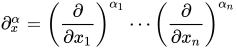
We will use the multi-index notation: Let , with standing for the nonnegative integers; denote and



- .
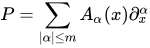
Holmgren's theorem in its simpler form could be stated as follows:
- Assume that P = ∑|α| ≤m Aα(x)∂α
x is an elliptic partial differential operator with real-analytic coefficients. If Pu is real-analytic in a connected open neighborhood Ω ⊂ Rn, then u is also real-analytic.
This statement, with "analytic" replaced by "smooth", is Hermann Weyl's classical lemma on elliptic regularity:[2]
- If P is an elliptic differential operator and Pu is smooth in Ω, then u is also smooth in Ω.
This statement can be proved using Sobolev spaces.
Classical form
Let be a connected open neighborhood in , and let be an analytic hypersurface in , such that there are two open subsets and in , nonempty and connected, not intersecting nor each other, such that .



Let be a differential operator with real-analytic coefficients.
Assume that the hypersurface is noncharacteristic with respect to at every one of its points:

- .

Above,

the principal symbol of . is a conormal bundle to , defined as .


The classical formulation of Holmgren's theorem is as follows:
- Holmgren's theorem
- Let be a distribution in such that in . If vanishes in , then it vanishes in an open neighborhood of .[3]










