Isbell's zigzag theorem
Theorem of dominion in abstract algebra
From Wikipedia, the free encyclopedia
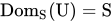
Isbell's zigzag theorem, a theorem of abstract algebra characterizing the notion of a dominion, was introduced by American mathematician John R. Isbell in 1966.[1] Dominion is a concept in semigroup theory, within the study of the properties of epimorphisms. For example, let U is a subsemigroup of S containing U, the inclusion map is an epimorphism if and only if , furthermore, a map is an epimorphism if and only if .[2] The categories of rings and semigroups are examples of categories with non-surjective epimorphism, and the Zig-zag theorem gives necessary and sufficient conditions for determining whether or not a given morphism is epi.[3] Proofs of this theorem are topological in nature, beginning with Isbell (1966) for semigroups, and continuing by Philip (1974), completing Isbell's original proof.[3][4][5] The pure algebraic proofs were given by Howie (1976) and Storrer (1976).[3][4][note 1]



Statement
Zig-zag

Zig-zag:[7][2][8][9][10][note 2] If U is a submonoid of a monoid (or a subsemigroup of a semigroup) S, then a system of equalities;

in which and , is called a zig-zag of length m in S over U with value d. By the spine of the zig-zag we mean the ordered (2m + 1)-tuple .



Dominion
Dominion:[5][6] Let U be a submonoid of a monoid (or a subsemigroup of a semigroup) S. The dominion is the set of all elements such that, for all homomorphisms coinciding on U, .


We call a subsemigroup U of a semigroup U closed if , and dense if .[2][12]
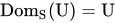
Isbell's zigzag theorem
Isbell's zigzag theorem:[13]
If U is a submonoid of a monoid S then if and only if either or there exists a zig-zag in S over U with value d that is, there is a sequence of factorizations of d of the form
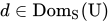


This statement also holds for semigroups.[7][14][9][4][10]
For monoids, this theorem can be written more concisely:[15][2][16]
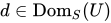
Let S be a monoid, let U be a submonoid of S, and let . Then if and only if in the tensor product .



Application
- Let U be a commutative subsemigroup of a semigroup S. Then is commutative.[10]
- Every epimorphism from a finite commutative semigroup S to another semigroup T is surjective.[10]
- Inverse semigroups are absolutely closed.[7]
- Example of non-surjective epimorphism in the category of rings:[3] The inclusion is an epimorphism in the category of all rings and ring homomorphisms by proving that any pair of ring homomorphisms which agree on are fact equal.



 ...
...A proof sketch for example of non-surjective epimorphism in the category of rings by using zig-zag |
|---|
|
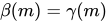
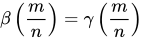
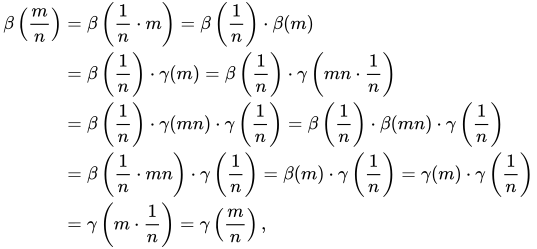
We show that: Let to be ring homomorphisms, and , . When for all , then for all .
as required. |