Johnson's SU-distribution
Family of probability distributions
From Wikipedia, the free encyclopedia
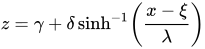
The Johnson's SU-distribution is a four-parameter family of probability distributions first investigated by N. L. Johnson in 1949.[1][2] Johnson proposed it as a transformation of the normal distribution:[1]



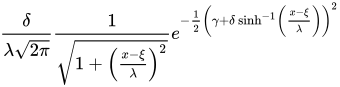
| Johnson's SU | |||
|---|---|---|---|
|
Probability density function  | |||
|
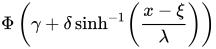
Cumulative distribution function  | |||
| Parameters | (real) | ||
| Support | |||
| CDF | |||
| Mean | |||
| Median | |||
| Variance | |||
| Skewness | |||
| Excess kurtosis |
| ||
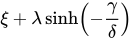


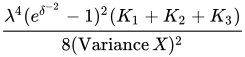


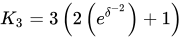
where .

Generation of random variables
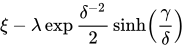
Let U be a random variable that is uniformly distributed on the unit interval [0, 1]. Johnson's SU random variables can be generated from U as follows:
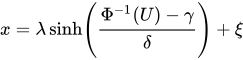
where Φ is the cumulative distribution function of the normal distribution.
Johnson's SB-distribution
N. L. Johnson[1] firstly proposes the transformation :
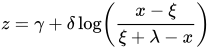
where .
Johnson's SB random variables can be generated from U as follows:
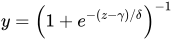

The SB-distribution is convenient to Platykurtic distributions (Kurtosis). To simulate SU, sample of code for its density and cumulative distribution function is available here
Applications
Johnson's -distribution has been used successfully to model asset returns for portfolio management.[3] This comes as a superior alternative to using the Normal distribution to model asset returns. An R package, JSUparameters, was developed in 2021 to aid in the estimation of the parameters of the best-fitting Johnson's -distribution for a given dataset. Johnson distributions are also sometimes used in option pricing, so as to accommodate an observed volatility smile; see Johnson binomial tree.

An alternative to the Johnson system of distributions is the quantile-parameterized distributions (QPDs). QPDs can provide greater shape flexibility than the Johnson system. Instead of fitting moments, QPDs are typically fit to empirical CDF data with linear least squares.
Johnson's -distribution is also used in the modelling of the invariant mass of some heavy mesons in the field of B-physics.[4]

