Consider an ordinary linear homogeneous differential equation of the form
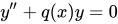
with

continuous.
We say this equation is oscillating if it has a solution y with infinitely many zeros, and non-oscillating otherwise.
The theorem states[1] that the equation is non-oscillating if
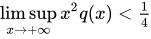
and oscillating if
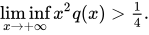
To illustrate the theorem consider

where  is real and non-zero. According to the theorem, solutions will be oscillating or not depending on whether is positive (non-oscillating) or negative (oscillating) because

To find the solutions for this choice of  , and verify the theorem for this example, substitute the 'Ansatz'

which gives

This means that (for non-zero ) the general solution is

where  and
and  are arbitrary constants.
It is not hard to see that for positive the solutions do not oscillate while for negative  the identity

shows that they do.
The general result follows from this example by the Sturm–Picone comparison theorem.
There are many extensions to this result, such as the Gesztesy–Ünal criterion.[2]

![{\displaystyle {\mathcal {R}}:=[t_{0},t_{0}+a]\times \{x\in \mathbb {R} ^{n}:\Vert x-x_{0}\Vert \leq b\}}](https://wikimedia.org/api/rest_v1/media/math/render/svg/1326ec20dcf92a7c0aee94cd49f940180830569a)