Kt/V
From Wikipedia, the free encyclopedia
In medicine, Kt/V is a number used to quantify hemodialysis and peritoneal dialysis treatment adequacy.
- K – dialyzer clearance of urea
- t – dialysis time
- V – volume of distribution of urea, approximately equal to patient's total body water
In the context of hemodialysis, Kt/V is a pseudo-dimensionless number; it is dependent on the pre- and post-dialysis concentration (see below). It is not the product of K and t divided by V, as would be the case in a true dimensionless number.[1] In peritoneal dialysis, it isn't dimensionless at all.
It was developed by Frank Gotch and John Sargent as a way for measuring the dose of dialysis when they analyzed the data from the National Cooperative Dialysis Study.[2] In hemodialysis the US National Kidney Foundation Kt/V target is ≥ 1.3, so that one can be sure that the delivered dose is at least 1.2.[3] In peritoneal dialysis the target is ≥ 1.7/week.[3]
Despite the name, Kt/V is quite different from standardized Kt/V.
K (clearance) multiplied by t (time) is a volume (since mL/min × min = mL, or L/h × h = L), and (K × t) can be thought of as the mL or L of fluid (blood in this case) cleared of urea (or any other solute) during the course of a single treatment. V also is a volume, expressed in mL or L. So the ratio of K × t / V is a so-called "dimensionless ratio" and can be thought of as a multiple of the volume of plasma cleared of urea divided by the distribution volume of urea. When Kt/V = 1.0, a volume of blood equal to the distribution volume of urea has been completely cleared of urea.
The relationship between Kt/V and the concentration of urea C at the end of dialysis can be derived from the first-order differential equation that describes exponential decay and models the clearance of any substance from the body where the concentration of that substance decreases in an exponential fashion:
| 1 |
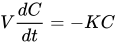
where
- C is the concentration [mol/m3]
- t is the time [s]
- K is the clearance [m3/s]
- V is the volume of distribution [m3]
From the above definitions it follows that is the first derivative of concentration with respect to time, i.e. the change in concentration with time.

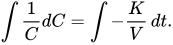
This equation is separable and can be integrated (assuming K and V are constant) as follows:
| 2a |
After integration,
| 2b |
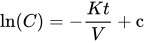
where
- c is the constant of integration
If one takes the antilog of equation 2b the result is:
| 2c |

where
- e is the base of the natural logarithm
By integer exponentiation this can be written as:
| 3 |
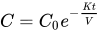
where
- C0 is the concentration at the beginning of dialysis [mmol/L] or [mol/m3].
The above equation can also be written as[2]
| 4 |
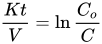
Normally we measure postdialysis serum urea nitrogen concentration C and compare this with the initial or predialysis level C0. The session length or time is t and this is measured by the clock. The dialyzer clearance K is usually estimated, based on the urea transfer ability of the dialyzer (a function of its size and membrane permeability), the blood flow rate, and the dialysate flow rate.[4] In some dialysis machines, the urea clearance during dialysis is estimated by testing the ability of the dialyzer to remove a small salt load that is added to the dialysate during dialysis.
Relation to URR
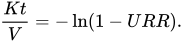
The URR or Urea reduction ratio is simply the fractional reduction of urea during dialysis. So by definition, URR = 1 − C/C0. So 1−URR = C/C0. So by algebra, substituting into equation (4) above, since ln C/C0 = − ln C0/C, we get:
| 8 |
Sample calculation
Patient has a mass of 70 kg (154 lb) and gets a hemodialysis treatment that lasts 4 hours where the urea clearance is 215 mL/min.
- K = 215 mL/min
- t = 4.0 hours = 240 min
- V = 70 kg × 0.6 L of water/kg of body mass = 42 L = 42,000 mL
Therefore:
- Kt/V = 1.23
This means that if you dialyze a patient to a Kt/V of 1.23, and measure the postdialysis and predialysis urea nitrogen levels in the blood, then calculate the URR, then −ln(1−URR) should be about 1.23.
The math does not quite work out, and more complicated relationships have been worked-out to account for the fluid removal (ultrafiltration) during dialysis as well as urea generation (see urea reduction ratio). Nevertheless, the URR and Kt/V are so closely related mathematically, that their predictive power has been shown to be no different in terms of prediction of patient outcomes in observational studies.
Post-dialysis rebound
The above analysis assumes that urea is removed from a single compartment during dialysis. In fact, this Kt/V is usually called the "single-pool" Kt/V. Due to the multiple compartments in the human body, a significant concentration rebound occurs following hemodialysis. Usually rebound lowers the Kt/V by about 15%. The amount of rebound depends on the rate of dialysis (K) in relation to the size of the patient (V). Equations have been devised to predict the amount of rebound based on the ratio of K/V, but usually this is not necessary in clinical practice. One can use such equations to calculate an "equilibrated Kt/V" or a "double-pool Kt/V", and some think that this should be used as a measure of dialysis adequacy, but this is not widely done in the United States, and the KDOQI guidelines (see below) recommend using the regular single pool Kt/V for simplicity.
Peritoneal dialysis
Kt/V (in the context of peritoneal dialysis) was developed by Michael J. Lysaght in a series of articles on peritoneal dialysis.[5][6]
The steady-state solution of a simplified mass transfer equation that is used to describe the mass exchange over a semi-permeable membrane and models peritoneal dialysis is
| 6a |

where
- CB is the concentration in the blood [ mol/m3 ]
- KD is the clearance [ m3/s ]
- is the urea mass generation [ mol/s ]

This can also be written as:
| 6b |

The mass generation (of urea), in steady state, can be expressed as the mass (of urea) in the effluent per time:
| 6c |

where
- CE is the concentration of urea in effluent [ mol/m3 ]
- VE is the volume of effluent [ m3 ]
- t is the time [ s ]
Lysaght, motivated by equations 6b and 6c, defined the value KD:
| 6d |
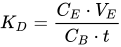
Lysaght uses "ml/min" for the clearance. In order to convert the above clearance (which is in m3/s) to ml/min one has to multiply by 60 × 1000 × 1000.
Once KD is defined the following equation is used to calculate Kt/V:
| 7a |

where
- V is the volume of distribution. It has to be in litres (L), as the equation is not really non-dimensional.
The 7/3 is used to adjust the Kt/V value so it can be compared to the Kt/V for hemodialysis, which is typically done thrice weekly in the USA.
Weekly Kt/V
To calculate the weekly Kt/V (for peritoneal dialysis) KD has to be in litres/day. Weekly Kt/V is defined by the following equation:
| 7b |
![{\displaystyle {\mbox{Weekly }}Kt/V={\frac {7K_{D}[\mathrm {L} /{\mbox{day}}]}{V[\mathrm {L} ]}}.}](https://wikimedia.org/api/rest_v1/media/math/render/svg/e210a50912859eb00553ae20283624f4f5b99eaa)
Sample calculation
Assume:




Then by equation 6d, KD is: 1.3334×10−07 m3/s or 8.00 mL/min or 11.52 L/d.
Kt/V and the weekly Kt/V by equations 7a and 7b respectively are thus: 0.45978 and 1.9863.
A simplified analysis of Kt/V in PD
On a practical level, in peritoneal dialysis the calculation of Kt/V is often relatively easy because the fluid drained is usually close to 100% saturated with urea,[citation needed] i.e. the dialysate has equilibriated with the body. Therefore, the daily amount of plasma cleared is simply the drain volume divided by an estimate of the patient's volume of distribution.
As an example, if someone is infusing four 2 liter exchanges a day, and drains out a total of 9 liters per day, then they drain 9 × 7 = 63 liters per week. If the patient has an estimated total body water volume V of about 35 liters, then the weekly Kt/V would be 63/35, or about 1.8.
The above calculation is limited by the fact that the serum concentration of urea is changing during dialysis. So ideally this should not be used as it has not taken in account the urea level in dialysate or serum...so it cannot be labelled as urea clearance In automated PD this change cannot be ignored; thus, blood samples are usually measured at some time point in the day and assumed to be representative of an average value. The clearance is then calculated using this measurement.
Reason for adoption
Kt/V has been widely adopted because it was correlated with survival. Before Kt/V nephrologists measured the serum urea concentration (specifically the time-averaged concentration of urea (TAC of urea)), which was found not to be correlated with survival (due to its strong dependence on protein intake) and thus deemed an unreliable marker of dialysis adequacy.