Lighthill's eighth power law
From Wikipedia, the free encyclopedia
In aeroacoustics, Lighthill's eighth power law states that power of the sound created by a turbulent motion, far from the turbulence, is proportional to eighth power of the characteristic turbulent velocity, derived by Sir James Lighthill in 1952.[1][2] This is used to calculate the total acoustic power of the jet noise. The law reads as
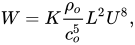
where
- is the acoustic power in the far-field,
- is the proportionality constant (or Lighthill's constant),
- is the uniform fluid density,
- is the speed of sound,
- is the characteristic length scale of the turbulent source and
- is the characteristic velocity scale of the turbulent source.


The eighth power is experimentally verified and found to be accurate for low speed flows, i.e., Mach number is small, . And also, the source has to be compact to apply this law.
