Martiusstraße
From Wikipedia, the free encyclopedia

The Martiusstraße in Munich Schwabing leads from Leopoldstraße to Kißkaltplatz. It was named after naturalist Carl Friedrich Philipp von Martius. He was director of the Alter Botanischer Garten in Munich and member of the Bavarian Academy of Sciences and Humanities.
The Martiusstraße is a protected building ensemble consisting of a number of state apartment units, which were built in the early 20th century as a closed concept, over a two-year period, in what was then a contemporary Art Nouveau style. The road had already been designed around 1885 before the annexation of Schwabing to Munich, as a connecting piece of road between Leopoldstraße, then still called Schwabinger Landstraße (highway from Schwabing), and Königinstraße. The western section was built between 1906 and 1908 to the then Kaulbachplatz (today Kißkaltplatz). As an eastern extension of the axis between Elisabeth- / Franz-Joseph-Straße, Martiusstraße was also a preferred area for state apartment buildings in Schwabing. Anton Hatzl, architect and owner, built a closed row of four buildings (No. 1, 3, 5, 7) on the north side and another building (No. 4) to the south. They were later supplemented by two similar designed houses (No. 6, 8) by Franz Popp. Only the latter has lost its elaborate facade design due to the removal of damages and debris from the war, therefore the former architectural importance as structurally emphasized prelude of the street line, together with the unchanged object Martiusstraße 7, no longer comes across clearly. Under a uniform conception, four-storey, elegant apartment units in the neo-baroque Art Nouveau style of plasticity and rich ornamentation were created on the short, straight street section. The adjacent buildings complement the street space.[1]
South of Martiusstraße, in the area of house number 2, BLfD's historically protected monument body graves of the early Middle Ages can be found.
 Two gate posts with lattice from 1890 at the beginning of Martiusstraße to the 1889 by Friedrich Steffan neo-Renaissance building on the corner of Leopoldstraße
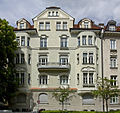 richly structured and stuccoed Art Nouveau building built by Anton Hatzl in 1906–07 with two oriels and gables at Martiusstraße 1
 Art Nouveau building built by Anton Hatzl in 1906 with a wide double facade at Martiusstraße 3
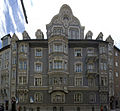 Art Nouveau building at Martiusstraße 4
 Art Nouveau building at Martiusstraße 5
 Art Nouveau building at Martiusstraße 7, where the gallery Otto Stangls was located from 1948 to 1962[3]
.JPG)


