Solomon's Stables
Islamic prayer hall in the Al-Aqsa Mosque compound
From Wikipedia, the free encyclopedia
Solomon's Stables (Latin: Stabula Salomonis[1], Hebrew: אורוות שלמה, Arabic: إسطبلات سليمان) is an ancient underground vaulted hall in the Temple Mount in Jerusalem, since 1996 housing Al-Marwani Mosque (Arabic: المصلى المرواني)[2][3][4], part of the Al-Aqsa mosque compound in Jerusalem.[5][6] It is 600 square yards (500 square metres) in area, and is located under the southeastern corner of the compound, 12.5 m (41 ft) below the courtyard, and features twelve rows of pillars and arches. The name "Solomon's Stables", of Crusader origin, was historically the standard Islamic name for the structure as well.[7] It was alternatively known by locals as the "Old Mosque".[8][9]

אורוות שלמה, إسطبلات سليمان, Stabula Salomonis | |
In December 1996 the new mosque was officially inaugurated as El-Marwani Mosque. The Solomon's Stables no longer exist as such. | |
  Solomon's Stables Shown within Old City of Jerusalem | |
| Alternative name | Al-Marwani Mosque |
|---|---|
| Location | Old City of Jerusalem |
| Region | Levant, Middle East |
| Coordinates | 31°46′35″N 35°14′13″E |
| Type | Underground vaulted hall |
| Area | 500 square metres (600 square yards) |
| History | |
| Builder | Herod the Great |
| Cultures | Second Temple Judaism, Byzantine culture, Crusader states, Islamic culture |
| Site notes | |
| Public access | Yes |
| Architecture | |
| Architectural styles | Herodian architecture, Byzantine architecture |
In December 1996 the Jerusalem Waqf renamed and reckleslly renovated the area, since which the salvaged debris has provided a rare source of information for the Temple Mount's history, where archaeological research is heavily restricted.[10]
History
.jpg)
The large almost rectangular platform above the slopes of the hill known as the Temple Mount, was constructed by building a substructure consisting of a series of vaulted arches in order to reduce pressure on the retaining walls.[11] These vaults, according to Priscilla Soueck, were "supported by eighty-eight pillars resting on massive Herodian blocks and divided into twelve rows of galleries",[12] and may have originally been storage areas of the Second Temple. According to the PEF Survey of Palestine, the vaulting and piers are of Byzantine origin.[9] Some of the original interior survives in the area of the Herodian staircases, although not in the area now renovated for use as a mosque.[11] Visitors are rarely permitted to enter the areas with Herodian finishes.[11]
The underground space for the most part remained empty except during Crusader rule over Jerusalem.[13] It was probably first restored by the Fatimids, before the Crusaders converted it into a stable for the cavalry. According to John of Würzburg they contained more than 2,000 horses and 1,500 camels, while Theoderich gave the much more impressive number of 10,000 horses together with their grooms.[14]
The rings for tethering horses can still be seen on some of the pillars. The structure has been called Solomon's Stables since the time of the Crusades as a historical composite: 'Solomon's' anachronistically refers to the First Temple built on the site, while the 'stables' refers to the functional usage of the space by the Crusaders in the time of Baldwin II (King of Jerusalem 1118–1131 CE).[15]
The structure also contains a small shrine known as the "Cradle of Jesus", within a larger hall known as the "Chamber of Mary". The site has been associated with Jesus and Mary by both Muslims and Christians since before the crusades, but it is in fact a Roman or Byzantine niche, carved from a single stone block and set on its back below a dome. Above the "cradle" is a richly adorned wooden dome supported by four marble pillars, probably from the era of Sultan Suleiman the Magnificent. [16]
Modern construction of the Marwani prayer hall
Al-Marwani consists of two parts: The first section, corridors of the triple gate, consists of three corridors. The first corridor runs from the main door, the second is a hallway with storage, and the third is now closed with stone, possibly dating to the same period of the Umayyad. The second section, a large settlement area, consists of thirteen terraces of giant pillars. The weight of some of those stones is several tons. There is a high ceiling and a small door connecting the two sections. The area of Marwani is about four dunums, four point five acres, or precisely 3,750 square metres (40,400 sq ft).[17] It can accommodate approximately 4,000 worshipers.
This Musalla is the largest roofed area in Al-Aqsa and has 16 standing stone towers on strong stone pillars. It is entered by going down a flight of stairs near Bi'r al-Waraqah (under al-Qibli musalla) to the northeast of the al-Aqsa Mosque building, or down a newly constructed grand staircase to two northern arches near the east enclosure wall of al-Aqsa.[17]
In the winter of 1996 the Jerusalem Islamic Waqf acquired a permit to use Solomon's Stables as an alternative place of worship for occasional rainy days of the holy month of Ramadan.[13] Later the Waqf declared that it aimed to create a mosque for 10,000 worshippers, making it the largest mosque in the country.[13] This move was designed to strengthen the Muslim claim over the Temple Mount.[13] The Committee for the Prevention of Destruction of Antiquities on the Temple Mount, a group of Israeli archeologists, alleged that construction of the new prayer hall was an attempt by the Waqf to remove archeological evidence that a Jewish temple ever stood at the Temple Mount.[18]

The Waqf began digging a huge hole in the southeastern area of the Temple Mount, without a permit from the Jerusalem municipality or archaeological supervision using tractors and heavy vehicles.[13] This action drew criticism from archaeologists, who said that archaeological strata and artifacts were being damaged in the process and the excavations weakened the stability of the Southern Wall. The excavations are thought to have been responsible for creating a large, visible bulge in the Southern Wall that threatened the structural integrity of the Temple Mount, necessitating major repairs.[19] The repairs were called "unsightly" because they appear as a large, bright, white patch of smooth stones in a golden tan wall of rusticated ashlar.[19]
In December 1996 the new mosque was officially inaugurated as Al-Marwani Mosque and named after the Umayyad Al-Marwani family, the family of Abd al-Malik ibn Marwan, the Umayyad caliph that built the Al-Aqsa Compound where the Al-Marwani Mosque is located at.[citation needed]
In 1999, construction began on an emergency exit for the Al-Marwani Mosque. In doing so, bulldozers dug a pit more than 40 metres (131 ft) long and nearly 12 metres (40 ft) deep, with lorry trucks carting away hundreds of tons of soil and debris from the area. In order to preserve the archaeological integrity of the site, the soil that had been carted away was reclaimed by Israeli archaeologists, who began sifting through the removed earth in search of undisclosed artefacts, a project that became known as the Temple Mount Sifting Project.[20]
2019 fire
On April 15, 2019, a minor fire broke out in the guard room in the courtyard of Al-Marwani Mosque. The Waqf fire brigade succeeded in putting out the fire. From some angles it appeared as if smoke was coming out of the underground mosque itself.[21]
Artifacts
The soil removed from the dig was dumped near the Mount of Olives and a salvage operation, the Temple Mount Sifting Project, was undertaken in order to sift through the debris for archaeological remains. Many important finds have turned up.[22] Israeli Antiques Authority published a report in 1999. According to this report:[13]
- 14 percent of the shards dated to the First Temple period
- 19 percent to the Second Temple period
- 6 percent to the Roman period
- 14 percent to the Byzantine period
- 15 percent to the early Muslim and medieval periods
- 32 percent could not be identified.
In a June 2000 interview with The Jerusalem Post, the chief Waqf archaeologist said that his colleagues examined the material taken out of the dig "either before or after the excavation" and "found nothing of special interest".[13] In 2016 exquisite floor tiles of the Roman opus sectile type discovered during the sifting process were published and interpreted as likely belonging to the Herodian Temple complex, where they were adorning the floors of the porticos.[23]
Gallery
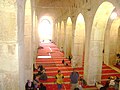 The Musalla al-Marwani
 The Musalla al-Marwani
 The Musalla al-Marwani


