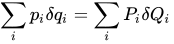
Mathieu transformation From Wikipedia, the free encyclopedia The Mathieu transformations make up a subgroup of canonical transformations preserving the differential form ∑ i p i δ q i = ∑ i P i δ Q i {\displaystyle \sum _{i}p_{i}\delta q_{i}=\sum _{i}P_{i}\delta Q_{i}\,} The transformation is named after the French mathematician Émile Léonard Mathieu. In order to have this invariance, there should exist at least one relation between q i {\displaystyle q_{i}} and Q i {\displaystyle Q_{i}} only (without any p i , P i {\displaystyle p_{i},P_{i}} involved). Ω 1 ( q 1 , q 2 , … , q n , Q 1 , Q 2 , … Q n ) = 0 ⋮ Ω m ( q 1 , q 2 , … , q n , Q 1 , Q 2 , … Q n ) = 0 {\displaystyle {\begin{aligned}\Omega _{1}(q_{1},q_{2},\ldots ,q_{n},Q_{1},Q_{2},\ldots Q_{n})&=0\\&{}\ \ \vdots \\\Omega _{m}(q_{1},q_{2},\ldots ,q_{n},Q_{1},Q_{2},\ldots Q_{n})&=0\end{aligned}}} where 1 < m ≤ n {\displaystyle 1<m\leq n} . When m = n {\displaystyle m=n} a Mathieu transformation becomes a Lagrange point transformation. See also Canonical transformation References Lanczos, Cornelius (1970). The Variational Principles of Mechanics. Toronto: University of Toronto Press. ISBN 0-8020-1743-6. Whittaker, Edmund. A Treatise on the Analytical Dynamics of Particles and Rigid Bodies. This classical mechanics–related article is a stub. You can help Wikipedia by expanding it.vte Related Articles~TimelinesTop QsFact Checks
 and
and  only (without any
  involved).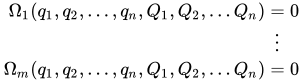
 . When
  a Mathieu transformation becomes a Lagrange point transformation.