Mon (emblem)
Japanese emblems
From Wikipedia, the free encyclopedia
Mon (紋, [mõ̞ꜜɴ]), also called mondokoro (紋所) or kamon (家紋), are Japanese emblems used to decorate and identify an individual, a family, or an institution. Mon is an encompassing term that may refer to any such device, kamon and mondokoro refer specifically to emblems that are used to identify a family, while shinmon (神紋), shamon (社紋), and jimon (寺紋) identify god, shrine, or temple, respectively.[a]

A mon reference in 2004 compiles Japan's 241 general categories of mon based on structural resemblance (a single mon may belong to multiple categories), with 5,116 distinct individual mon.[1]
It is well acknowledged that there are a number of lost or obscure mon.[1][b] Among mon, the mon officially used by the family is called jōmon (定紋). Over time, new mon have been created, such as kaemon (替紋), which is secondary or unofficial mon, and onnamon (女紋), which is created for a woman after marriage by modifying part of her original family mon, so that by 2023 there will be a total of 20,000 to 25,000 mon.[2]
The devices are similar to the badges and coat of arms in European heraldic tradition, which likewise are used to identify individuals and families. Mon are often referred to as crests in Western literature, the crest being a European heraldic device similar to the mon in most functions.[c] Japanese mon influenced Louis Vuitton's monogram designs through Japonisme in Europe in the late 1800s.[3][4][5][relevant?]
History

The concept of Mon, when defined as "stylized symbol", has a long history, possibly nearly comparable to the history of logograms. One of the known early examples is Dharmachakra[d] used by Emperor Ashoka around 270-230 BCE.[e] It is not established if the concept was introduced to Japan before or after the formal introduction of Buddhism in 552 AD.[f]
Popular use of Mon originated in Japan in the mid-Heian period (c. 900–1000) as a way to identify individuals and families among the nobility. They had a clear social rank order within the class, and when gissha (牛車, bullock cart) passed each other on the road, the one with the lower status had to give way. So the family mon (家紋, Kamon) was indicated on the gissha as the practical status symbol. The Heiji Monogatari Emaki, an emakimono (絵巻物, picture scroll) depicting the Heiji rebellion, shows kamon painted on gissha:

The nobility began to use mon on their own costumes, and the samurai class that emerged in the late Heian period and came to power in the Kamakura period (1185–1333) followed suit.[2][7] By the 12th century, sources give a clear indication that heraldry had been implemented as a distinguishing device, especially for use in battle. It is seen on flags, tents, and equipment. On the battlefield, mon served as army standards, even though this usage was not universal and uniquely designed army standards were just as common as mon-based standards (cf. sashimono, uma-jirushi). When heraldry is meant to describe the system of armorial bearings, Mon thus predate heraldry in the country by at least 100-150 years.
Gradually, mon spread to the lower classes, and in the Muromachi period (1336–1573), merchants painted emblems on their shop signs, which became mon. In the Edo period (1603–1867), kabuki actors used mon, and the general public was allowed to choose and use their favorite mon. By the Genroku period (1680–1709) in the early Edo period, the use of mon was fully established among the general public. However, the use of the chrysanthemum mon used by the imperial family and the hollyhock mon used by the Tokugawa shogunate was prohibited.[2][7] Mon were also adapted by various organizations, such as merchant and artisan guilds, temples and shrines, theater troupes, and even criminal gangs. They served as a useful means for recognition, especially among the illiterate.
 The mon on the right sleeve of the kimono of Kabuki actor Ichikawa Yaozo III, dressed as Umeōmaru. The kanji 八, meaning 'eight', is written within the triple square. Ukiyo-e (woodblock print) by Utagawa Kunimasa, 1796.
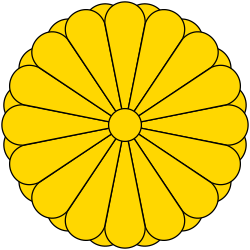 The imperial crest of Japan—a stylized chrysanthemum blossom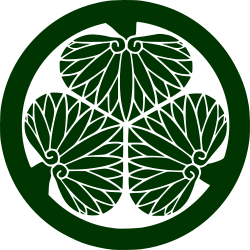


Japanese traditional formal attire generally displays the mon of the wearer's family. Commoners without mon often used those of their patron or the organization they belonged. In cases when none of those were available, they sometimes used one of the few mon which were seen as "vulgar", or invented or adapted whatever mon they wished, passing it on to their descendants. It was not uncommon for shops to adopt/develop mon to identify themselves and their products/services.
Occasionally, patrons granted the use of their mon to their retainers as a reward. Similar to the granting of the patron's surname, this was considered a very high honor. Alternatively, the patron may have added elements of its mon to that of the retainer and granted the use, or chosen an entirely different mon for them.
Design


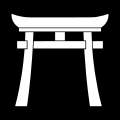
Mon motifs can be broadly classified into five categories: animals, plants, nature, buildings and vehicles, and tools and patterns, each with its own meaning. The most common animal motifs are the crane and the turtle (often depicted as a hexagon representing the turtle shell), which, according to tradition, were symbols of longevity and were used to wish the family a long and prosperous life. Plant mon were symbols of wealth and elegance, so they were often used to wish for the improvement of the family's social status and economic power, and motifs such as wisteria and paulownia were often used. Mon depicting buildings, vehicles, or tools often indicated occupation or status. For example, a mon with a torii gate indicated a family associated with Shintō, a mon with a gissha wheel indicated nobility, and a mon with a nail puller indicated a family associated with construction. The mon of nature was a symbol of respect for nature and prayers for a good harvest, and motifs such as the moon, mountains, and thunder were used.[2][7]
The most commonly used mon motifs are wisteria, paulownia, hawk feathers, flowering quince, and creeping woodsorrel, which are called the godaimon (五大紋, five major mon). However, according to a dictionary of mon published by Shōgakukan, oak is listed instead of paulownia.[2] There are more than 150 types of wisteria mon, and their use by the Fujiwara clan led to their popularization.[8]
Similar to the blazon in European heraldry, mon are also named by the content of the design, even though there is no set rule for such names. Unlike in European heraldry, however, this "blazon" is not prescriptive —the depiction of a mon does not follow the name— instead, the names only serve to describe the mon. The pictorial depictions of the mon are not formalized, and small variations of what is supposed to be the same mon can sometimes be seen, but the designs are, for the most part, standardized through time and tradition. At the same time, small differences, such as a bird in the mon is depicted with an open or closed beak, can be significant, making the versions unique.
The degree of variation tolerated differs from mon to mon as well. For example, the paulownia crest with 5-7-5 leaves is reserved for the prime minister, whereas paulownia with fewer leaves could be used by anyone. The imperial chrysanthemum also specifies 16 petals, whereas chrysanthemum with fewer petals are used by other lesser imperial family members.
Japanese heraldry does not have a cadency or quartering system, but it is not uncommon for cadet branches of a family to choose a slightly different mon from the senior branch. Each princely family (shinnōke), for example, uses a modified chrysanthemum crest as their mon. Mon holders may also combine their mon with that of their patron, benefactor or spouse, sometimes creating increasingly complicated designs.
Mon are essentially monochrome; the color does not constitute part of the design and they may be drawn in any color.
- Pattern variations of Wisteria Mon
 Eda Fuji, single Wisteria with stem
 Kujō Sagari Fuji, double, flowers only, drooping down
 Kikkō Kumai Fuji no Ha, nine leaves, leaves only, in Kikkō hexagon
 Migi Mawari Katatate Tomoe Fuji, single, right-turn, drooping up
 Chigai Fuji, crossed double, drooping up
 Chigai Sagari Fuji, crossed double, drooping down
 Hana Fuji Guruma, octuple, facing-out, wheel
 Jiku Tsuki Fuji no Maru, with stem, flowers only, circle
 Mukai Fuji Bishi, split double, facing-in, rhombus
 Kuroda Fuji, triple, left-turn, in Tomoe shape
 Wari Fuji no Hana, split, detail extraction


Modern usage

Virtually all modern Japanese families have a mon, but unlike before the Meiji Restoration when rigid social divisions existed, mon play a more specialized role in everyday life. On occasions when the use of a mon is required, one can try to look up their families in the temple registries of their ancestral hometown or consult one of the many genealogical publications available. Many websites also offer mon lookup services. Professional wedding planners, undertakers and other "ritual masters" may also offer guidance on finding the proper mon.
Mon are seen widely in stores and shops engaged in traditional crafts and specialties. They are favored by sushi restaurants, which often incorporate a mon into their logos. Mon designs can be seen on the ceramic roof tiles of older houses, or sometimes on excavated roof tile fragments of ancient castles and temples. Mon designs frequently decorate senbei, sake, tōfu and other packaging for food products to lend them an air of elegance, refinement and tradition. The paulownia mon appears on the obverse side of the 500 yen coin.
Items symbolizing family crafts, arts or professions were often chosen as a mon; likewise, mon were, and still are, also passed down a lineage of artists. Geisha typically wear the mon of their okiya (geisha house) on their clothing when working; individual geisha districts, known as hanamachi, also have their own distinctive mon, such as the plover crest (chidori) of Ponto-chō in Kyoto.
A woman may still wear her maiden mon if she wishes and pass it on to her daughters; she does not have to adopt her husband's or father's mon. Flowers, trees, plants and birds are also common elements of mon designs.[9]
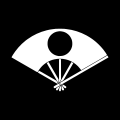
Mon also add formality to a kimono. A kimono may have one, three or five mon. The mon themselves can be either formal or informal, depending on the formality of the kimono, with formality ranging from the most formal 'full sun' (日向 (hinata)) crests to the least formal 'shadow' (影 (kage)) crests. Very formal kimono display more mon, frequently in a manner that makes them more conspicuous; the most formal kimono display mon on both sides of the chest, on the back of each sleeve, and in the middle of the back. On the armor of a warrior, it might be found on the 兜 (kabuto) (helmet), on the 胴 (dō) (breast plate), and on flags and various other places. Mon also adorned coffers, tents, fans and other items of importance.
As in the past, modern mon are not regulated by law, with the exception of the imperial chrysanthemum crest, which doubles as the national emblem, and the paulownia, which is the mon of the office of prime minister and also serves as the emblem of the cabinet and government (see national emblems of Japan for further information). Some local governments and associations may use a mon as their logo or trademark, thus enjoying its traditional protection, but otherwise mon are not recognized by law. One of the best-known examples of a mon serving as a corporate logo is that of Mitsubishi, a name meaning 'three lozenges' (occasionally translated as 'three buffalo nuts'), which are represented as rhombuses.[10]
In Western heraldry
Japanese mon are sometimes used as charges or crests in Western heraldry. They are blazoned in traditional heraldic style rather than in the Japanese style. Examples include the swastika with arrows used by Japanese ambassador Hasekura Tsunenaga, the Canadian-granted arms of the Japanese-Canadian politician David Tsubouchi,[11] and Akihito's arms as a Knight of the Garter.[12]
 The swastika with arrows used by the 17th-century Japanese ambassador Hasekura Tsunenaga

.svg)
Gallery of representative Mon by theme
Imperial mons
 Imperial crest of Japan & mon of the Emperor
 Mon of the Akisino branch of the Imperial House
 Mon of the Hitachi branch of the Imperial House
 Mon of the Takamatsu branch of the Imperial House
 Mon of the Mikasa branch of the Imperial House
 Mon of the Takamado branch of the Imperial House
 Mon of the Fushimi cadet branch of the Imperial House
 Mon of the Hachijō cadet branch of the Imperial House
 Mon of the Takahito cadet branch of the Imperial House
 Mon of the Kaninnomiya cadet branch of the Imperial House


Animal motif
 Crane crest of the Mori clan (similar to Japan Airlines)
 Triple crane crest
 Maruni chigai takanoha, the crossing pair of hawk feathers in circle
 Mythical Yatagarasu three-legged crow
 Quintuple Chidori bird mon
 Kotobuki ebi, auspicious Ise Ebi prawn


Flower and Plant motif


 Flower rhombus in three Kikkō (亀甲, turtle shell hexagon), crest of Azai clan
 Sumikirikakuni hanakaku (隅切り角に花角紋)
 Tachi omodaka or upright threeleaf arrowhead (sagittaria trifolia)
 Triple pine tree (maruni hidari sangaimatsu) of the Hira clan, member of Taira clan (Heike)


 Sparrows and bamboo (take ni suzume) of the Date clan
 Boke quince flower of Mokkō Mon (木瓜紋)
.svg)


.svg)
Astronomy motif
 Yatsuashi hiashi mon of the Kikuchi clan (eight sun-rays)
 三光紋 (Sankō Mon) (Three lights. The Sun, Moon and Star), 神紋 (Shinmon) of 妙見菩薩 (Myōken Bosatsu), the North Star deity of Taoist Big Dipper worship and Shintō, used by Chiba Shrine.[13]
 九曜紋 (Kuyō mon), representing the Sun, Venus, Mars, Jupiter, Saturn, Mercury, (full-)Moon, and the two quarter phases of the moon,[g] the kamon of Date Masamune, Ishida Mitsunari, Hosokawa Tadaoki, and shamon of Chiba Shrine.[14]
 Kokumochiji-nuki Hidari-mitsudomoe (thunder) [j]
.svg)


Tools motif
 Chigai kuginuki (Two nail pullers interlocked)



Geometric motif
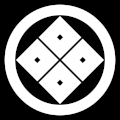 Maruni sumitate yotsume, circle and four eyelets on the edge, of the Uda Genji
 Yamabishi, the crest of the Yamaguchi-gumi yakuza clan. The motif is based on the kanji for yama (山, mountain).
 Swastika, or Manji Mon of the Hachisuka clan. This is also the 寺紋 (jimon) of Kinryū-zan Sensō-ji, the oldest temple in Tōkyō.
 Mitsu Uroko Mon of the Hōjō clan


Building and vehicle motifs
 Gissha (牛車, bullock cart) wheel motif called the 源氏車 (genji guruma) of Satō clan in Fujiwara no Hidesato-branch of Fujiwara clan


See also
Notes
- Monshō (紋章) is a generic term referring to the designs on badges, kabuto crests, company logos, seals, coat of arms, insignia, emblems, and any other such marking device.
- Some 6939 mon are listed here Archived 2016-10-28 at the Wayback Machine.
- The Japanese term Datemono (立物) or more specifically Kashiradate (頭立て), the ornament on top (as opposed to front, side, or back) of kabuto, is synonymous with 'crest' in the original meaning.
- One of the oldest known examples is Golden Sun Bird from 1200-1050 BCE, excavated in 2001. See a picture of this relic here.
- Note the introduction was diplomatic without aggression.
- See Lunar phase#Waxing and waning for the Waxing (上弦, Jōgen, increscent) and Waning (下弦, Kagen, decrescent) phases. Frequently, the shape as seen in the Northern Hemisphere of Waxing First Quarter Moon (上弦の月 (Jōgen no Tsuki), strictly, all the shapes during the first half of any Lunar Month from the new moon to the full moon) and Waning Last Quarter Moon (下弦の月 (Kagen no Tsuki), moon shapes during the last half of a month from the full moon to the new moon) are used to represent the two phases.
- See the gate ornament below the name plate in this picture showing the shape of a tied-up and hung monkey as a lucky scapegoat. Also see this picture.
- See ja:タチバナ#家紋 (in Japanese) for info.
- See Tomoe#Tomoe emblem history in Japan for details.
- This meaning is not well known in modern Japan, and the design is commonly called the 六文銭 (rokumonsen) out of the belief that the toll for crossing the Sanzu River is 6 Mon.[15] The correct name of this mon is 六道銭 (Rokudōsen) or 六連銭 (Rokurensen).
- It is hypothesized that this design is patterned after the Kabuto crest of a respected Christian adversary, Wada Koremasa. See Tarosuke (9 March 2014). "中川クルスについてのお話&中川etc" [Tales on Nakagawa Cross] (in Japanese). for info.
