Morse homology
From Wikipedia, the free encyclopedia
In mathematics, specifically in the field of differential topology, Morse homology is a homology theory defined for any smooth manifold. It is constructed using the smooth structure and an auxiliary metric on the manifold, but turns out to be topologically invariant, and is in fact isomorphic to singular homology. Morse homology also serves as a model for the various infinite-dimensional generalizations known as Floer homology theories.
Given any (compact) smooth manifold, let f be a Morse function and g a Riemannian metric on the manifold. (These are auxiliary; in the end, the Morse homology depends on neither.) The pair gives us a gradient vector field. We say that is Morse–Smale if the stable and unstable manifolds associated to all of the critical points of f intersect each other transversely.

For any such pair , it can be shown that the difference in index between any two critical points is equal to the dimension of the moduli space of gradient flows between those points. Thus there is a one-dimensional moduli space of flows between a critical point of index i and one of index . Each flow can be reparametrized by a one-dimensional translation in the domain. After modding out by these reparametrizations, the quotient space is zero-dimensional — that is, a collection of oriented points representing unparametrized flow lines.

A chain complex may then be defined as follows. The set of chains is the Z-module generated by the critical points. The differential d of the complex sends a critical point p of index i to a sum of index- critical points, with coefficients corresponding to the (signed) number of unparametrized flow lines from p to those index- critical points. The fact that the number of such flow lines is finite follows from the compactness of the moduli space.
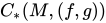

The fact that this defines a chain complex (that is, that ) follows from an understanding of how the moduli spaces of gradient flows compactify. Namely, in the coefficient of an index- critical point q is the (signed) number of broken flows consisting of an index-1 flow from p to some critical point r of index and another index-1 flow from r to q. These broken flows exactly constitute the boundary of the moduli space of index-2 flows: The limit of any sequence of unbroken index-2 flows can be shown to be of this form, and all such broken flows arise as limits of unbroken index-2 flows. Unparametrized index-2 flows come in one-dimensional families, which compactify to compact one-manifolds with boundaries. The fact that the boundary of a compact one-manifold has signed count zero proves that .


Invariance of Morse homology
It can be shown that the homology of this complex is independent of the Morse–Smale pair (f, g) used to define it. A homotopy of pairs (ft, gt) that interpolates between any two given pairs (f0, g0) and (f1, g1) may always be defined. Either through bifurcation analysis or by using a continuation map to define a chain map from to , it can be shown that the two Morse homologies are isomorphic. Analogous arguments using a homotopy of homotopies shows that this isomorphism is canonical.


Another approach to proving the invariance of Morse homology is to relate it directly to singular homology. One can define a map to singular homology by sending a critical point to the singular chain associated to the unstable manifold associated to that point; inversely, a singular chain is sent to the limiting critical points reached by flowing the chain using the gradient vector field. The cleanest way to do this rigorously is to use the theory of currents.
The isomorphism with singular homology can also be proved by demonstrating an isomorphism with cellular homology, by viewing an unstable manifold associated to a critical point of index i as an i-cell, and showing that the boundary maps in the Morse and cellular complexes correspond.