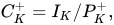
The narrow class group features prominently in the theory of representing integers by quadratic forms. An example is the following result (Fröhlich and Taylor, Chapter V, Theorem 1.25).
- Theorem. Suppose that
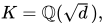 where d is a square-free integer, and that the narrow class group of K is trivial. Suppose that

- is a basis for the ring of integers of K. Define a quadratic form
 ,
,
- where NK/Q is the norm. Then a prime number p is of the form
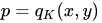
- for some integers x and y if and only if either

- or

- or
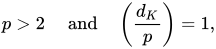
- where dK is the discriminant of K, and

- denotes the Legendre symbol.
For example, one can prove that the quadratic fields Q(√−1), Q(√2), Q(√−3) all have trivial narrow class group. Then, by choosing appropriate bases for the integers of each of these fields, the above theorem implies the following:
- A prime p is of the form p = x2 + y2 for integers x and y if and only if

- (This is known as Fermat's theorem on sums of two squares.)
- A prime p is of the form p = x2 − 2y2 for integers x and y if and only if

- A prime p is of the form p = x2 − xy + y2 for integers x and y if and only if
 (cf. Eisenstein prime)
An example that illustrates the difference between the narrow class group and the usual class group is the case of Q(√6). This has trivial class group, but its narrow class group has order 2. Because the class group is trivial, the following statement is true:
- A prime p or its inverse −p is of the form ± p = x2 − 6y2 for integers x and y if and only if

However, this statement is false if we focus only on p and not −p (and is in fact even false for p = 2), because the narrow class group is nontrivial. The statement that classifies the positive p is the following:
- A prime p is of the form p = x2 − 6y2 for integers x and y if and only if p = 3 or
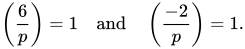
(Whereas the first statement allows primes  , the second only allows primes
  .)
.)