Nebelschütz
Municipality in Saxony, Germany
From Wikipedia, the free encyclopedia
Nebelschütz (German) or Njebjelčicy (Upper Sorbian) is a Sorbian village in the district of Bautzen of Saxony in eastern Germany. It lies to the south-east of Kamenz.

Nebelschütz/Njebjelčicy | |
|---|---|
Aerial view | |
 Coat of arms | |
Location of Nebelschütz/Njebjelčicy
within Bautzen district 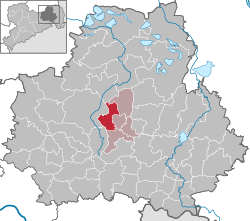 | |
 Location of Nebelschütz/Njebjelčicy | |
  Nebelschütz/Njebjelčicy  Nebelschütz/Njebjelčicy | |
| Coordinates: 51°16′N 14°10′E | |
| Country | Germany |
| State | Saxony |
| District | Bautzen |
| Municipal assoc. | Am Klosterwasser |
| Subdivisions | 5 |
| Government | |
| • Mayor (2022–29) | André Bulang[1] |
| Area | |
• Total | 22.92 km2 (8.85 sq mi) |
| Elevation | 194 m (636 ft) |
| Population (2024-12-31)[2] | |
• Total | 1,183 |
| • Density | 51.61/km2 (133.7/sq mi) |
| Time zone | UTC+01:00 (CET) |
| • Summer (DST) | UTC+02:00 (CEST) |
| Postal codes | 01920 |
| Dialling codes | 03578 |
| Vehicle registration | BZ, BIW, HY, KM |
| Website | www.nebelschuetz.de |
The municipality is part of the recognized Sorbian settlement area in Saxony. Upper Sorbian has an official status next to German, all villages bear names in both languages. In 2004, two thirds of the population spoke Sorbian.[3]
_1.jpg)


The town is dominated by the Baroque church of St Martin, which stands on high ground. Whilst mildly impressive from the outside the church is more noted for its magnificent interior.
The church has a curious combination of both pulpit and altar, reflecting the Catholic dominance within the Sorbian area.
History
The village is first mentioned in 1304 in a document written in the nearby monastery of Panschwitz-Kuckau. The local church was founded by 1346 as a filial church of the parish in Kamenz (Kamjenc), when it was part of the Czech (Bohemian) Crown Lands.[4] In 1880, the village had a population of 271, 90,4% Sorbs.[4]

