Omental foramen
Part of the human abdomen
From Wikipedia, the free encyclopedia
In human anatomy, the omental foramen (epiploic foramen, foramen of Winslow after the anatomist Jacob B. Winslow, or uncommonly aditus; Latin: Foramen epiploicum) is the passage of communication, or foramen, between the greater sac, and the lesser sac of the peritoneal cavity.

| Omental foramen | |
|---|---|
 Horizontal disposition of the peritoneum in the upper part of the abdomen. | |
 Entry to omental bursa (black arrow) by omental foramen (white mark) | |
| Details | |
| Identifiers | |
| Latin | foramen omentale |
| TA98 | A10.1.02.403 |
| TA2 | 3704 |
| FMA | 14711 |
| Anatomical terminology | |
Borders
It has the following borders:
- anterior: the free border of the lesser omentum, known as the hepatoduodenal ligament. This has two layers and within these layers are the common bile duct, hepatic artery, and hepatic portal vein.
- posterior: the peritoneum covering the inferior vena cava
- superior: the peritoneum covering the caudate lobe of the liver
- inferior: the peritoneum covering the commencement of the duodenum and the hepatic artery, the latter passing forward below the foramen before ascending between the two layers of the lesser omentum.
- left lateral: gastrosplenic ligament and splenorenal ligament
As the portal vein is the most posterior structure in the hepatoduodenal ligament, and the inferior vena cava lies under the posterior wall, the epiploic foramen can be remembered as lying between the two great veins of the abdomen.
Additional images
 Vertical disposition of the peritoneum. Main cavity, red; omental bursa, blue. (Bristle in omental foramen labeled at upper left.)
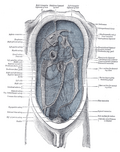 Diagram to show the lines along which the peritoneum leaves the wall of the abdomen to invest the viscera.
 Epiploic foramen


