Ostrowski numeration
From Wikipedia, the free encyclopedia
In mathematics, Ostrowski numeration, named after Alexander Ostrowski, is either of two related numeration systems based on continued fractions: a non-standard positional numeral system for integers and a non-integer representation of real numbers.
Fix a positive irrational number α with continued fraction expansion [a0; a1, a2, ...]. Let (qn) be the sequence of denominators of the convergents pn/qn to α: so qn = anqn−1 + qn−2. Let αn denote Tn(α) where T is the Gauss map T(x) = {1/x}, and write βn = (−1)n+1 α0 α1 ... αn: we have βn = anβn−1 + βn−2.
Every positive real x can be written as
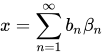
where the integer coefficients 0 ≤ bn ≤ an and if bn = an then bn−1 = 0.
