Ariolimax columbianus
Species of slug
From Wikipedia, the free encyclopedia
Ariolimax columbianus, the Pacific banana slug, is a species of slug found on the Pacific coast of North America.[3] It is the second-largest species of terrestrial slug in the world, growing up to 25 centimeters (9.8 in) long.[3] An important function of this particular species is the role it plays in seed dispersion.[4]

| Ariolimax columbianus | |
|---|---|
| |
Scientific classification  | |
| Kingdom: | Animalia |
| Phylum: | Mollusca |
| Class: | Gastropoda |
| Order: | Stylommatophora |
| Family: | Ariolimacidae |
| Genus: | Ariolimax |
| Species: | A. columbianus |
| Binomial name | |
| Ariolimax columbianus (Gould, 1851) | |
| Synonyms[2] | |
|
List
| |

Distribution
Ariolimax columbianus is endemic to the Pacific Northwest, and inhabits forests ranging from the northern California coast to Alaska.[5] It is the only species of the genus Ariolimax found outside of California.[6] It is found in moist and damp areas of the forest floor.[7]
Description
Ariolimax columbianus can grow up to 25 centimeters long, making it the second largest terrestrial slug in the world.[3] It is often bright yellow, but it can also be greenish, brown, tan, or white. Ariolimax columbianus commonly also has black spots covering the tail, sometimes so extensively that the tail may appear completely black. Individual slugs can also change color from changes in their environment and eating habits, and can also indicate if a slug is healthy or injured.[5]
Gallery
 Mantle, note the prominent pneumostome.
 Yellow morph from the Henry Cowell Redwoods.
 Brown version at Reinhardt Redwood Regional Reserve.
 Tail, note full length foot fringe and keel. This individual appears to lack melanin, possibly displaying albinism.
 Blending in with the leaf litter.
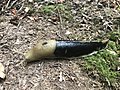 A Pacific banana slug whose tail appears to be nearly entirely black.
 Feeding on a mushroom.
 Two yellow Pacific Banana Slugs on the forest floor.


