Partial fractions in complex analysis
From Wikipedia, the free encyclopedia
In complex analysis, a partial fraction expansion is a way of writing a meromorphic function as an infinite sum of rational functions and polynomials. When is a rational function, this reduces to the usual method of partial fractions.

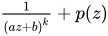
By using polynomial long division and the partial fraction technique from algebra, any rational function can be written as a sum of terms of the form , where and are complex, is an integer, and is a polynomial. Just as polynomial factorization can be generalized to the Weierstrass factorization theorem, there is an analogy to partial fraction expansions for certain meromorphic functions.


A proper rational function (one for which the degree of the denominator is greater than the degree of the numerator) has a partial fraction expansion with no polynomial terms. Similarly, a meromorphic function for which goes to 0 as goes to infinity at least as quickly as has an expansion with no polynomial terms.


Calculation
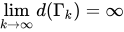
Let be a function meromorphic in the finite complex plane with poles at and let be a sequence of simple closed curves such that:


- The origin lies inside each curve
- No curve passes through a pole of
- lies inside for all
- , where gives the distance from the curve to the origin
- one more condition of compatibility with the poles , described at the end of this section




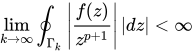
Suppose also that there exists an integer such that

Writing for the principal part of the Laurent expansion of about the point , we have

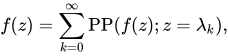
if . If , then


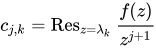
where the coefficients are given by

should be set to 0, because even if itself does not have a pole at 0, the residues of at must still be included in the sum.


Note that in the case of , we can use the Laurent expansion of about the origin to get



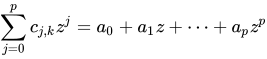
so that the polynomial terms contributed are exactly the regular part of the Laurent series up to .

For the other poles where , can be pulled out of the residue calculations:


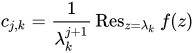
![{\displaystyle \sum _{j=0}^{p}c_{j,k}z^{j}=[\operatorname {Res} _{z=\lambda _{k}}f(z)]\sum _{j=0}^{p}{\frac {1}{\lambda _{k}^{j+1}}}z^{j}}](https://wikimedia.org/api/rest_v1/media/math/render/svg/62c6284c7bc74e6a8b46f1c3cd669d822572ca23)
- To avoid issues with convergence, the poles should be ordered so that if is inside , then is also inside for all .


Example
The simplest meromorphic functions with an infinite number of poles are the non-entire trigonometric functions. As an example, is meromorphic with poles at , The contours will be squares with vertices at traversed counterclockwise, , which are easily seen to satisfy the necessary conditions.


On the horizontal sides of ,
![{\displaystyle z=t\pm \pi ki,\ \ t\in [-\pi k,\pi k],}](https://wikimedia.org/api/rest_v1/media/math/render/svg/5c110193122a94de152b8b3a78e807c9bebd846b)
so


for all real , which yields



For , is continuous, decreasing, and bounded below by 1, so it follows that on the horizontal sides of , . Similarly, it can be shown that on the vertical sides of .




With this bound on we can see that


That is, the maximum of on occurs at the minimum of , which is .


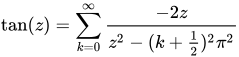
Therefore , and the partial fraction expansion of looks like


The principal parts and residues are easy enough to calculate, as all the poles of are simple and have residue -1:

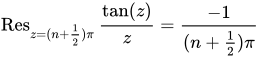
We can ignore , since both and are analytic at 0, so there is no contribution to the sum, and ordering the poles so that , etc., gives


![{\displaystyle \tan(z)=\sum _{k=0}^{\infty }\left[\left({\frac {-1}{z-(k+{\frac {1}{2}})\pi }}-{\frac {1}{(k+{\frac {1}{2}})\pi }}\right)+\left({\frac {-1}{z+(k+{\frac {1}{2}})\pi }}+{\frac {1}{(k+{\frac {1}{2}})\pi }}\right)\right]}](https://wikimedia.org/api/rest_v1/media/math/render/svg/3d4fc5b2892b34d59b63ba9d175a2008ede88804)