Partial geometry
From Wikipedia, the free encyclopedia
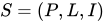
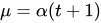
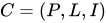
An incidence structure consists of a set of points, a set of lines, and an incidence relation, or set of flags, ; a point is said to be incident with a line if . It is a (finite) partial geometry if there are integers such that:


- For any pair of distinct points and , there is at most one line incident with both of them.
- Each line is incident with points.
- Each point is incident with lines.
- If a point and a line are not incident, there are exactly pairs , such that is incident with and is incident with .


A partial geometry with these parameters is denoted by .

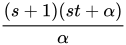
- The number of points is given by and the number of lines by .
- The point graph (also known as the collinearity graph) of a is a strongly regular graph: .
- Partial geometries are dualizable structures: the dual of a is simply a .


Special cases
- The generalized quadrangles are exactly those partial geometries with .
- The Steiner systems are precisely those partial geometries with .