Perineal nerve
Nerve of the perineum
From Wikipedia, the free encyclopedia
The perineal nerve is a nerve of the pelvis. It arises from the pudendal nerve in the pudendal canal. It gives superficial branches to the skin, and a deep branch to muscles. It supplies the skin and muscles of the perineum. Its latency is tested with electrodes.

| Perineal nerve | |
|---|---|
The superficial branches of the internal pudendal artery. (Perineal nerve visible but not labeled.) | |
 Pudendal nerve, its course through the lesser sciatic foramen, and branches, including inferior anal at bottom right. | |
| Details | |
| From | Pudendal nerve |
| Innervates | Perineum, scrotum or labia majora, superficial transverse perineal muscle, bulbospongiosus muscle, ischiocavernosus muscle, bulb of penis, levator ani, external anal sphincter |
| Identifiers | |
| Latin | nervi perineales |
| TA98 | A14.2.07.039 |
| TA2 | 6556 |
| FMA | 21866 |
| Anatomical terms of neuroanatomy | |
Structure
The perineal nerve is a branch of the pudendal nerve.[1][2] It lies below the internal pudendal artery. It accompanies the perineal artery. It passes through the pudendal canal for around 2 or 3 cm.[1][2] Whilst still in the canal, it divides into superficial branches and a deep branch.[1] The superficial branches of the perineal nerve become the posterior scrotal nerves in men,[3] and the posterior labial nerves in women.[1] The deep branch of the perineal nerve (also known as the "muscular" branch) travels to the muscles of the perineum.[1] Both of these are superficial to the dorsal nerve of the penis or the dorsal nerve of the scrotum.[4]
Function
The perineal nerve supplies the skin and muscles of the perineum.[1] The superficial branches supply sensation to the perineum, and the scrotum in men or the labia majora in women.[1] The deep branch supplies superficial transverse perineal muscle, the bulbospongiosus muscle, the ischiocavernosus muscle, the bulb of penis, levator ani, and the external anal sphincter.[1]
Clinical significance
The latency of the perineal nerve can be measured with electrodes.[5] It is used to test nerve function.[5]
Additional images
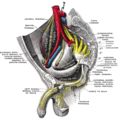 Sacral plexus of the right side. (Perineal nerve visible at center right.)


