Power gain
From Wikipedia, the free encyclopedia
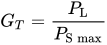
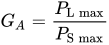
In electrical engineering, the power gain of an electrical network is the ratio of an output power to an input power. Unlike other signal gains, such as voltage and current gain, "power gain" may be ambiguous as the meaning of terms "input power" and "output power" is not always clear. Three important power gains are operating power gain, transducer power gain and available power gain. Note that all these definitions of power gains employ the use of average (as opposed to instantaneous) power quantities and therefore the term "average" is often suppressed, which can be confusing at occasions.
The operating power gain of a two-port network, GP, is defined as:

where
- PL is the maximum time-averaged power delivered to the load, where the maximization is over the load impedance, i.e., we desire the load impedance which maximizes the time-averaged power delivered to the load.
- PI is the time-averaged input power to the network.
If the time-averaged input power depends on the load impedance, one must take the maximum of the ratio, not just the maximum of the numerator.