Province of Verbano-Cusio-Ossola
Province in Piedmont, Italy
From Wikipedia, the free encyclopedia
The province of Verbano-Cusio-Ossola (Italian: provincia del Verbano-Cusio-Ossola, Italian: [verˈbaːno ˈkuːzjo ˈɔssola], Piedmontese: Provincia dël Verban-Cusi-Òssola) is a province in the region of Piedmont in northern Italy. It was created in 1992 through the fusion of three geographical areas which had previously been part of the province of Novara. The area flanking the western shore of Verbano (or Lago Maggiore) forms the eastern part of the province; Cusio (or Lago d’Orta) and its environs form the southern part; while the north and west of the province consist of the Ossola, a region of Alpine mountains and valleys. The ISO code for the province is VB.
_-_DSC03687.JPG)
Province of Verbano-Cusio-Ossola
| |
|---|---|
Villa Taranto in Verbania, seat of the prefecture | |
 Flag  Coat of arms | |
 Map highlighting the location of the province of Verbano-Cusio-Ossola in Italy | |
 Interactive map of Province of Verbano-Cusio-Ossola | |
| Country |  Italy Italy |
| Region |  Piedmont Piedmont |
| Capital(s) | Verbania |
| Municipalities | 74 |
| Government | |
| • President | Giandomenico Albertella |
| Area | |
• Total | 2,260.91 km2 (872.94 sq mi) |
| Population | |
• Total | 152,677 |
| • Density | 67.5290/km2 (174.899/sq mi) |
| GDP | |
| • Total | €3.733 billion (2015) |
| • Per capita | €23,259 (2015) |
| Time zone | UTC+1 (CET) |
| • Summer (DST) | UTC+2 (CEST) |
| Postal code | Verbania: 28921-28925, Other areas: 28811-28897 |
| Telephone prefix | 0163, 0322, 0323, 0324 |
| ISO 3166 code | VB |
| Vehicle registration | VB |
| ISTAT | 103 |

The province has a population of 152,677, distributed over an area of 2,260.91 square kilometres (872.94 mi2) across its 74 municipalities, with the biggest population centres being its capital Verbania, on the shores of Lago Maggiore, Domodossola, the main town of the Ossola, and Omegna, at the northern end of Lago d’Orta.[5][6][1]
Municipalities
- Antrona Schieranco
- Anzola d'Ossola
- Arizzano
- Arola
- Aurano
- Baceno
- Bannio Anzino
- Baveno
- Bee
- Belgirate
- Beura-Cardezza
- Bognanco
- Borgomezzavalle
- Brovello-Carpugnino
- Calasca-Castiglione
- Cambiasca
- Cannero Riviera
- Cannobio
- Caprezzo
- Casale Corte Cerro
- Ceppo Morelli
- Cesara
- Cossogno
- Craveggia
- Crevoladossola
- Crodo
- Domodossola
- Druogno
- Formazza
- Germagno
- Ghiffa
- Gignese
- Gravellona Toce
- Gurro
- Intragna
- Loreglia
- Macugnaga
- Madonna del Sasso
- Malesco
- Masera
- Massiola
- Mergozzo
- Miazzina
- Montecrestese
- Montescheno
- Nonio
- Oggebbio
- Omegna
- Ornavasso
- Pallanzeno
- Piedimulera
- Pieve Vergonte
- Premeno
- Premia
- Premosello-Chiovenda
- Quarna Sopra
- Quarna Sotto
- Re
- San Bernardino Verbano
- Santa Maria Maggiore
- Stresa
- Toceno
- Trarego Viggiona
- Trasquera
- Trontano
- Valle Cannobina
- Valstrona
- Vanzone con San Carlo
- Varzo
- Verbania
- Vignone
- Villadossola
- Villette
- Vogogna


Demographics
As of 2026, the population is 152,677, of which 48.8% are male, and 51.2% are female. Minors make up 12.3% of the population, and seniors make up 29.2%.[7][8]
Historical population | |||||||||||||||||||||||||||||||||||||||||||||||||||||||
|
| ||||||||||||||||||||||||||||||||||||||||||||||||||||||
| Source: ISTAT[9][10] | |||||||||||||||||||||||||||||||||||||||||||||||||||||||
Immigration
As of 2025, of the known countries of birth of 148,110 residents, the most numerous are: Italy (136,166 – 91.9%), Morocco (1,485 – 1%), Romania (1,271 – 0.9%), Albania (1,040 – 0.7%).[11][12]
Culture
UNESCO Sacred Mountains
In 2003, the Sacred Mountain of Domodossola and the Sacred Mountain of Ghiffa were inserted by UNESCO in the World Heritage List.
 Sacro Monte di Domodossola
View of the chapels IX and XI Sacro Monte di Domodossola
Chapel IX Sacro Monte di Domodossola
 Sacro Monte di Ghiffa
Crucifixion and Trinity, 16th century Sacro Monte di Ghiffa
Unknown artist of the 18th century, Three Angels visiting Abraham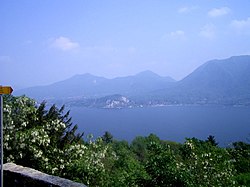 Sacro Monte di Ghiffa
Landscape from the Sacro Monte


Cuisine
Common in the whole Insubria area are bruscitti, originating from Alto Milanese, which consists of braised meat cut very thin and cooked in wine and fennel seeds, historically obtained by stripping leftover meat.
.jpg)

.jpg)
Transport

Motorways
The province is crossed by the following motorways (in Italian, autostrade):
