Pöschl–Teller potential
Quantum mechanical potential
From Wikipedia, the free encyclopedia
In mathematical physics, a Pöschl–Teller potential, named after the physicists Herta Pöschl[1] (credited as G. Pöschl) and Edward Teller, is a special class of potentials for which the one-dimensional Schrödinger equation can be solved in terms of special functions.
Definition
In its symmetric form is explicitly given by[2]

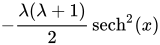
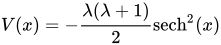
and the solutions of the time-independent Schrödinger equation

with this potential can be found by virtue of the substitution , which yields

- .
![{\displaystyle \left[(1-u^{2})\psi '(u)\right]'+\lambda (\lambda +1)\psi (u)+{\frac {2E}{1-u^{2}}}\psi (u)=0}](http://wikimedia.org/api/rest_v1/media/math/render/svg/9304e92f3b53756e2ed60ba87f7854fc21f370f8)
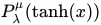
Thus the solutions are just the Legendre functions with , and , . Moreover, eigenvalues and scattering data can be explicitly computed.[3] In the special case of integer , the potential is reflectionless and such potentials also arise as the N-soliton solutions of the Korteweg–De Vries equation.[4]





The more general form of the potential is given by[2]

Rosen–Morse potential
A related potential is given by introducing an additional term:[5]


