Quadratic set
From Wikipedia, the free encyclopedia
In mathematics, a quadratic set is a set of points in a projective space that bears the same essential incidence properties as a quadric (conic section in a projective plane, sphere or cone or hyperboloid in a projective space).
Let be a projective space. A quadratic set is a non-empty subset of for which the following two conditions hold:
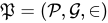


- (QS1) Every line of intersects in at most two points or is contained in .
- ( is called exterior to if , tangent to if either or , and secant to if .)
- (QS2) For any point the union of all tangent lines through is a hyperplane or the entire space .


A quadratic set is called non-degenerate if for every point , the set is a hyperplane.
A Pappian projective space is a projective space in which Pappus's hexagon theorem holds.
The following result, due to Francis Buekenhout, is an astonishing statement for finite projective spaces.
- Theorem: Let be a finite projective space of dimension and a non-degenerate quadratic set that contains lines. Then: is Pappian and is a quadric with index .






