The Ratner orbit closure theorem asserts that the closures of orbits of unipotent flows on the quotient of a Lie group by a lattice are nice, geometric subsets. The Ratner equidistribution theorem further asserts that each such orbit is equidistributed in its closure. The Ratner measure classification theorem is the weaker statement that every ergodic invariant probability measure is homogeneous, or algebraic: this turns out to be an important step towards proving the more general equidistribution property. There is no universal agreement on the names of these theorems: they are variously known as the "measure rigidity theorem", the "theorem on invariant measures" and its "topological version", and so on.
The formal statement of such a result is as follows. Let  be a Lie group,
  a lattice in , and
  a one-parameter subgroup of consisting of unipotent elements, with the associated flow
  on
on  . Then the closure of every orbit
  of is homogeneous. This means that there exists a connected, closed subgroup
  of such that the image of the orbit
  for the action of by right translations on under the canonical projection to is closed, has a finite -invariant measure, and contains the closure of the -orbit of
  as a dense subset.
The simplest case to which the statement above applies is 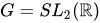 . In this case it takes the following more explicit form; let
  be a lattice in
  and
and  a closed subset which is invariant under all maps
 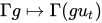 where
where 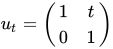 . Then either there exists an
  such that
  (where
  ) or
) or  .
.
In geometric terms is a cofinite Fuchsian group, so the quotient  of the hyperbolic plane by is a hyperbolic orbifold of finite volume. The theorem above implies that every horocycle of
  has an image in
  which is either a closed curve (a horocycle around a cusp of ) or dense in .