Let X be a separable, reflexive Banach space with norm || || and fix T > 0. Let BV−([0, T]; X) denote the space of all left-continuous functions z : [0, T] → X with bounded variation on [0, T].
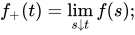
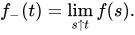
For any function of time f, use subscripts +/− to denote the right/left continuous versions of f, i.e.
For any sub-interval [a, b] of [0, T], let Var(z, [a, b]) denote the variation of z over [a, b], i.e., the supremum
![{\displaystyle \mathrm {Var} (z,[a,b])=\sup \left\{\left.\sum _{i=1}^{k}\|z(t_{i})-z(t_{i-1})\|\right|a=t_{0}<t_{1}<\cdots <t_{k}=b,k\in \mathbb {N} \right\}.}](https://wikimedia.org/api/rest_v1/media/math/render/svg/b2781b0ba8525067779c75c99a53bbe49fa143ba)
The first step in the construction of the reduced derivative is the "stretch" time so that z can be linearly interpolated at its jump points. To this end, define
![{\displaystyle {\hat {\tau }}\colon [0,T]\to [0,+\infty );}](https://wikimedia.org/api/rest_v1/media/math/render/svg/1e737f11d760c05c2d1927103cc3cd1473207bdc)
![{\displaystyle {\hat {\tau }}(t)=t+\int _{[0,t]}\|\mathrm {d} z\|=t+\mathrm {Var} (z,[0,t]).}](https://wikimedia.org/api/rest_v1/media/math/render/svg/972ebeaf806f346c4e79a1f930208e306a80315b)
The "stretched time" function τ̂ is left-continuous (i.e. τ̂ = τ̂−); moreover, τ̂− and τ̂+ are strictly increasing and agree except at the (at most countable) jump points of z. Setting T̂ = τ̂(T), this "stretch" can be inverted by
![{\displaystyle {\hat {t}}\colon [0,{\hat {T}}]\to [0,T];}](https://wikimedia.org/api/rest_v1/media/math/render/svg/763ea8ee779ed226fd4a3292a1928f8f021c032c)
![{\displaystyle {\hat {t}}(\tau )=\max\{t\in [0,T]|{\hat {\tau }}(t)\leq \tau \}.}](https://wikimedia.org/api/rest_v1/media/math/render/svg/874cbf0398cf62bdff069c4890dc154db9bbdfc2)
Using this, the stretched version of z is defined by
![{\displaystyle {\hat {z}}\in C^{0}([0,{\hat {T}}];X);}](https://wikimedia.org/api/rest_v1/media/math/render/svg/4bad73eb11e65a2529f4d8127fec80a33903bf55)

where θ ∈ [0, 1] and

The effect of this definition is to create a new function ẑ which "stretches out" the jumps of z by linear interpolation. A quick calculation shows that ẑ is not just continuous, but also lies in a Sobolev space:
![{\displaystyle {\hat {z}}\in W^{1,\infty }([0,{\hat {T}}];X);}](https://wikimedia.org/api/rest_v1/media/math/render/svg/cef1b19ebc0346cef61b1d088c8fd2e95588255e)
![{\displaystyle \left\|{\frac {\mathrm {d} {\hat {z}}}{\mathrm {d} \tau }}\right\|_{L^{\infty }([0,{\hat {T}}];X)}\leq 1.}](https://wikimedia.org/api/rest_v1/media/math/render/svg/8fd0a327a3a85dfababcf9f067831e440c2c6805)
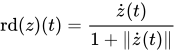
The derivative of ẑ(τ) with respect to τ is defined almost everywhere with respect to Lebesgue measure. The reduced derivative of z is the pull-back of this derivative by the stretching function τ̂ : [0, T] → [0, T̂]. In other words,
![{\displaystyle \mathrm {rd} (z)\colon [0,T]\to \{x\in X|\|x\|\leq 1\};}](https://wikimedia.org/api/rest_v1/media/math/render/svg/caec43e35e5b32d9ad2ceee375e80c4ea101c134)

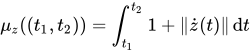
Associated with this pull-back of the derivative is the pull-back of Lebesgue measure on [0, T̂], which defines the differential measure μz:
![{\displaystyle \mu _{z}([t_{1},t_{2}))=\lambda ([{\hat {\tau }}(t_{1}),{\hat {\tau }}(t_{2}))={\hat {\tau }}(t_{2})-{\hat {\tau }}(t_{1})=t_{2}-t_{1}+\int _{[t_{1},t_{2}]}\|\mathrm {d} z\|.}](https://wikimedia.org/api/rest_v1/media/math/render/svg/5815bbce672785a0188233e6e339c49324410563)