Regulated rewriting
From Wikipedia, the free encyclopedia
Regulated rewriting is a specific area of formal languages studying grammatical systems which are able to take some kind of control over the production applied in a derivation step. For this reason, the grammatical systems studied in Regulated Rewriting theory are also called "Grammars with Controlled Derivations". Among such grammars can be noticed:
Basic concepts
Definition
A Matrix Grammar, , is a four-tuple where
1.- is an alphabet of non-terminal symbols
2.- is an alphabet of terminal symbols disjoint with
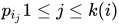
3.- is a finite set of matrices, which are non-empty sequences
,
with , and
, where each
, is an ordered pair
being
these pairs are called "productions", and are denoted
. In these conditions the matrices can be written down as
4.- S is the start symbol





![{\displaystyle m_{i}=[p_{i_{1}},...,p_{i_{k(i)}}]}](https://wikimedia.org/api/rest_v1/media/math/render/svg/61dd55b386cf8a681723d9949309cd789a1bdabb)





![{\displaystyle m_{i}=[L_{i_{1}}\rightarrow R_{i_{1}},...,L_{i_{k(i)}}\rightarrow R_{i_{k(i)}}]}](https://wikimedia.org/api/rest_v1/media/math/render/svg/ba9714cd393287ab54e770e2be8588d31172c582)
Definition
Let be a matrix grammar and let
the collection of all productions on matrices of .
We said that is of type according to Chomsky's hierarchy with , or "increasing length"
or "linear" or "without -productions" if and only if the grammar has the corresponding property.




The classic example
- Note: taken from Abraham 1965, with change of nonterminals names
The context-sensitive language is generated by the where is the non-terminal set, is the terminal set, and the set of matrices is defined as , , , .





![{\displaystyle \left[S\rightarrow abc\right]}](https://wikimedia.org/api/rest_v1/media/math/render/svg/b251a2153439b879e2965d00f8b3e6ead866447f)
![{\displaystyle \left[S\rightarrow aAbBcC\right]}](https://wikimedia.org/api/rest_v1/media/math/render/svg/3627dbfc269dcd0c3a7e5a7aef3722098d1ca27e)
![{\displaystyle \left[A\rightarrow aA,B\rightarrow bB,C\rightarrow cC\right]}](https://wikimedia.org/api/rest_v1/media/math/render/svg/d9dec7ddac7f0ae8beac5d633b0dc7b756832aa4)
![{\displaystyle \left[A\rightarrow a,B\rightarrow b,C\rightarrow c\right]}](https://wikimedia.org/api/rest_v1/media/math/render/svg/6f30939ba85809d56b82ed6e926bc9913551faf2)
Time Variant Grammars
Basic concepts
Definition
A Time Variant Grammar is a pair where
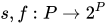
is a grammar and is a function from the set of natural
numbers to the class of subsets of the set of productions.