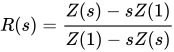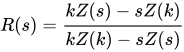
where  is a PRF,
  is a positive real constant, and
  is the complex frequency variable, can be written as,
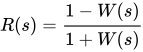
where,
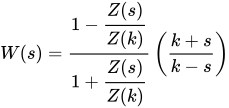
Since is PRF then

is also PRF. The zeroes of this function are the poles of  . Since a PRF can have no zeroes in the right-half s-plane, then can have no poles in the right-half s-plane and hence is analytic in the right-half s-plane.
Let

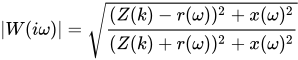
Then the magnitude of  is given by,
Since the PRF condition requires that  for all
  then
then  for all . The maximum magnitude of occurs on the
  axis because is analytic in the right-half s-plane. Thus
  for
for  .
.
Let  , then the real part of
  is given by,

Because  for then
 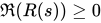 for and consequently must be a PRF.[2]
Richards' theorem can also be derived from Schwarz's lemma.[3]