Manduca rustica
Species of moth
From Wikipedia, the free encyclopedia
Manduca rustica, the rustic sphinx, is a moth of the family Sphingidae. The species was first described by Johan Christian Fabricius in 1775.[1]

| Rustic sphinx | |
|---|---|
| |
Scientific classification  | |
| Kingdom: | Animalia |
| Phylum: | Arthropoda |
| Class: | Insecta |
| Order: | Lepidoptera |
| Family: | Sphingidae |
| Genus: | Manduca |
| Species: | M. rustica |
| Binomial name | |
| Manduca rustica (Fabricius, 1775) | |
| Synonyms | |
| |

Distribution
It is found in the southern parts of the United States (straying into the northern United States at times), southward through Mexico, Central America and South America to Uruguay.
Description
 Male Manduca rustica rustica, dorsal view
 Male Manduca rustica rustica, ventral view


Biology
The larvae feed on a variety of plants including Jasminum, Bignonia and Chilopsis. Larvae have been recorded on plants from a variety of families, including Bignoniaceae, Oleaceae, Verbenaceae, Convolvulaceae and Lamiaceae.[2]
The species is widespread and adaptable, living in varied habitats from rainforests to deserts and thriving in urban and disturbed habitat. It can live on many types of native and exotic plants.[3]
Subspecies
- Manduca rustica cortesi (Cary, 1963) (Mexico)
- Manduca rustica cubana (Wood, 1915) (Cuba, Jamaica)
- Manduca rustica calapagensis (Holland, 1889) (Galápagos Islands)
- Manduca rustica harterti (Rothschild, 1894) (Lesser Antilles, including Bonaire and St. Lucia)
- Manduca rustica rustica (Americas)
 Manduca rustica calapagensis, female, dorsal
 Manduca rustica calapagensis, female, ventral
 Manduca rustica cubana dorsal MHNT
 Manduca rustica cubana ventral MHNT
 Manduca rustica harterti, dorsal view
 Manduca rustica harterti, ventral view


Gallery
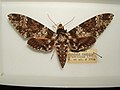 Female
 Variation
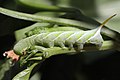 Larva
Larva Adult
Adult


