As an example on how to compute the s-wave (i.e. angular momentum  ) scattering length for a given potential we look at the infinitely repulsive spherical potential well of radius
  in 3 dimensions. The radial Schrödinger equation () outside of the well is just the same as for a free particle:
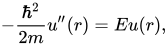
where the hard core potential requires that the wave function  vanishes at
  ,
,  .
The solution is readily found:
.
The solution is readily found:
 .
.
Here 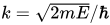 and
and  is the s-wave phase shift (the phase difference between incoming and outgoing wave), which is fixed by the boundary condition ;
  is an arbitrary normalization constant.
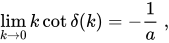
One can show that in general  for small
  (i.e. low energy scattering). The parameter
  of dimension length is defined as the scattering length. For our potential we have therefore
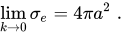
  , in other words the scattering length for a hard sphere is just the radius. (Alternatively one could say that an arbitrary potential with s-wave scattering length has the same low energy scattering properties as a hard sphere of radius .)
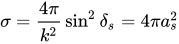
To relate the scattering length to physical observables that can be measured in a scattering experiment we need to compute the cross section
, in other words the scattering length for a hard sphere is just the radius. (Alternatively one could say that an arbitrary potential with s-wave scattering length has the same low energy scattering properties as a hard sphere of radius .)
To relate the scattering length to physical observables that can be measured in a scattering experiment we need to compute the cross section  . In scattering theory one writes the asymptotic wavefunction as (we assume there is a finite ranged scatterer at the origin and there is an incoming plane wave along the
  -axis):
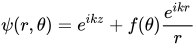
where  is the scattering amplitude. According to the probability interpretation of quantum mechanics the differential cross section is given by
 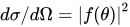 (the probability per unit time to scatter into the direction
  ). If we consider only s-wave scattering the differential cross section does not depend on the angle
  , and the total scattering cross section is just
  . The s-wave part of the wavefunction
  is projected out by using the standard expansion of a plane wave in terms of spherical waves and Legendre polynomials
  :
:
![{\displaystyle e^{ikz}\approx {\frac {1}{2ikr}}\sum _{l=0}^{\infty }(2l+1)P_{l}(\cos \theta )\left[(-1)^{l+1}e^{-ikr}+e^{ikr}\right]}](https://wikimedia.org/api/rest_v1/media/math/render/svg/7547703b43771dee798f13f57cee27e2be4c6e76)
By matching the component of to the s-wave solution  (where we normalize such that the incoming wave
  has a prefactor of unity) one has:

This gives: