Sebastopol (mortar)
Monument in Addis Ababa, Ethiopia
From Wikipedia, the free encyclopedia
Sebastopol was the name of a large artillery mortar commissioned by the Ethiopian Emperor Tewodros II (1818–1868). The name was taken from the Crimean town of Sevastopol, the site of a battle during the Crimean War. The mortar weighed approximately 6.7 tons, and was capable of firing off half-ton artillery rounds.

 The Sebastopol in the Wollo Province | |
 Interactive map of Sebastopol Artillery Mortar | |
| Location | Addis Ababa, Ethiopia |
|---|---|
| Coordinates | 9°1′37.37″N 38°45′6.03″E |
| Type | Monument |
| Material | Bronze |
| Completion date | 1868 |
In an attempt to speed up industrialisation, Tewodros had welcomed British and French officials and a group of German missionaries into his kingdom. In 1866, following a series of diplomatic misunderstandings and the king's increasingly erratic behaviour, all foreigners were taken prisoner. Tewodros ordered the artisan-missionaries, led by Theophilus Waldmeier, to construct a brass cannon capable of firing a 1,000-pound (450 kg) cannon ball. It took seven months to construct and two furnace were built for the casting. When it was transported to Magdala a special road had to be built. At times 800 men were needed to move it; the 200 mile journey took six months.[1] Meanwhile the British expedition to Abyssinia was sent to free the captives, which resulted in the Battle of Magdala.[2]
Although there are no records of the mortar being used in the battle it remains half-buried in the ground, on the plateau at Meqedela,[citation needed] near Amba Mariam. A bronze replica has been cast and displayed in the centre of a roundabout at Tewodros Square, Churchill Avenue, Addis Ababa.[3]
Gallery
 The original mortar
 The mortar monument on Tewodros Square, Addis Ababa
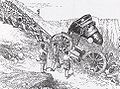 Ethiopian soldiers dragging the mortar


