Selberg's zeta function conjecture
From Wikipedia, the free encyclopedia
In mathematics, the Selberg conjecture, named after Atle Selberg, is a theorem about the density of zeros of the Riemann zeta function ζ(1/2 + it). It is known that the function has infinitely many zeroes on this line in the complex plane: the point at issue is how densely they are clustered. Results on this can be formulated in terms of N(T), the function counting zeroes on the line for which the value of t satisfies 0 ≤ t ≤ T.
In 1942 Atle Selberg investigated the problem of the Hardy–Littlewood conjecture 2; and he proved that for any

there exist

and
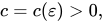
such that for

and

the inequality

holds true.
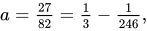
In his turn, Selberg stated a conjecture relating to shorter intervals,[1] namely that it is possible to decrease the value of the exponent a = 0.5 in