Soyuz-2
Russian medium-lift launch rocket
From Wikipedia, the free encyclopedia
Soyuz‑2 (Russian: Союз‑2, lit. 'Union‑2', GRAU index: 14A14) is a Russian expendable medium-lift launch vehicle and the seventh major iteration of the Soyuz rocket family. Compared to its predecessors, Soyuz-2 features significant upgrades, including improved engines and a digital flight control system that enables launches from fixed platforms and supports larger payload fairings.

A Soyuz‑2.1b rocket launches carrying a GLONASS-K2 satellite to orbit | |
| Function | Medium-lift launch vehicle |
|---|---|
| Manufacturer | RKTs Progress |
| Country of origin | Russia |
| Cost per launch | US$35 million (2018, 2.1b without fourth stage)[1][2] |
| Size | |
| Height | 46.3 m (152 ft)[3] |
| Diameter | 10.3 m (33 ft 10 in) |
| Mass | 312,000 kg (688,000 lb) |
| Stages | 3 or 4 |
| Capacity | |
| Payload to LEO | |
| Altitude | 240 km (150 mi) |
| Orbital inclination |
|
| Mass |
|
| Payload to Polar orbit | |
| Altitude | 240 km (150 mi) |
| Orbital inclination | 98° |
| Mass |
|
| Payload to TLI[a] | |
| Mass | B: 2,350 kg (5,180 lb)[2] |
| Associated rockets | |
| Family | R-7 (Soyuz) |
| Based on | Soyuz-FG |
| Derivative work | Soyuz-ST Soyuz-2.1v |
| Launch history | |
| Status | Active |
| Launch sites | |
| Total launches | 165 (A: 81, B: 84) |
| Success(es) | 160 (A: 78, B: 82) |
| Failure | 4 (A: 2, B: 2) |
| Partial failure | 1 (A: 1, B: 0) |
| First flight |
|
| Last flight |
|
| Carries passengers or cargo | |
| Boosters (First stage) – Block B, V, G & D[b] | |
| No. boosters | 4 |
| Height | 19.6 m (64 ft 4 in) |
| Diameter | 2.68 m (8 ft 10 in) |
| Empty mass | 3,784 kg (8,342 lb) |
| Gross mass | 44,413 kg (97,914 lb) |
| Propellant mass |
|
| Powered by | 1 × RD-107A |
| Maximum thrust | SL: 838.5 kN (188,500 lbf) vac: 1,021.3 kN (229,600 lbf) |
| Specific impulse | SL: 262 s (2.57 km/s) vac: 319 s (3.13 km/s)[4] |
| Burn time | 118 seconds |
| Propellant | LOX / RP-1 |
| Second stage (core) – Block A | |
| Height | 27.1 m (88 ft 11 in) |
| Diameter | 2.95 m (9 ft 8 in) |
| Empty mass | 6,545 kg (14,429 lb) |
| Gross mass | 99,765 kg (219,944 lb) |
| Propellant mass |
|
| Powered by | 1 × RD-108A |
| Maximum thrust | SL: 792.5 kN (178,200 lbf) vac: 990.2 kN (222,600 lbf) |
| Specific impulse | SL: 255 s (2.50 km/s) vac: 319 s (3.13 km/s)[4] |
| Burn time | 286 seconds |
| Propellant | LOX / RP-1 |
| Third stage – Block I[c] | |
| Height | 6.7 m (22 ft 0 in) |
| Diameter | 2.66 m (8 ft 9 in) |
| Empty mass | 2,355 kg (5,192 lb) |
| Gross mass | 27,755 kg (61,189 lb) |
| Propellant mass |
|
| Powered by | A: 1 × RD-0110 B: 1 × RD-0124 |
| Maximum thrust | A: 298.03 kN (67,000 lbf) B: 294.3 kN (66,200 lbf)[5] |
| Specific impulse | A: 325 s (3.19 km/s) B: 359 s (3.52 km/s)[6] |
| Burn time | A: 250 seconds B: 270 seconds |
| Propellant | LOX / RP-1 |
| Fourth stage (optional) – Fregat / Fregat-M[7] | |
| Height | Fregat: 1.875 m (6 ft 1.8 in) Fregat-M: 1.945 m (6 ft 4.6 in) |
| Diameter | Fregat: 3.44 m (11 ft 3 in) Fregat-M: 3.8 m (12 ft 6 in) |
| Empty mass | Fregat: 945 kg (2,083 lb) Fregat-M: 1,035 kg (2,282 lb) |
| Gross mass | Fregat: 6,235 kg (13,746 lb) Fregat-M: 7,640 kg (16,840 lb) |
| Propellant mass | Fregat: 5,307 kg (11,700 lb) Fregat-M: 6,650 kg (14,660 lb) |
| Powered by | 1 × S5.92 |
| Maximum thrust | 13.93–19.85 kN (3,130–4,460 lbf) |
| Specific impulse | 320–333.2 s (3.14–3.27 km/s) |
| Burn time | Up to 1,100 seconds (up to 7 starts) |
| Propellant | N2O4 / UDMH |
| Fourth stage (optional) – Volga[8] | |
| Height | 1.025 m (3 ft 4.4 in) |
| Diameter | 3.2 m (10 ft 6 in) |
| Empty mass | 840 kg (1,850 lb) |
| Propellant mass | 300–900 kg (660–1,980 lb) |
| Powered by | 1 × 17D64[9] |
| Maximum thrust | 2.94 kN (660 lbf) |
| Specific impulse | 307 s (3.01 km/s) |
| Propellant | N2O4 / UDMH |
Developed by the Progress Rocket Space Centre (RKTs Progress) in Samara, Soyuz-2 is used to place payloads into low Earth orbit in standard configuration but can also support missions to higher orbits using an additional upper stage, most commonly the Fregat, though the smaller Volga is available as a less expensive option. Since its introduction in 2004, Soyuz-2 has gradually replaced earlier Soyuz variants and is launched from the facilities of its R-7 derived predecessors: Site 31/6 at the Baikonur Cosmodrome in Kazakhstan and Sites 43/3 and 43/4 at the Plesetsk Cosmodrome in northwestern Russia, and, since 2016, Site 1S at the Vostochny Cosmodrome in eastern Russia.
The Soyuz‑2 family includes several variants. The base model, Soyuz‑2.1a, debuted on 8 November 2004, followed by the Soyuz‑2.1b, with a 15 percent more powerful third stage, on 27 December 2006. A derivative version, Soyuz‑ST, was introduced in 2011 with modifications for operation at the Guiana Space Centre, the European Space Agency's launch site in French Guiana. Launches from this site were suspended in 2022 following the Russian invasion of Ukraine.
History
The Soyuz-2 project was initiated in the early 1990s by RKTs Progress with support from the Government of Russia as the "Rus" program. Following the Dissolution of the Soviet Union, it aimed to consolidate production within Russia and replace foreign-supplied systems while modernizing the aging Soyuz-U and Molniya-M launch vehicles. These earlier rockets relied on 1960s-era analog guidance systems developed by the Ukrainian Polisvit Special Design Bureau.[10]
Soyuz-2 introduced a fully digital flight control system and upgraded engines. Development of the digital system began in 1993 at NPO Avtomatiki in Yekaterinburg, incorporating triple redundancy and dual gyroscopes to improve reliability. The modernization program also included updated RD-107A and RD-108A engines for the boosters and core stage, as well as the development of the new RD-0124 third-stage engine employing oxygen-rich staged combustion. Together, these upgrades were intended to increase payload capacity by approximately 1,200 kilograms (2,600 lb).[11]
Financial constraints in the late 1990s led to a phased implementation of upgrades. The improved RD-107A and RD-108A engines were completed before the other planned improvements and entered service first on the transitional Soyuz-FG, while most structural and avionics changes were introduced later with Soyuz-2.1a. The new RD-0124 engine was later introduced with Soyuz-2.1b.[11]
Soyuz-2.1a conducted a suborbital flight test from Plesetsk Cosmodrome on 8 November 2004 and entered operational service in October 2006 with the launch of MetOp-A for the European Space Agency and EUMETSAT. Soyuz-2.1b followed in December 2006. Between 2010 and 2019, the Soyuz-2 family gradually replaced the Molniya-M, Soyuz-U and Soyuz-FG.[12][13]
Variants
Soyuz-2.1a
Soyuz‑2.1a introduced the digital flight control system, replacing the analog unit used on previous Soyuz rockets.[2] The system was physically lighter and enabled in-flight trajectory adjustments and supported larger payload fairings, permitting the launch of heavier commercial satellites.[14]
The vehicle uses upgraded RD-107A and RD-108A engines, featuring over 1,000 single-component injectors replacing earlier dual-component designs, improving combustion efficiency and increasing specific impulse by approximately 5-second (0.049 km/s).[15][2]
The third stage retained the RD-0110 engine but adopted enlarged propellant tanks and a revised structure shared with Soyuz-2.1b.
These changes combined increased payload capacity by about 300 kilograms (660 lb).[3][16]
The first Soyuz‑2.1a launch took place on 8 November 2004 from Plesetsk Cosmodrome Site 43 with a boilerplate payload simulating a Zenit-8 reconnaissance satellite.[2]
Soyuz-2.1b
Soyuz 2.1b retains the upgrades of the 2.1a and introduces a new third stage powered by the RD-0124 engine. Using oxygen-rich staged combustion, the engine increases specific impulse from 326 to 359 seconds (3.20 to 3.52 km/s). Although maximum thrust was slightly reduced from 298 to 294 kilonewtons (67,000 to 66,000 lbf), extended burn time with the same propellant load improved overall performance.
The enhanced third stage significantly increased payload capability. From the Baikonur Cosmodrome, payload capacity to low Earth orbit rose from approximately 7,430 kilograms (16,380 lb) for the 2.1a to 8,670 kilograms (19,110 lb) for the 2.1b.[17][18]
The first Soyuz‑2.1b launch occurred on 26 July 2008 from Plesetsk Cosmodrome Site 43 with a classified military payload.[19]
 Closeup of booster and core stage engines of a Soyuz‑2.1a during launch
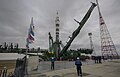 Soyuz‑2.1a prepared for Soyuz MS-26
 Soyuz‑2.1b prepared for GLONASS-K2 satellite launch
.jpg)
.jpg)


Vostochny modifications
The Soyuz-2 family received specific modifications for operation from the Vostochny Cosmodrome, aimed at improving reliability, compatibility with ground infrastructure, and safety:[20][21]
- Enhanced Durability: The rocket was modified to remain fueled on the launch pad for up to 100 hours and withstand transport over distances of up to 10,000 kilometres (6,200 mi) from the manufacturing site in Samara to the Russian Far East.
- Adaptation for Vertical Integration: Structural and piping modifications enable vertical payload integration and safely vent excess propellant outside the Mobile Service Tower, minimizing oxygen vapor buildup inside the gantry.
- Upgraded Computer: Offers six times the performance, reduced weight, and simplified wiring through multiplexing and shared data buses.[22][23][24]
- Improved Batteries: New nickel-cadmium batteries eliminate the need for a dedicated charging station.
On 1 October 2015, it was revealed that parts of the assembly complex at Vostochny had been incorrectly designed for a different rocket variant, with some structures too small to accommodate Soyuz-2. This issue cast doubt on the planned inaugural launch in December 2015.[25] The first launch successfully took place on 28 April 2016.[26]
Notable missions
Suborbital test flight
On 8 November 2004, at 18:30 UTC, the first Soyuz‑2 rocket, in the Soyuz‑2.1a configuration, was launched from the Plesetsk Cosmodrome in Russia. The rocket followed a suborbital trajectory, with the third stage and Boilerplate landing in the Pacific Ocean.
Maiden launch
The first attempt at launching a Soyuz‑2 to orbit with the MetOp-A satellite occurred on 17 July 2006. It was scrubbed two hours before the launch by an automatic sequence after the onboard computer failed to check the launch azimuth. Fuelling of the rocket was underway at the time, and all launch complex equipment and onboard preliminary checks had proceeded without incident. The rocket was left fuelled on the launch pad for the next attempt on 18 July 2006. Launch was eventually conducted on 19 October 2006.
First crewed mission
The first crewed launch of Soyuz‑2 took place on 9 April 2020, carrying Soyuz MS-16 to the ISS.
Naphthyl fuel
Following successful ground testing, a naphthyl (Russian: нафтил) fueled Soyuz‑2.1b launch took place on 22 October 2022 at Vostochny. Naphthyl is an environmentally safe hydrocarbon fuel with fewer aromatic compounds than kerosene, which also slightly improves engine performance. There are only minor differences in thermal properties, viscosity, and surface tension, so this did not require significant engine changes.[27]
Launch statistics
Since 2006, Soyuz‑2 rockets have accumulated a total of 165 launches, 160 of which were successful, yielding a 97% success rate.
For Soyuz flights for ESA/Ariannespace from French Guiana see Soyuz-ST.
Launch outcomes
- Failure
- Partial failure
- Success
- Planned
Launch sites
- Baikonur
- Plesetsk
- Vostochny
List of launches
| Launch date Time (UTC) |
Configuration | Launch site | Result | Payload | Mission type | Remarks |
|---|---|---|---|---|---|---|
| 8 November 2004 18:30 |
Soyuz‑2.1a | Plesetsk, Site 43 | Success | Zenit-8 (boilerplate) | Suborbital flight test | |
| 19 October 2006 16:28 |
Soyuz‑2.1a / Fregat | Baikonur, Site 31 | Success | MetOp-A | Weather satellite | |
| 24 December 2006 08:34 |
Soyuz‑2.1a / Fregat | Plesetsk, Site 43 | Success | Meridian 1 | Military communications satellite | |
| 27 December 2006 14:28 |
Soyuz‑2.1b / Fregat | Baikonur, Site 31 | Success | CoRoT | Astronomy satellite | |
| 26 July 2008 18:31 |
Soyuz‑2.1b | Plesetsk, Site 43 | Success[28] | Kosmos 2441 (Persona No.1) | Reconnaissance satellite | Launch was successful, but the satellite failed after a few months of operations due to an electrical fault. |
| 21 May 2009 21:53 |
Soyuz‑2.1b / Fregat | Plesetsk, Site 43 | Failure[29] | Meridian 2 | Military communications satellite | Bulging of third-stage combustion chamber led to fuel leak and automatic deactivation; satellite in unusable orbit after failed correction attempt. |
| 17 September 2009 15:55 |
Soyuz‑2.1b / Fregat | Baikonur, Site 31 | Success | Meteor-M No.1 |
Weather satellite + 6 piggyback satellites |
|
| 19 October 2010 17:11 |
Soyuz‑2.1a / Fregat‑M | Baikonur, Site 31 | Success | Globalstar-2 F1 (6 satellites) | Communications satellite | |
| 2 November 2010 00:59 |
Soyuz‑2.1a / Fregat‑M | Plesetsk, Site 43 | Success | Meridian 3 | Military communications satellite | |
| 26 February 2011 03:07 |
Soyuz‑2.1b / Fregat‑M | Plesetsk, Site 43 | Success | Kosmos 2471 (GLONASS-K 11L) | Navigation satellite | |
| 4 May 2011 17:41 |
Soyuz‑2.1a / Fregat‑M | Plesetsk, Site 43 | Success | Meridian 4 | Military communications satellite | |
| 13 July 2011 02:27 |
Soyuz‑2.1a / Fregat‑M | Baikonur, Site 31 | Success | Globalstar-2 F2 (6 satellites) | Communications satellite | |
| 2 October 2011 20:15 |
Soyuz‑2.1b / Fregat‑M | Plesetsk, Site 43 | Success | Kosmos 2474 (GLONASS-M 742) | Navigation satellite | |
| 28 November 2011 08:25 |
Soyuz‑2.1b / Fregat‑M | Plesetsk, Site 43 | Success[30] | Kosmos 2478 (GLONASS-M 746) | Navigation satellite | |
| 23 December 2011 12:08 |
Soyuz‑2.1b / Fregat‑M | Plesetsk, Site 43 | Failure[31] | Meridian 5 | Military communications satellite | Third-stage engine shut down early and exploded, sending the rocket off course; satellite not deployed. |
| 28 December 2011 17:09 |
Soyuz‑2.1a / Fregat‑M | Baikonur, Site 31 | Success[32] | Globalstar-2 F3 (6 satellites) | Communications satellite | |
| 17 September 2012 16:28 |
Soyuz‑2.1a / Fregat | Baikonur, Site 31 | Success | MetOp-B | Weather satellite | |
| 14 November 2012 11:42 |
Soyuz‑2.1a / Fregat‑M | Plesetsk, Site 43 | Success | Meridian 6 | Military communications satellite | |
| 6 February 2013 16:04:24 |
Soyuz‑2.1a / Fregat‑M | Baikonur, Site 31 | Success | Globalstar-2 F4 (6 satellites) | Communications satellite | |
| 19 April 2013 10:00:00 |
Soyuz‑2.1a | Baikonur, Site 31 | Success | Bion-M No.1 |
Biological science satellite + 5 piggyback satellites |
|
| 26 April 2013 05:23:46 |
Soyuz‑2.1b / Fregat‑M | Plesetsk, Site 43 | Success[33] | Kosmos 2485 (GLONASS-M 747) | Navigation satellite | |
| 7 June 2013 18:37:59 |
Soyuz‑2.1b | Plesetsk, Site 43 | Success[34] | Kosmos 2486 (Persona No.2) | Reconnaissance satellite | |
| 25 June 2013 17:28:48 |
Soyuz‑2.1b | Baikonur, Site 31 | Success[35] | Resurs-P No.1 | Earth observation satellite | |
| 23 March 2014 22:54:03 |
Soyuz‑2.1b / Fregat‑M | Plesetsk, Site 43 | Success[36] | Kosmos 2494 (GLONASS-M 754) | Navigation satellite | |
| 6 May 2014 13:49:35 |
Soyuz‑2.1a | Plesetsk, Site 43 | Success[37] | Kosmos 2495 (Kobalt-M) | Reconnaissance satellite | |
| 14 June 2014 17:16:48 |
Soyuz‑2.1b / Fregat‑M | Plesetsk, Site 43 | Success[38] | Kosmos 2500 (GLONASS-M 755) | Navigation satellite | |
| 8 July 2014 15:58:28 |
Soyuz‑2.1b / Fregat‑M | Baikonur, Site 31 | Success[39] | Meteor-M No.2
|
Weather satellite + 6 piggyback satellites |
|
| 18 July 2014 20:50:00 |
Soyuz‑2.1a | Baikonur, Site 31 |
Success | Foton-M No.4 | Microgravity and biology research satellite | |
| 29 October 2014 07:09:43 |
Soyuz‑2.1a | Baikonur, Site 31 | Success | Progress M-25M | ISS cargo spacecraft. This was the first time Soyuz 2.1a rocket was used for an ISS mission launch. | |
| 30 October 2014 01:42:52 |
Soyuz‑2.1a / Fregat‑M | Plesetsk, Site 43 | Success | Meridian 7 | Military communications satellite | |
| 30 November 2014 21:52:26 |
Soyuz‑2.1b / Fregat‑M | Plesetsk, Site 43 | Success | Kosmos 2501 (GLONASS-K 12L) | Navigation satellite | |
| 25 December 2014 03:01:13 |
Soyuz‑2.1b | Plesetsk, Site 43 | Success | Kosmos 2502 (Lotos-S1 No.1) | ELINT | |
| 26 December 2014 18:55:50 |
Soyuz‑2.1b | Baikonur, Site 31 | Success | Resurs-P No.2 | Earth observation satellite | |
| 27 February 2015 11:01:35 |
Soyuz‑2.1a | Plesetsk, Site 43 | Success | Kosmos 2503 (Bars-M 1L) | Reconnaissance | |
| 28 April 2015 07:09:50 |
Soyuz‑2.1a | Baikonur, Site 31 | Failure | Progress M-27M | ISS logistics | The spacecraft lost attitude control and communications after launch vibrations caused damage.[40] ISS docking was canceled,[41] and the mission was declared a total loss.[42] |
| 5 June 2015 15:23:54 |
Soyuz‑2.1a | Plesetsk, Site 43 | Success | Kosmos 2505 (Kobalt-M) | Reconnaissance | |
| 23 June 2015 16:44:00 |
Soyuz‑2.1b | Plesetsk, Site 43 | Success | Kosmos 2506 (Persona No.3) | Reconnaissance | |
| 17 November 2015 06:33:41 |
Soyuz‑2.1b | Plesetsk, Site 43 | Success | Kosmos 2510 (EKS) |
Missile early warning | |
| 21 December 2015 08:44:39 |
Soyuz‑2.1a | Baikonur, Site 31 | Success | Progress MS-01 | ISS logistics | |
| 7 February 2016 00:21:07 |
Soyuz‑2.1b / Fregat‑M | Plesetsk, Site 43 | Success | Kosmos 2514 (GLONASS-M 751) | Navigation | |
| 13 March 2016 18:56:00 |
Soyuz‑2.1b | Baikonur, Site 31 | Success | Resurs-P No.3 | Earth observation | |
| 24 March 2016 09:42 |
Soyuz‑2.1a | Plesetsk, Site 43 | Success | Kosmos 2515 (Bars-M 2L) | Reconnaissance | |
| 31 March 2016 16:23:57 |
Soyuz‑2.1a | Baikonur, Site 31 | Success | Progress MS-02 | ISS logistics | |
| 28 April 2016 02:01:21 |
Soyuz‑2.1a / Volga | Vostochny, Site 1S | Success[26] | Mikhailo Lomonosov[43]
|
Gamma-ray astronomy Technology demonstrations |
|
| 29 May 2016 08:44:37 |
Soyuz‑2.1b / Fregat‑M | Plesetsk, Site 43 | Success[45] | Kosmos 2516 (GLONASS-M 760) | Navigation | The third stage shut down early, but Fregat compensated with a longer burn, placing the satellite in the correct orbit.[46] |
| 25 May 2017 06:33 |
Soyuz‑2.1b / Fregat‑M | Plesetsk, Site 43 | Success[47] | EKS-2 | Missile early warning | |
| 14 June 2017 09:20 |
Soyuz‑2.1a | Baikonur, Site 31 | Success | Progress MS-06 | ISS logistics | |
| 14 July 2017 06:36:49 |
Soyuz‑2.1a / Fregat‑M | Baikonur, Site 31 | Partial failure | Kanopus-V-IK Many cubesats |
Earth observation Heliophysics |
At least 9 of 72 CubeSats failed, due to a Fregat-M upper stage failure.[48][49] |
| 22 September 2017 00:02:32 |
Soyuz‑2.1b / Fregat‑M | Plesetsk, Site 43 | Success | Kosmos 2522 (GLONASS-M 752) | Navigation | |
| 14 October 2017 08:46:53 |
Soyuz‑2.1a | Baikonur, Site 31 | Success | Progress MS-07 | ISS logistics | |
| 28 November 2017 05:41:46 |
Soyuz‑2.1b / Fregat‑M | Vostochny, Site 1S[50] | Failure[51] | Meteor-M No.2-1 Ionosfera Baumanets Several cubesats |
Weather Ionospheric research |
Orbital insertion burn fired while the upper stage was oriented in the wrong direction, causing it to re-enter the atmosphere. Roscosmos found 20 years earlier Baikonur coordinates had been mistakenly hardcoded into a Fregat subroutine, and the error only surfaced due to the launch from Vostochny. Critics say the explanation avoids assigning personal blame.[52] |
| 2 December 2017 10:43:26 |
Soyuz‑2.1b | Plesetsk, Site 43 | Success[53] | Kosmos 2524 (Lotos S1 No.2) | ELINT | |
| 1 February 2018 02:07:18[54] |
Soyuz‑2.1a / Fregat‑M | Vostochny, Site 1S[50] | Success[55][56] | Kanopus-V No.3, No.4 Lemur-2 74, 75, 76, 77 S-Net 1, 2, 3, 4 D-Star One v.1.1[57] |
Earth observation Technology demonstrations |
|
| 13 February 2018 08:13:33 |
Soyuz‑2.1a | Baikonur, Site 31 | Success[58] | Progress MS-08 | ISS logistics | |
| 16 June 2018 21:30 |
Soyuz‑2.1b / Fregat‑M | Plesetsk, Site 43 | Success | Kosmos 2527 (GLONASS-M 756) | Navigation | |
| 9 July 2018 21:51 |
Soyuz‑2.1a | Baikonur, Site 31 | Success[59] | Progress MS-09 | ISS logistics | |
| 25 October 2018 00:15 |
Soyuz‑2.1b | Plesetsk, Site 43 | Success[60] | Kosmos 2528 (Lotos-S1 No.3) | ELINT | |
| 3 November 2018 20:17 |
Soyuz‑2.1b / Fregat‑M | Plesetsk, Site 43 | Success[61] | Kosmos 2529 (GLONASS-M 757) | Navigation | |
| 27 December 2018 02:07 |
Soyuz‑2.1a / Fregat‑M | Vostochny, Site 1S | Success[62] | Kanopus-V No.5 and Kanopus-V No.6 Dove Flock-w × 12 |
Earth observation satellites. | |
| 21 February 2019 19:47 |
Soyuz‑2.1b / Fregat‑M | Baikonur, Site 31 | Success[63] | EgyptSat A | Earth observation | |
| 4 April 2019 11:01 |
Soyuz‑2.1a | Baikonur, Site 31 | Success[64] | Progress MS-11 | ISS logistics | |
| 27 May 2019 09:23 |
Soyuz‑2.1b / Fregat‑M | Plesetsk, Site 43 | Success[65] | GLONASS-M 758 | Navigation. | Lightning struck the rocket 14 seconds after launch without affecting its performance.[65] |
| 5 July 2019 05:41 |
Soyuz‑2.1b / Fregat‑M | Vostochny, Site 1S | Success[66] | Meteor-M No.2-2 Microsputnik | Weather | |
| 30 July 2019 05:56 |
Soyuz‑2.1a / Fregat‑M | Plesetsk, Site 43 | Success[67] | Meridian 8 | Communications | |
| 31 July 2019 12:10 |
Soyuz‑2.1a | Baikonur, Site 31 | Success[68] | Progress MS-12 | ISS logistics | |
| 22 August 2019 03:38 |
Soyuz‑2.1a | Baikonur, Site 31 | Success[69] | Soyuz MS-14 (uncrewed flight test) | ISS crew transport | |
| 26 September 2019 07:46 |
Soyuz‑2.1b / Fregat‑M | Plesetsk, Site 43 | Success[70] | Kosmos 2541 | Military reconnaissance | |
| 6 December 2019 09:34 |
Soyuz‑2.1a | Baikonur, Site 31/6 | Success | Progress MS-13 / 74P | ISS logistics | |
| 11 December 2019 | Soyuz‑2.1b / Fregat‑M | Plesetsk, Site 43/4 | Success | GLONASS-M 759 | Navigation | |
| 6 February 2020 21:42:41 |
Soyuz‑2.1b / Fregat‑M | Baikonur, Site 31/6 | Success | OneWeb-2 (34 satellites) (Baikonur flight 1)[71] |
Communications | |
| 20 February 2020 08:24:54 |
Soyuz‑2.1a / Fregat‑M | Plesetsk, Site 43/3 | Success | Meridian M-9 (19L) | Military comsat[72] | |
| 16 March 2020 18:28:00 |
Soyuz‑2.1b / Fregat‑M | Plesetsk, Site 43/3 | Success[51] | GLONASS-M No.760 (Kosmos 2545) |
Navigation | |
| 21 March 2020 17:06:58 |
Soyuz‑2.1b / Fregat‑M | Baikonur, Site 31/6 | Success[51][73] | OneWeb-3 (34 satellites) (Baikonur flight 2) |
Communications | |
| 9 April 2020 08:05:06 |
Soyuz‑2.1a | Baikonur, Site 31/6 | Success[51] | Soyuz MS-16 | ISS crew transport | |
| 25 April 2020 01:51:41 |
Soyuz‑2.1a | Baikonur, Site 31/6 | Success[74] | Progress MS-14 | ISS logistics | |
| 22 May 2020 06:45[75] |
Soyuz‑2.1b / Fregat‑M | Plesetsk, Site 43 | Success | EKS-4 (Tundra 14L)[76] | Early warning | |
| 23 July 2020 14:26:22 |
Soyuz‑2.1a | Baikonur, Site 31/6 | Success | Progress MS-15 | ISS logistics | |
| 28 September 2020 11:20:00 |
Soyuz‑2.1b / Fregat‑M | Plesetsk, Site 43/4 | Success | Gonets-M (17/18/19) GEN-1 (Antilles and Amidala) (Canada), Lemur-2 (4) (United States), MeznSat (United Arab Emirates), SALSAT (Germany), NetSat-1 to 4 (Germany), ICEYE-X6 and X7 (Finland), LacunaSat-3 (Lithuania), Yarilo-1 and 2 (Russia), Norbi (Russia) and Dekart (Descartes) (Russia)[77] |
Communications | |
| 14 October 2020 05:45:04[78] |
Soyuz‑2.1a | Baikonur, Site 31/6 | Success | Soyuz MS-17 | ISS crew transport | |
| 25 October 2020 19:08:42[79] |
Soyuz‑2.1b / Fregat‑M | Plesetsk, Site 43/4 | Success | Kosmos 2547 (GLONASS-K 15L) | Navigation | |
| 3 December 2020 01:14[80] |
Soyuz‑2.1b / Fregat | Plesetsk, Site 43/3 | Success | Gonets-M 20/21/22 ERA-1 (Kosmos-2548) (nanosatellite) |
Communication Technology – Russian Ministry of Defense |
|
| 18 December 2020 12:26:26[81] |
Soyuz‑2.1b / Fregat | Vostochny, Site 1S | Success | OneWeb-4 (36 satellites) (Vostochny flight 1) |
Communications | |
| 2 February 2021 20:45:28[82] |
Soyuz‑2.1b | Plesetsk, Site 43/4 | Success | Kosmos 2549 (Lotos-S1 No.4) | ELINT | |
| 15 February 2021 04:45:05[83] |
Soyuz‑2.1a | Baikonur, Site 31/6 | Success | Progress MS-16 | ISS logistics | |
| 28 February 2021 06:55:01[84] |
Soyuz‑2.1b / Fregat‑M | Baikonur, Site 31/6 | Success | Arktika-M No.1 | Weather satellite | |
| 22 March 2021 06:07:12[85] |
Soyuz‑2.1a / Fregat‑M | Baikonur, Site 31/6 | Success | CAS500-1 A cluster of secondary commercial payloads (+37 satellites). |
Earth observation | |
| 25 March 2021 02:47:33[86] |
Soyuz‑2.1b / Fregat | Vostochny, Site 1S | Success | OneWeb-5 (36 satellites) (Vostochny flight 2) |
Communications | |
| 9 April 2021 07:42:40[87] |
Soyuz‑2.1a | Baikonur, Site 31/6 | Success | Soyuz MS-18 | ISS crew transport | |
| 25 April 2021 22:14:08[88] |
Soyuz‑2.1b / Fregat | Vostochny, Site 1S | Success | OneWeb-6 (36 satellites) (Vostochny flight 3) |
Communications | |
| 28 May 2021 17:38:39[89] |
Soyuz‑2.1b / Fregat | Vostochny, Site 1S | Success | OneWeb-7 (36 satellites) (Vostochny flight 4) |
Communications | |
| 25 June 2021 19:50:00[90] |
Soyuz‑2.1b | Plesetsk, Site 43/4 | Success | Kosmos 2550 (Pion-NKS No.1) | SIGINT | |
| 29 June 2021 23:27:20[91] |
Soyuz‑2.1a | Baikonur, Site 31/6 | Success | Progress MS-17 | ISS logistics | |
| 1 July 2021 12:48:33[92] |
Soyuz‑2.1b / Fregat | Vostochny, Site 1S | Success | OneWeb-8 (36 satellites) (Vostochny flight 5) |
Communications | |
| 21 August 2021 22:13:40[93] |
Soyuz‑2.1b / Fregat | Baikonur, Site 31/6 | Success | OneWeb-9 (34 satellites) (Baikonur flight 3) |
Communications | |
| 14 September 2021 18:07:19[94] |
Soyuz‑2.1b / Fregat | Baikonur, Site 31/6 | Success | OneWeb-10 (34 satellites) (Baikonur flight 4) |
Communications | |
| 5 October 2021 08:55:02[95] |
Soyuz‑2.1a | Baikonur, Site 31/6 | Success | Soyuz MS-19 | ISS crew transport | |
| 14 October 2021 09:40:10[96] |
Soyuz‑2.1b / Fregat | Vostochny, Site 1S | Success | OneWeb (36 satellites) (Vostochny flight 6) |
Communications | |
| 28 October 2021 00:00:32[97] |
Soyuz‑2.1a | Baikonur, Site 31/6 | Success | Progress MS-18 | ISS logistics | |
| 24 November 2021 13:06:35[98] |
Soyuz‑2.1b | Baikonur, Site 31/6 | Success | Prichal | ISS assembly | |
| 25 November 2021 01:09:13[99] |
Soyuz‑2.1b / Fregat | Plesetsk, Site 43/4 | Success | Kosmos 2552 (EKS-5, Tundra 15L) | Early warning | |
| 8 December 2021 07:38:15[100] |
Soyuz‑2.1a | Baikonur, Site 31/6 | Success | Soyuz MS-20 | ISS crew transport and space tourism | |
| 27 December 2021 13:10:37[101] |
Soyuz‑2.1b / Fregat | Baikonur, Site 31/6 | Success | OneWeb (36 satellites) (Baikonur flight 5) |
Communications | |
| 5 February 2022 07:00:00[102] |
Soyuz‑2.1a / Fregat | Plesetsk, Site 43/4 | Success | Kosmos 2553 | Military | |
| 15 February 2022 04:25:39[103] |
Soyuz‑2.1a | Baikonur, Site 31/6 | Success | Progress MS-19 | ISS logistics | |
| 18 March 2022 15:55:18[104] |
Soyuz‑2.1a | Baikonur, Site 31/6 | Success | Soyuz MS-21 | ISS crew transport | |
| 22 March 2022 12:48:22[105] |
Soyuz‑2.1a / Fregat | Plesetsk, Site 43/4 | Success | Meridian-M 10 (20L) | Military communications | |
| 7 April 2022 11:20:18[106] |
Soyuz‑2.1b | Plesetsk, Site 43/3 | Success | Kosmos 2554 (Lotos-S1 No.5) | ELINT | |
| 19 May 2022 08:03:32[107] |
Soyuz‑2.1a | Plesetsk, Site 43/4 | Success | Kosmos 2556 (Bars-M 3L) | Reconnaissance | |
| 3 June 2022 09:32:16[108] |
Soyuz‑2.1a | Baikonur, Site 31/6 | Success | Progress MS-20 | ISS logistics | |
| 7 July 2022 09:18:06[109] |
Soyuz‑2.1b / Fregat‑M | Plesetsk, Site 43/4 | Success | Kosmos 2557 (GLONASS-K 16L) | Navigation | |
| 9 August 2022 05:52:38[110] |
Soyuz‑2.1b / Fregat‑M | Baikonur, Site 31/6 | Success | Khayyam 16 rideshare cubesats |
Earth observation | |
| 21 September 2022 13:54:49[111] |
Soyuz‑2.1a | Baikonur, Site 31/6 | Success | Soyuz MS-22 | ISS crew transport | |
| 10 October 2022 02:52:32[112] |
Soyuz‑2.1b / Fregat‑M | Plesetsk, Site 43/3 | Success | Kosmos 2559 (GLONASS-K 17L) | Navigation | |
| 22 October 2022 19:57:09[113] |
Soyuz‑2.1b / Fregat‑M | Vostochny, Site 1S | Success | Gonets-M 23/24/25 (33L/34L/35L), Skif-D | Communications | |
| 26 October 2022 00:20:09[114] |
Soyuz‑2.1a | Baikonur Site 31/6 | Success | Progress MS-21 | ISS logistics | |
| 2 November 2022 06:47:48[115] |
Soyuz‑2.1b / Fregat‑M | Plesetsk, Site 43/4 | Success | Kosmos 2563 (EKS-6, Tundra 16L) | Early warning | |
| 28 November 2022 15:13:50[116] |
Soyuz‑2.1b / Fregat‑M | Plesetsk, Site 43/3 | Success | Kosmos 2564 (GLONASS-M 761) | Navigation | |
| 30 November 2022 21:10:25[117] |
Soyuz‑2.1b | Plesetsk, Site 43/4 | Success | Kosmos 2565 (Lotos-S1 No.6) Kosmos 2566 |
ELINT | |
| 9 February 2023 06:15:36[118] |
Soyuz‑2.1a | Baikonur, Site 31/6 | Success | Progress MS-22 | ISS logistics | |
| 24 February 2023 00:24:29[119] |
Soyuz‑2.1a | Baikonur, Site 31/6 | Success | Soyuz MS-23 | ISS crew transport | |
| 23 March 2023 06:40:11[120] |
Soyuz‑2.1a | Plesetsk, Site 43/3 | Success | Kosmos 2567 (Bars-M 4L) | Reconnaissance | |
| 24 May 2023 12:56:07[121] | Soyuz‑2.1a | Baikonur, Site 31/6 | Success | Progress MS-23 | ISS logistics | |
| 26 May 2023 21:14:51[122] | Soyuz‑2.1a / Fregat‑M | Vostochny, Site 1S | Success | Kondor-FKA No.1 | Reconnaissance | |
| 27 June 2023 11:34:49[123] | Soyuz‑2.1b / Fregat‑M | Vostochny, Site 1S | Success | Meteor-M No.2-3 42 rideshare satellites |
Weather Various uses |
|
| 7 August 2023 13:19:25[124] | Soyuz‑2.1b / Fregat‑M | Plesetsk, Site 43/3 | Success | Kosmos 2569 (GLONASS-K2 13L) | Navigation | |
| 10 August 2023 23:10:57[125] | Soyuz‑2.1b / Fregat‑M | Vostochny, Site 1S | Success | Luna 25 (Luna-Glob lander) | Lunar exploration | |
| 23 August 2023 01:08:10[126] | Soyuz‑2.1a | Baikonur, Site 31/6 | Success | Progress MS-24 | ISS logistics | |
| 15 September 2023 15:44:35[127] | Soyuz‑2.1a | Baikonur, Site 31/6 | Success | Soyuz MS-24 | ISS crew transport | |
| 27 October 2023 06:04:43[128] | Soyuz‑2.1b | Plesetsk, Site 43/3 | Success | Kosmos 2570 (Lotos-S1 No.7) Kosmos 2571 |
ELINT | |
| 25 November 2023 20:58:06[129] | Soyuz‑2.1b | Plesetsk, Site 43/4 | Success | Kosmos 2572 (Razdan 1) | Reconnaissance | |
| 1 December 2023 09:25:11[130] | Soyuz‑2.1a | Baikonur, Site 31/6 | Success | Progress MS-25 | ISS logistics | |
| 16 December 2023 09:17:48[131] | Soyuz‑2.1b / Fregat‑M | Baikonur, Site 31/6 | Success | Arktika-M No.2 | Meteorology | |
| 21 December 2023 08:48:39[132] | Soyuz‑2.1b | Plesetsk, Site 43/4 | Success | Kosmos 2573 (Bars-M 5L) | Reconnaissance | |
| 15 February 2024 03:25:05[133] | Soyuz‑2.1a | Baikonur, Site 31/6 | Success | Progress MS-26 | ISS logistics | |
| 29 February 2024 05:43:26[134] | Soyuz‑2.1b / Fregat‑M | Vostochny, Site 1S | Success | Meteor-M No.2-4 18 rideshare satellites |
Weather Various uses |
|
| 23 March 2024 12:36:10[135] | Soyuz‑2.1a | Baikonur, Site 31/6 | Success | Soyuz MS-25 | ISS crew transport | |
| 31 March 2024 09:36:45[136] | Soyuz‑2.1b | Baikonur, Site 31/6 | Success | Resurs-P No.4 | Earth observation | |
| 16 May 2024 21:21:29[137] | Soyuz‑2.1b / Fregat‑M | Plesetsk, Site 43/4 | Success | Kosmos 2576 (Nivelir-L No.4) 9 rideshare satellites |
Reconnaissance Various uses |
|
| 30 May 2024 09:42:59[138] | Soyuz‑2.1a | Baikonur, Site 31/6 | Success | Progress MS-27 | ISS logistics | |
| 15 August 2024 03:20:18[139] | Soyuz‑2.1a | Baikonur, Site 31/6 | Success | Progress MS-28 | ISS logistics | |
| 11 September 2024 16:23:12[140] | Soyuz‑2.1a | Baikonur, Site 31/6 | Success | Soyuz MS-26 | ISS crew transport | |
| 31 October 2024 07:51:31[141] | Soyuz‑2.1a | Plesetsk, Site 43/4 | Success | Kosmos 2579 (Bars-M 6L) | Reconnaissance | |
| 4 November 2024 23:18:40[142] | Soyuz‑2.1b / Fregat‑M | Vostochny, Site 1S | Success | Ionosfera-M No.1 Ionosfera-M No.2 53 rideshare satellites |
Ionospheric research Various uses |
|
| 21 November 2024 12:22:23[143] | Soyuz‑2.1a | Baikonur, Site 31/6 | Success | Progress MS-29 | ISS logistics | |
| 29 November 2024 21:50:25[144] | Soyuz‑2.1a / Fregat‑M | Vostochny, Site 1S | Success | Kondor-FKA No.2 | Reconnaissance | |
| 4 December 2024 18:03:13[145] | Soyuz‑2.1b | Plesetsk, Site 43/4 | Success | Kosmos 2580 (Lotos-S1 No.8) | ELINT | |
| 25 December 2024 07:45:42[146] | Soyuz‑2.1b | Baikonur, Site 31/6 | Success | Resurs-P No.5 | Earth observation | 2,000th R-7 family rocket launched.[147] |
| 27 February 2025 21:24:27[148] | Soyuz‑2.1a | Baikonur, Site 31/6 | Success | Progress MS-30 | ISS logistics | |
| 2 March 2025 22:22:16[149] | Soyuz‑2.1b / Fregat‑M | Plesetsk, Site 43/3 | Success | Kosmos 2584 (GLONASS-K2 No. 14L (K2 No.2)) |
Navigation | |
| 8 April 2025 05:47:15[150] | Soyuz‑2.1a | Baikonur, Site 31/6 | Success | Soyuz MS-27 | ISS crew transport | |
| 23 May 2025 08:36[151] | Soyuz‑2.1b / Fregat‑M | Plesetsk, Site 43/4 | Success | Kosmos 2588 (Unknown Payload) | ? | |
| 3 July 2025 19:32:40[152] | Soyuz‑2.1a | Baikonur, Site 31/6 | Success | Progress MS-31 | ISS logistics | |
| 25 July 2025 05:54:04[153] | Soyuz‑2.1b / Fregat‑M | Vostochny, Site 1S | Success | Ionosfera-M No.3 Ionosfera-M No.4 18 rideshare satellites |
Ionospheric research Various uses |
|
| 20 August 2025 17:13:10[154] | Soyuz‑2.1b | Baikonur, Site 31/6 | Success | Bion-M No.2 | Biological science | |
| 11 September 2025 15:54:06[155] | Soyuz‑2.1a | Baikonur, Site 31/6 | Success | Progress MS-32 | ISS logistics | |
| 13 September 2025 02:10:00[156] | Soyuz‑2.1b / Fregat‑M | Plesetsk, Site 43/3 | Success | Kosmos 2595 (GLONASS-K No. 18L) Kosmos 2596 (Mozhayets-6) |
Navigation & Small experimental satellite | |
| 27 November 2025 09:27:57[157] | Soyuz‑2.1a | Baikonur, Site 31/6 | Success | Soyuz MS-28 | ISS crew transport | pad structure damaged during launch |
| 25 December 2025 14:11[158] | Soyuz‑2.1a | Plesetsk, Site 43/4 | Success | Obzor-R No.1 | Earth observation | |
| 28 December 2025 13:18:05[159] | Soyuz‑2.1b / Fregat‑M | Vostochny, Site 1S | Success | Aist-2T No.1 Aist-2T No.2 50 rideshares |
Earth observation Various uses |
|
| 5 February 2026 18:59[160] | Soyuz‑2.1b / Fregat‑M | Plesetsk, Site 43/4 | Success | Kosmos 2600 to Kosmos 2608 | 9 Military payloads | |
| 22 March 2026 11:59:51[161] | Soyuz‑2.1a | Baikonur, Site 31/6 | Success | Progress MS-33 | ISS logistics | |
| 23 March 2026 17:24[162] | Soyuz‑2.1b | Plesetsk, Site 43/4 | Success | 16 × Rassvet-3 | Internet constellation | First batch of Rassvet-3 satellites for the Byuro-1440 internet constellation. |
| 3 April 2026 06:28[163] | Soyuz‑2.1a / Fregat | Plesetsk, Site 43/3 | Success | Meridian-M 11 (21L) | Military communications | |
| 16 April 2026 23:18[164] | Soyuz‑2.1b / Volga | Plesetsk, Site 43/4 | Success | kosmos satellites | Multiple Military payloads | This is the second time the Soyuz has used the Volga upper stage, the first time was in 2016 with the launch of Vostochny. |
| 25 April 2026 22:21:47[165] | Soyuz‑2.1a | Baikonur, Site 31/6 | Success | Progress MS-34 | ISS logistics |
Planned launches
See also

Notes
- This is a transliteration of the second through fifth letters of the Cyrillic alphabet (Б, В, Г, Д). A sense-for-sense translation would correspond to the second through fifth letters of the Latin alphabet, 'Block B, C, D & E'.
- This is a transliteration of the tenth letter of the Cyrillic alphabet (И), which also carries the numerical value 10 in Cyrillic numerals. A sense-for-sense translation would use a Roman numeral, 'Block X'.

