St. Alban's Bay Culvert
From Wikipedia, the free encyclopedia
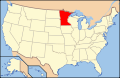
 US 169 800 feet (240 m) north of Crow Wing County Highway 26, Garrison Township, Minnesota
St. Alban's Bay Culvert at Mille Lacs Lake | |
 The St. Alban's Bay Culvert from the southeast | |
   | |
| Location | US 169 800 feet (240 m) north of Crow Wing County Highway 26, Garrison Township, Minnesota |
|---|---|
| Coordinates | 46°16′28.5″N 93°49′19″W / 46.274583°N 93.82194°W |
| Area | Less than one acre |
| Built | 1938–9 |
| Built by | Civilian Conservation Corps, Minnesota Department of Highways |
| Architect | Howard O. Skooglun (architect), Harold E. Olson (engineer), Arthur R. Nichols (landscape architect) |
| Architectural style | National Park Service rustic |
| MPS | Federal Relief Construction in Minnesota, 1933-1941 |
| NRHP reference No. | 15000788[1] |
| Designated | November 16, 2015 |
The St. Alban's Bay Culvert is a historic bridge in Garrison Township, Minnesota, United States. It carries the four-lane U.S. Route 169 (US 169) over the head of a stream flowing out of Mille Lacs Lake. It was built from 1938 to 1939 as part of a major New Deal project to create a scenic parkway along the lakeshore. The bridge was listed on the National Register of Historic Places in 2015 as the St. Alban's Bay Culvert at Mille Lacs Lake for having state-level significance in the themes of architecture and politics/government. It was nominated for being a well-preserved example of the Minnesota Highway Department's earliest scenic improvements, its rare status as a highway bridge built by the department's Roadside Development Division—a unit usually focused on overlooks and waysides—and for its fine National Park Service rustic design.[2]
The St. Alban's Bay Culvert is functionally a concrete box culvert. However it has 40-foot-long (12 m) headwalls faced with random ashlar of local granite. This facing is about 9 inches (23 cm) thick, disguising a core of mortared lake boulders. The walls rise 2 feet 9 inches (84 cm) over the height of the roadbed to form a low railing. At either end of the bridge, 9-foot (2.7 m) panels of a second layer of masonry add visual interest. The culvert opening, often obscured by high water, is surmounted by a 6-foot (1.8 m) elliptical arch.[2]
The bridge measures 72 feet 6 inches (22.10 m) wide from outside to outside, with a 66-foot (20 m) roadbed. Repaving over the years has buried the original 9-inch (23 cm) stone curbs.[2]