Church of St. Athanasius of Mouzaki
Church in Kastoria, Greece
From Wikipedia, the free encyclopedia
St. Athanasius of Mouzaki (Greek: Άγιος Αθανάσιος του Μουζάκη) is a Greek Orthodox church located in Kastoria, Greece.[1][2] It was built in 1383–1384 by the brothers Teodor II Muzaka and Stoya Muzaka of the house of Muzaka, a noble Albanian family that controlled the city at the time, and it is dedicated to St. Athanasius.[1][2] It is considered one of the most important monuments of 14th century Kastoria and is the last church built in Kastoria before its annexation by the Ottoman Empire.[2]

| Church of Saint Athanasius of Mouzaki | |
|---|---|
Ναός του Αγίου Αθανασίου του Μουζάκη Shën Thanasi i Muzakajve | |
Church of St. Athanasius of Mouzaki in 2010 | |
| Religion | |
| Affiliation | Eastern Orthodox |
| Leadership | Greek Orthodox Church |
| Location | |
| Location | Kastoria, Greece |
 Interactive map of Church of Saint Athanasius of Mouzaki | |
| Coordinates | 40.5152°N 21.2672°E |
| Architecture | |
| Type | Church |
| Style | Byzantine architecture |
| Founder | Teodor II Muzaka and Stoya Muzaka |
| Completed | 1384 |
Decorations
The church is decorated with scenes of saints dressed in Byzantine clothing, a typical feature of Byzantine iconography. The frescoes are remarkable for depicting for the first time in Byzantine iconography, Jesus Christ and the Virgin Mary in imperial costume.[3] The depiction of Virgin Mary as a queen is an atypical feature for the Byzantine iconography.[4] Another unusual feature of the church is that, despite the fact that St. Alexander is traditionally not included among the ranks of military saints,[5] the church of St Athanasius of Mouzaki is decorated with a portrait of St. Alexander and St. Mercurios in military clothing. Within the church is also a fresco of Saint George who is painted rather strange and particularly odd in the Byzantine-styled art. He is wearing a mantle and a cloak that has a double-headed eagle with a star in the middle, similar to the one that the Byzantine emperor John V Palaiologos rewarded to Andrea II Muzaka from his victory over Vukašin of Serbia. This could possibly imply that during the Middle Ages, Andrea was viewed as a great warrior of God by the Albanian people.[6]
Legacy
The church influenced greatly the artistic production of Kastoria and Western Macedonia in the late 14th and early 15th century.[7][clarification needed]
Gallery
 Front view of the Church
 Side view of the Church
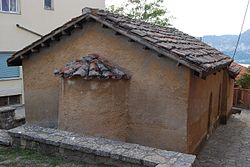 Back view of the Church
 The Founders Inscription with the names of the founders Stoya Muzaka and Teodor II Muzaka
 Icons on the wall
 Depiction of Andrea II Muzaka in the church. His coat of arms, awarded by the Byzantine emperor, can be seen on the fresco.
 Frescoes of Saints Theodore Tiron and Theodore Stratelates
 Fresco of the Raising of Lazarus
 A scene from the church depicting the Dormition of the Mother of God
 Depiction of Jesus in royal Byzantine robes; part of the Deesis. Next to him is his mother Mary wearing similar robing, John the Baptist, and two noblemen; one of them thought to be Andrea II Muzaka.


.webp)


