Since  and
and  are linearly independent it follows that the Wronskian
 ![{\displaystyle \displaystyle W[u,v]}](https://wikimedia.org/api/rest_v1/media/math/render/svg/c820fef1589a33bce2242cc08ad974ea7c2477bd) must satisfy
must satisfy \equiv W(x)\neq 0}](https://wikimedia.org/api/rest_v1/media/math/render/svg/d501ffc610f7df8afc109ef7cae821b2b0200f07) for all
for all  where the differential equation is defined, say
  . Without loss of generality, suppose that
  . Then
 So at
So at 
 and either
  and
and  are both positive or both negative. Without loss of generality, suppose that they are both positive. Now, at
 and since and are successive zeros of
  it causes
  . Thus, to keep
  we must have
  . We see this by observing that if
 ![{\displaystyle \displaystyle u'(x)>0{\mbox{ }}\forall {\mbox{ }}x\in \left(x_{0},x_{1}\right]}](https://wikimedia.org/api/rest_v1/media/math/render/svg/74c839ac14b57926dbead5506cdaec6d1c2e93ff) then would be increasing (away from the -axis), which would never lead to a zero at . So for a zero to occur at at most
then would be increasing (away from the -axis), which would never lead to a zero at . So for a zero to occur at at most  (i.e.,
  and it turns out, by our result from the Wronskian that ). So somewhere in the interval
  the sign of
  changed. By the Intermediate Value Theorem there exists
 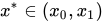 such that
  .
.
On the other hand, there can be only one zero in , because otherwise  would have two zeros and there would be no zeros of
  in between, and it was just proved that this is impossible.

