Subexponential distribution (light-tailed)
Type of light-tailed probability distribution
From Wikipedia, the free encyclopedia
In probability theory, in the context of light-tailed distributions, one definition of a subexponential distribution is as a probability distribution whose tails decay at an exponential rate, or faster: a real-valued distribution is called subexponential if, for a random variable ,


- , for large and some constant .



Note that this is almost the opposite of the more established meaning of subexponential in the context of Heavy-tailed distributions, where "sub" means that the rate of decay is slower than exponential, rather than that the tail is lighter than exponential.
The subexponential norm, , of a random variable is defined by

- where the infimum is taken to be if no such exists.



This is an example of a Orlicz norm. An equivalent condition for a distribution to be subexponential is then that [1]: §2.7
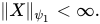
Subexponentiality can also be expressed in the following equivalent ways:[1]: §2.7
- for all and some constant .
- for all and some constant .
- For some constant , for all .
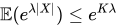
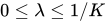
- exists and for some constant , for all .
- is sub-Gaussian.