Sylvester's triangle problem
From Wikipedia, the free encyclopedia

Sylvester's theorem or Sylvester's formula describes a particular interpretation of the sum of three pairwise distinct vectors of equal length in the context of triangle geometry. It is also referred to as Sylvester's (triangle) problem in literature, when it is given as a problem rather than a theorem. The theorem is named after the British mathematician James Joseph Sylvester.
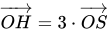
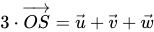
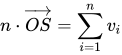
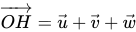
Consider three pairwise distinct vectors of equal length , and each of them acting on the same point thus creating the points , and . Those points form the triangle with as the center of its circumcircle. Now let denote the orthocenter of the triangle, then connection vector is equal to the sum of the three vectors:[1][2]


Furthermore, since the points and are located on the Euler line together with the centroid the following equation holds:[3]