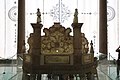
Marble Throne
Throne in Tehran, Iran
From Wikipedia, the free encyclopedia
History
The throne was commissioned by Fath-Ali Shah Qajar in 1805 (1221 AH). It was designed by Mirza Baba Shirazi (Naqqash Bashi) and royal stonecutter, Mohammad Ebrahim Esfahani. It consists of 65 marble stone pieces from a mine in Yazd. The throne's supports are carved in the shape of men, women, fairies, and demons.

In his book, "The History of Buildings in the Royal Citadel of Tehran", Yahya Zoka describes the construction of this Takht:
"As it was impossible to carry Tavus and Naderi Takhts, this Takht was made, modeled after Solomon the Prophet’s Takht who was the king of the Jews and was in possession of great power. [Thus], as Fat′h-Ali Shah was compared to him as for his wealth and power, this throne was named Solomon’s Takht after the original throne of Solomon which is said to have been carried in the sky and flown by genies and fairies, and would land to the wish of Solomon. After the throne was put in terrace, the terrace was given the name Takht-e Marmar''.[1]
Gallery
 Drawing by Eugène Flandin, 1840
 Mozaffar ad-Din Shah Qajar on the Marble Throne
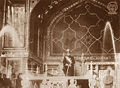 Ahmad Shah Qajar on the Marble Throne, 1919
 Reza Shah, the founder of the Pahlavi dynasty, on the Marble Throne, 1925