Talk:Atomic clock/Archive 1
From Wikipedia, the free encyclopedia
 | This is an archive of past discussions about Atomic clock. Do not edit the contents of this page. If you wish to start a new discussion or revive an old one, please do so on the current talk page. |
| Archive 1 |
Chip scale atomic clock accuracy
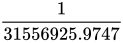
While the accuracy of the chip scale atomic clock is mentioned here, it is not mentioned precisely. The referenced commercially available chip scale atomic clock is off by a second every 634.19583967529 years [Microsemi 1].
This differs substantially from the FOCS 1 clock of Switzerland, which is out by 1 second every 30 millions years .
I suggest that the accuracy of the chip scale atomic clock be listed in either Allan deviation or the time taken for it to be out by a second.
Whole Oats 7:16 am, 1 November 2019 (UTC)
Discussion
"The most accurate time scales are moderated by precise astronomical measurements and the insertion or removal of leap seconds. " seems to be wrong since TAI is just as accurate as anything else, in fact, you could argue that it's more "accurate" than UTC since you can use a precise TAI time in the future and know how long from now that is. With UTC you can't.
How did they set the first atomic clock? Did they use astronomical measurements or some other source?
--haavis 12:15, 5 Nov 2004 (UTC)
A: Using astronomical measurements. Does the last paragraph in caesium standard explain it well enough?
--tdunc 8:29,10 May 2007
"When the electrons are attracted back closer by the opposite charge of the nucleus, the electrons wiggle before they settle down in their new location. This moving charge causes the light, which is a wave of alternating electricity and magnetism."
This explaination is unacceptable. The author either needs to elaborate or change it all together, why the electron jumps to a lower level. I have reason to believe it is not because of attraction due to charge (which would be constant), rather the electron emits a photon thus lowering its energy level, which could by coincidence mimick charge attraction but I dont feel its the same concept. If so it needs to work both ways, we cant for instance say a repeling charge is responsible for an electron going into a higher energy level. What is with the word "wiggle" anyway?
- I have fixed the article to avoid this issue. The explanation is simply quantum mechanics. Chapter 9 of Griffith's undergraduate QM textbook has a cogent derivation. Amcfreely 07:01, 16 May 2006 (UTC)
There is also a transit delay of approximately 1 ms for every 300 kilometers (186 mi) the receiver is from the transmitter. When operating properly and when correctly synchronized, better brands of radio clocks are normally accurate to the second.
Don't you mean millisecond instead of second ? 1 ms for every 300 kilometers means you must be 300,000 (300 x 1000) kilometers from the source to cause a 1 second delay, since the circumference of the earth is ~40,000 km, this does not make much sense.
Radioactivity?
How radioactive are small atomic clocks? Is it safe to make handheld devices with them?
- A small atomic clock is about as radioactive as any other similarly-sized piece of electronics: that is, slightly less radioactive than the average brick. --Carnildo 09:33, 10 May 2006 (UTC)
atomic clocks are not based on radioactivity or decay but on electromagnetic wave frequencies, and the materials used (such as cesium 133) are stable, otherwise the clock wouldn't work well.81.206.145.191 21:43, 13 May 2007 (UTC)
- Right. Atomic clocks are based on the same effect that MRI medical imaging uses. The atomic nucleus in a magnetic field, can transition between spin states (called hyperfine transitions), and gives off microwave radiation. It's got nothing to do with nuclear radation from radiactivity. DonPMitchell (talk) 02:38, 11 August 2009 (UTC)
Cesium-133 is a stable isotope and is not dangerous in a radioactive sense. Rubidium-85 is also a stable isotope, where as Rubidium-87 is vaguely radioactive, decaying with beta-radiation (electron) with half-life of 4.88E10 years, which isn't directly lively. For all practical uses it is safe. Being alkali metals, they would be seriously bad if in contact with skin or water for that matter. Maybe a small text should state what needs to be said: "atomic clocks does not use radioactivity as a mechanism for measurement of time". It is a common misconception and clearly pointing this fact out should be helpful. Cfmd (talk) 00:43, 24 January 2011 (UTC)
Synchronization
How are Atomic clocks synchronized across the world, or are they not? Do they have to be in the same place to be synchronized off each other sort of thing? Even then how do they set them with such prescison accuracy? —The preceding unsigned comment was added by 90.192.138.193 (talk) 21:02, 22 December 2006 (UTC).
they can be synched to each other 1: over a symmetric latency connection (such as radio waves), or 2: by using GPS as a reference. a location can tell how it's time compares to GPS, or a single GPS satellite, say 50 nanoseconds ahead. then another place can use that information.81.206.145.191 21:43, 13 May 2007 (UTC)
Or you can pop a portable atomic clock with a battery backup on a plane. Jim77742 01:25, 20 June 2007 (UTC)
Using airplanes would be unpractical, because Einstein learned us that clocks run slower the faster their speed and the higher their altitude (or the lesser the gravitational field). See and for explanation and experiment with cesium clocks at moderate altitude. Jaho 00:16, 5 July 2007 (UTC)
An answer to the synchronization issue can be found on http://tycho.usno.navy.mil/twstt.html. Jaho 00:29, 5 July 2007 (UTC)
While the clocks may not need to be synchronized, they are often coordinated to roughly have the same time. Use of GPS, GLONASS and TWSTT for such synchronisation is being used. Caesium beam clocks is then usually allowed to count freely and unsteered and then GPS, GLONASS and TWSTT is used for comparison between clocks not being local to each other. Such comparison forms the base of the EAL, TAI and UTC time as being maintained by BIPM. For clocks with not requirement to be part of the BIPM network, they are usually synchronised once and for all using a GPS receiver and then set alone for itself. Many telecom applications does not require the network clock to even have Time of Day but only to give a very stable 2,048 MHz clock to the network. Cfmd (talk) 00:50, 24 January 2011 (UTC)
Mercury Atomic Clock Keeps Time with Record Accuracy
www.nist.gov/public_affairs/releases/mercury_atomic_clock.htm —The preceding unsigned comment was added by 218.102.23.117 (talk) 14:30, 8 January 2007 (UTC).
Radio clocks
"Atomic clocks" for less than $50: This marketing term "atomic clock" refers to a radio controlled device receiving a time signal from one or more transceivers connected to real atomic clocks. Examples at: koolatrononline(dot)stores(dot)yahoo(dot)net/hummer-multi-bank-automatic-clock(dot)html www(dot)ehow(dot)com/how_2099664_buy-atomic-clock(dot)html —Preceding unsigned comment added by 131.130.249.17 (talk) 09:07, 16 February 2010 (UTC)
Ytterbium atomic clocks
Someone should add something to this article about the new ytterbium atomic clocks under development. I don't know a lot about them, and, if no one else does it, may end up doing it myself after I read into it more, but if not, at least a mention should be added. —Preceding unsigned comment added by 99.249.74.84 (talk) 21:27, 15 December 2010 (UTC)
Maser
The following passage from this article:
“The first atomic clock was an ammonia maser device built in 1949 at the U.S. National Bureau of Standards (NBS, now NIST).”
seems to conflict with the passage from the “maser” article:
“Theoretically, the principle of the maser was described by Nikolay Basov and Alexander Prokhorov from Lebedev Institute of Physics at an All-Union Conference on Radio-Spectroscopy held by USSR Academy of Sciences in May 1952. They subsequently published their results in October 1954. Independently, Charles H. Townes, J. P. Gordon, and H. J. Zeiger built the first maser at Columbia University in 1953.”
Some explanation to harmonize the dates in these two passages would be helpful. Psalm 119:105 (talk) 09:58, 17 January 2011 (UTC)
Applications
Atomic clocks can also be used as sensors for gravitational and magnetic fields. See: http://www.wired.com/science/discoveries/news/2007/12/time_nist?currentPage=2 72.221.84.128 (talk) 14:56, 11 January 2012 (UTC)
Lord Kelvin reference
The statement that Kelvin proposed a clock based on atomic transitions seems a bit misleading. He proposed using the known distinct spectral frequencies of atoms, but wasn't he about 30 years too early to know about atomic transitions? — Preceding unsigned comment added by 173.206.4.23 (talk) 03:41, 1 November 2012 (UTC)
I noticed that as well. I thought the sentence went beyond misleading to just wrong. --Davefoc (talk) 08:30, 29 April 2015 (UTC)
- In my opinion, this statement about Lord Kelvin looks like a hoax. The reference is completely off topic, the given page of Treatise on Natural Philosophy is about the mechanical oscillation of cords. --Pasum (talk) 16:06, 19 December 2017 (UTC)
Assessment
Accuracy vs precision
A number of places in the article include references such as "accurate to one second". These should actually read "precise to one second". Accuracy refers to the central tendency of a measurement, whereas precision refers to the possible range of deviation. — Preceding unsigned comment added by 108.68.83.101 (talk) 03:00, 22 October 2013 (UTC)
- Please cite a source for your statements about the meaning of accuracy vs. precision. In common use among engineers, accuracy is often thought of as the difference between a measurement and the true value (if the true value can be ascertained) while precision is the repeatability of a measurement with a given measuring instrument. Jc3s5h (talk) 14:29, 22 October 2013 (UTC)
NIST's mercury ion clock
So, if that's the standard by which new clock technology is measured, why do we hear no more of it? Jim.henderson (talk) 21:08, 2 January 2015 (UTC)
Diagrams
 | It is requested that one or more physics diagrams be included in this article to improve its quality. Specific illustrations, plots, or diagrams can be requested at the Graphics Lab. For more information, refer to discussion on this page and/or the listing at Wikipedia:Requested images. |
The section Physics package realisations needs several diagrams added to improve clarity. RJFJR (talk) 13:59, 22 October 2015 (UTC)
Nuclear clock
Hi, nuclear clock redirects here while there is not mention of it within this article. Could someone says few words about it within this article or create another article for this kind of clock? Pamputt (talk) 16:56, 19 August 2016 (UTC)
- I replaced the redirect with a stub article. — Edgar.bonet (talk) 11:16, 22 August 2016 (UTC)
"According to sources"?
@Francis Flinch: Thanks for checking my edits, when you removed the uncertainties from the frequency table in this edit with the edit comment "according to sources", I don't quite understand.
The uncertainties were all taken from the cited sources. For example, the rubidium uncertainty was taken from the cited source, converted by a simple WP:CALCulation from a relative uncertainty of ±3×10⁻¹⁵ to an absolute uncertainty of 6834682610.904324(20).
Just re-checking in case I made a mistake: 87Sr has a frequency of 429228004229873.4 Hz with a relative uncertainty of ±1×10⁻¹⁵, which is 0.43 Hz, so 429228004229873.4(4) is correct. (Unless you'd prefer 429228004229873.40(43), but I think that's excessive precision.)
And the hydrogen maser citation (available at http://cyber.sci-hub.ac/MTAuMTA4OC8wMDI2LTEzOTQvOS8zLzAwNA==/essen1973.pdf if you'd like to check) already says 1420405751.7662±0.003 Hz.
I thought the uncertainties were an informative contrast to the exact-by-definition caesium value, but I can see how someone could disagree. You might find them unhelpful or distracting for various reasons, but "according to sources" confuses me. Could you clarify? 71.41.210.146 (talk) 17:02, 5 September 2016 (UTC)
- I think it is a good idea to simply state the recommended value of the frequency in the sources without complicating things with uncertainties. Maybe the involved uncertainties can be mentioned with some extra explanation for the casual reader.--Francis Flinch (talk) 18:13, 5 September 2016 (UTC)
Attosecond as unit of precision
I think the unit "attosecond" is dubious in this passage:
In the future this might lead to redefine the caesium microwave based SI second and other new dissemination techniques to transfer clock signals will be required that can be used in both shorter-range and longer-range (frequency) comparisons between attosecond (sub-1 × 10⁻¹⁷ s) accurate clocks without significantly compromising their performance.
The passage seems to call for a unit of relative precision (10−17 to 1), not a unit of time. Can User:Francis Flinch supply a quote from one of the cited sources to justify this unit? Jc3s5h (talk) 18:16, 14 November 2016 (UTC)
- This is obviously wrong. Using units of time for measuring clock accuracy can only make sense in that part of the sigma-tau plot where the slope is −1, i.e. where the accuracy is limited by jitter/phase noise. The quoted fractional accuracies refer to the bottom of that plot, where the slope is zero.
- The fractional accuracies can be converted to time accuracies by multiplying by the averaging time (σt ≈ σyτ, to within some multiplicative factor). If the averaging time was just one second, then a fractional accuracy of 10−17 could be more or less equivalent to 10 attoseconds. But it seems to me that the accuracies achieved are always for averaging times far longer than one second. For example, Fig. 1 of the first ref (PRL 97, 020801), shows a slope −1/2 from 101 to 105 s, with σyτ no less than 10−11 s. The third reference (Nature Physics) says “The record for stability is now held by an optical lattice clock based on ytterbium atoms, which recently demonstrated fractional frequency instability of 1.6 parts in 10^18 for an averaging time of 7 hours”. That puts σyτ ≈ 4×10⁻¹⁴ s. There is also this article in arXiv demonstrating “accuracy (6x10^{-18}) better than a single ion-based clock, with vastly reduced averaging times (3000 s).” which implies σyτ ≈ 1.8×10⁻¹⁴ s. While all those numbers are really impressive, we are in the tens of femtoseconds range, nowhere near the attosecond.
- — Edgar.bonet (talk) 21:30, 14 November 2016 (UTC)
- Good point, changed text accordingly.--Francis Flinch (talk) 12:26, 15 November 2016 (UTC)
- But then, what does “comparisons between sub microwave accurate clocks” mean? Is “sub microwave” a synonym of “optical”? If so, why not use “optical” instead? — Edgar.bonet (talk) 15:39, 15 November 2016 (UTC)
- I hope "better" is a good enough generalization. Tough research groups work on improving optical clocks, we actually can just speculate on what technology future better clocks will be based. A practical improvement of TAI will require a network of many of those better clocks.--Francis Flinch (talk) 16:17, 15 November 2016 (UTC)
External links modified
Hello fellow Wikipedians,
I have just modified 5 external links on Atomic clock. Please take a moment to review my edit. If you have any questions, or need the bot to ignore the links, or the page altogether, please visit this simple FaQ for additional information. I made the following changes:
- Corrected formatting/usage for http://www.symmetricom.com/media/files/downloads/product-datasheets/DS_SA%2045s_CSAC.pdf
- Corrected formatting/usage for http://www.franklinclock.com/faq.htm
- Corrected formatting/usage for http://www.allanstime.com/Publications/DWA/Science_Timekeeping/TheScienceOfTimekeeping.pdf
- Added archive https://web.archive.org/web/20130408111458/https://gps.afspc.af.mil/gps/archive/2012/nanus/2012034.nnu to https://gps.afspc.af.mil/gps/archive/2012/nanus/2012034.nnu
- Added archive https://web.archive.org/web/20130627155632/http://archive.nrc-cnrc.gc.ca/eng/projects/inms/optical-comb.html to http://archive.nrc-cnrc.gc.ca/eng/projects/inms/optical-comb.html
When you have finished reviewing my changes, you may follow the instructions on the template below to fix any issues with the URLs.
This message was posted before February 2018. After February 2018, "External links modified" talk page sections are no longer generated or monitored by InternetArchiveBot. No special action is required regarding these talk page notices, other than regular verification using the archive tool instructions below. Editors have permission to delete these "External links modified" talk page sections if they want to de-clutter talk pages, but see the RfC before doing mass systematic removals. This message is updated dynamically through the template {{source check}} (last update: 5 June 2024).
- If you have discovered URLs which were erroneously considered dead by the bot, you can report them with this tool.
- If you found an error with any archives or the URLs themselves, you can fix them with this tool.
Cheers.—InternetArchiveBot (Report bug) 12:55, 11 July 2017 (UTC)


 ...
...