Talk:Insect/Archive 1
From Wikipedia, the free encyclopedia
2002
2003
>> Insects do not breathe <<
They do, according to a research conducted earlier this year: http://www.anl.gov/OPA/news03/news030124.htm --172.177.6.244 13:56, 30 Nov 2003 (UTC)
- New link Meggar 01:58, 10 June 2007 (UTC)
2004
How are we going to make a page, list of insects, when there are at least 1 million named species...? ugen64 01:07, Feb 15, 2004 (UTC)
CSIRO entomology is a very good resource for the characterisitcs and life cycle of the insect families--nixie 13:22, 13 Oct 2004 (UTC)
It does not have to be a list of species; I have a book which lists all the families of insects. Other animal lists, such as the list of amphibians, display the classification to subfamily level. Also, a list of species would be very difficult to update. After all, new species of insects (and other arthropods) are constantly being discovered.--Crustaceanguy 13:43, 14 March 2007 (UTC)
Examples
I'd like to see examples of types of insects mentions. For example a few examples of the ocean insects alludes to and such. I read some of those lines and really wanted to know more. I think a few examples would help complete the article further. --Sketchee 02:14, Dec 4, 2004 (UTC)
2005
Triplehorn and Johnson call hexapoda a class and insecta a taxon (superorder?), including all insects, except for collembola, diplura and protura. What do you think about this? Matthias5 23:59, 11 Feb 2005 (UTC)
Arthropod classification varies a lot from one author to the next, but class Hexapoda usually appears in the context of a subphylum Uniramia, a group that molecular trees have called into question. Is there any compelling reason not to stick with the ranks presently listed? Josh
Familes redirecting to species...
It seems in my efforts to add individual species, I come across a bunch of examples of cases where a family is a redirect to a common name. I'm trying to figure out if I'm just being a whack job about this, or if others agree it's a bad idea. Examples include : Papilionidae and Blattodea as a few. It seems to me that anything above species should not redirect to a single common name that is a species. The reason this makes it more difficult for me is that if I want to put in a species that is below that, I have to go and destroy the redirect, copy taxoboxes and figure it all out to put in a single species...and when I have several it's frustrating. As an example, Mantodea used to redirect to Praying mantis, so that when I wanted to put in the Chinese mantis I had to break out Mantodea as well as Mantidae (oh, and for the record, I think this needs to be cleaned up). For those of you who actually understand this stuff it might be obvious, but it's a struggle for me every time. (Things I want to put in as examples are some butterflies: siproeta stelenes, dryas julia, heliconius charitonius, and junonia coenia that I have good images of.) I want to make sure I have consensus, and hopefully there can be a consensus about ripping these out. Wikibofh 04:26, 20 Jun 2005 (UTC)
Bristletails separate...
I think that Bristletails, silverfish, etc should be in a single group in the taxobox. It was recently broken back out. My source (the Firefly cited in sources) indicates that they are in the Subclass although different orders. It's published in 2002 thus is more recent than the link provided in the breakout. The authors of this section are George C. McGavin, Hopen Entomological Collections at the Oxford University Museum of Natural History, UK and Darren Mann of the same place. Without a more authoritative source, my intent is to collapse it back. Comments? Wikibofh 18:48, August 2, 2005 (UTC)
- Ok I don't get it. They currently are listed as separate orders (Microcoryphia & Thysanura) under the subclass Apterygota. That concurs with your source. Also, what do you propose to merge them into? Microcoryphia as a suborder of Thysanura? The link I used to back up the claim of different orders has a date of 2001. One year is not enough to make the difference there, so it appears there truly is a naming conflict. Is there some more authoritative source that can be called upon? - Taxman Talk 20:01, August 2, 2005 (UTC)
- Book is in my car. Had to make that last post from a public access. I'll post when I get home them problem...because I don't remember right now. :) Wikibofh 20:09, August 2, 2005 (UTC)
- Ok, here is the deal. I show the Subclass Apterygota with only two orders, Archaeognatha (Bristletails) and Thysanura (Silverfish, Firebrats and others., thus, no separate Microcoryphia. There is also the following comment:
- At one time three other orders were included, the proturans, the two-pronged bristletails or Diplura and the springtails or Collembola. However these groups lack the projecting mouth parts that today are taken to characterize insects, and so are now given separate status within the superclass Hexapoda.
- There is no mention of Microcoryphia. So, what do we think? Wikibofh 23:48, August 2, 2005 (UTC)
- Ok, well adding Mycrocoryphia was a mistake, since it is just another name for the Archaeognatha, and even the website I first found it on had that, I just overlooked it. But even the article Thysanura you put together refers to the Mycrocoryphia as being separated out. Anyway, it seems there is not really much agreement on taxonomy at all as reading from Linnaean taxonomy and our Wikipedia:WikiProject Tree of Life. I guess the best that can be done is be flexible and point out where different sources disagree on the taxonomy. - Taxman Talk 18:05, August 3, 2005 (UTC)
- Great...I saw you pull it out. Thanks for taking a look. I think taxonomic differences are a fundamental problem, not just here but in the scientific world. I think I even read something saying that they don't think DNA is going to sort it out. I think just going with one and noting the differences is our best bet, just like you. Thanks again. Wikibofh 19:20, August 3, 2005 (UTC)
- Ok, well adding Mycrocoryphia was a mistake, since it is just another name for the Archaeognatha, and even the website I first found it on had that, I just overlooked it. But even the article Thysanura you put together refers to the Mycrocoryphia as being separated out. Anyway, it seems there is not really much agreement on taxonomy at all as reading from Linnaean taxonomy and our Wikipedia:WikiProject Tree of Life. I guess the best that can be done is be flexible and point out where different sources disagree on the taxonomy. - Taxman Talk 18:05, August 3, 2005 (UTC)
Apterygota are a paraphyletic group. Since those are controversial in many circles, I think it would be better to use an alternate system, if we can find one that's reasonably standard. For instance, Systema Naturae lists the following:
- Subclass and order Archaeognatha
- Subclass Dicondylia
- Infraclass Thysanura
- Infraclass Pterygota
- Division Ephemeroptera
- Division Odonata
- Division Neoptera
I don't really like how many levels it uses, but it has the advantage of matching the phylogeny - see for instance TOL, and I'd recommend we use something similar. ITIS treats the Pterygota as a separate subclass from the Dicondylia, and that used to be listed on this page, but I suspect it's misusing the term Dicondylia. Josh
- Will you please stop this...you're hurting my head! :) (I'm kidding). Why is Apterygota paraphyletic? What doesn't it include? I think what we should try to do is come up with some reasonable modern alternative (and what you show might be that...I need to wrap my head around these) and then make sure we document it somewhere. If we decided we like it better, we'll document our old one and swap them out. Thanks for helping out. Wikibofh 13:57, August 4, 2005 (UTC)
- Well yes, that system agrees between tree of life and Systema Naturae, but I don't know if either is considered especially standard. They both appear to try to stay up to date with peer reviewed literature which sounds good, but I don't know to what extent they actually do. I also don't understand what you mean by Apterygota being paraphyletic. What doesn't it contain that it should? Do you mean the Protura and Diplura, which aren't now considered insects? I see some sources do list those as being in Apterygota. - Taxman Talk 15:12, August 4, 2005 (UTC)
The tree of life is actually fairly conservative, and I think it gives the generally accepted phylogeny, although you can find sources that place the Monura elsewhere. In that case, the Apterygota are paraphyletic because some members (Thysanura) are closer to the Pterygota than they are to the others (Archaeognatha). I don't know what, if any, common system reflects this; if there is none, we might also consider leaving out subclasses for the basal orders, the same way infraclasses are left out for the lower Pterygota. Josh
But size does matter :)
I think it still applies:
- " ... North american Feather-winged Beetle Nanosella fungi at 0.25mm is a serious contender for the title of smallest insect in the world... Megaphragma caribea from Guadeloupe, measuring out at a huge 0.17 mm long, is now probably the smallest known insect in the world."
- "Worlds Smallest Insect..... The "feather-winged" beetles and the "battledore-wing fairy flies" are smaller than some species of protozoa (single cell creatures)."
Wikibofh 20:56, August 3, 2005 (UTC)
- Cool. Wana write a stub on the thingy and update the article to reflect that information? Assuming that is a reliable source, I don't really know. One I pulled up agreed, but also doesn't seem authoritative. It does however refer to some other extreme insects, such as a 22 inch walking stick specimen! - Taxman Talk 22:04, August 3, 2005 (UTC)
- Ok, I'll see what I can stub out...will be a day or two. :) Wikibofh 22:47, August 3, 2005 (UTC)
BugGuide.net
The sole developer and owner of BugGuide.net is no longer able to maintain the website. This site has focused on North American insects and spiders, and contains thousands of photographs, as well as documentation on thousands of species and other taxonomic levels. It occurred to me that Wikipedia might be a good place to save some of that content. There are probably too many photos, and there are licensing issues to photos and content, but maybe it's possible to retain that content somewhere here.
I'm only a casual Wikipedia user and I'm not sure what the consensus is on the biological content of Wikipedia. Are people trying to record insects down to the species level, or is that considered too complex?
--Boone 00:24, August 18, 2005 (UTC)
- I think it would be fantastic if someone could try to arrange to capture that information. Wikibofh 01:21, August 18, 2005 (UTC)
- Yup, it would be great, and we could use a lot of that content, but licensing would be the big issue. We can't really bend on that, but if you'd like to contact him to see if he would be willing to license what he can under the GFDL for the text and GFDL or suitable creative commons for the images then that would be great. - Taxman Talk 02:56, August 18, 2005 (UTC)
- It appears the BugGuide has found a new home for now, so there's no need to rescue the content. I'm going to lobby for a more open license over there, and perhaps we can share some data in the future. Thanks for your feedback. --Boone 17:56, August 19, 2005 (UTC)
Help with identification
Does anybody know what kind of bug this is? And for bonus points, what kind of flower is this? If you know, please leave a message on my discussion page, because I'll probably forget to check back here.PiccoloNamek 05:49, 6 October 2005 (UTC)

- It's probably a kind of wasp. To identify it usually helps to tell where you took it, continent, state, etc. For the plant it can help to tell what habitat it is, such as forest, wetland, grassy field, etc. What I do to figure these out where I live is to go to a library or bookstore and grab a copy of the Audubon Society's field guide to North American insects, and look through those. They have pictures and identification guidelines. If no one happens to answer here, you can try the Science reference desk as some of us identify a lot of bugs there, but the field guide is a pretty good bet. - Taxman Talk 12:03, 7 October 2005 (UTC)
- It's a syrphid fly. You'll have to tell me what kind of flower; it's completely unfamiliar to me. Pollinator 05:30, 1 January 2006 (UTC)
Abdomen problem
This article is one of many bug-related pages that link to Abdomen, which is about human abdomens. We desperately need a page about insect/spider abdomens, with a disambig. I thought one of the people who watch Insect might be willing to write such an article (at least a stub to start). Thanks. Chick Bowen 05:02, 2 November 2005 (UTC)
Query on Harris citation: entomophagy
I would be most grateful for any information regarding the claim, attributed to Marvin Harris, that the taboo against entomophagy is based on the "fact" that larger food-animals require less labor than insects. I doubt that this is true; for the moment I'd love to know where Harris' claim can be found. Slow learner. 4:48p.m. 16 January 2006.
Bipedal insects
Ever heard about an insect that moves around on just two legs? They don't exactly walk, instead they skate on the water surface using only two legs:
"Marine midges in the Genus Pontomyia are perhaps the only insects that skate on two legs. Unlike most chironomids that are adapted for flying, Pontomia males are skate on the surface of the ocean while searching for females. Their wings are very reduced. Females remain larva-like, have extremely reduced or no legs, and never develop wings. Adult Pontomyia have no functional mouth parts and do not feed. They die shortly after mating or egg-laying and are one of the shortest lived insects known. Larvae feed on detritus and algae. After 4 instars, they pupate and emerge as adults. The adults live only a few hours and do not feed." http://www.unk.edu/acad/biology/hoback/marineinsects/pontomia.htm
- Incredible! I always thought there were no marine insects... What an extraordinary thing. Thanks for the link. --IronChris 18:35, 8 April 2006 (UTC)
how on earth do i get info on a praying mantice?
- Go to praying mantis. RexNL 22:40, 30 January 2006 (UTC)
Do insects have mucus?
It's a rather silly question but it's been bothering me for a while, after I saw David Firth's "Spoilsbury Toastboy -2." Citizen Premier 00:42, 3 February 2006 (UTC)
- You mean saliva? Yes, at least some do. Diptera, including mosquitoes, have salivary glands. This is how malaria is transmitted. I suspect many other insects will also have them. Some more "basal" creatures have them as well, e.g. ticks. - Samsara contrib talk 19:09, 18 February 2006 (UTC)
Good article status
This article was self-nominated for good article status. I think the article is very close, but as the nominator (Samsara) mentioned, there are no footnotes. I'd like to see footnotes or in-line citations before awarding good article status. Lbbzman 03:58, 12 February 2006 (UTC)
Attraction to light
There's a nice picture of flies attracted to light but no explanation - something which would be useful to the article. I'm assuming this helps them find their way out of holes or which way is up, but would like to see a proper scientific explanation. BigBlueFish 16:21, 20 February 2006 (UTC)
Time to get some formatting done
The main hindrence at the moment, is the "Classes & Orders" section of the taxobox. With the articles I have worked on, if it was large, it became its own section within the article. At the moment, it forces the images to the left, and looks very bad as there is litle room for the text, and the text is staggered. Texts looks much better if it is always aligned on the left.
Secondly, I think we should do as we did with the frog article, and create a well captioned gallery of quality photos. As insects are obviously more diverse, we wouldn't have much room for repeats. So we should only include images from each "group", e.g. one of a matid, one of a fly etc. It may also be hard to properly identify the insects, so I don't know how we will go with that. What do you all think? --liquidGhoul 07:56, 21 February 2006 (UTC)
- The article already features images of the Orthoptera (grasshopper), Diptera (fly), Mantodea (mantis), Hymenoptera (bee) and Lepidoptera (butterfly). I therefore particularly suggest for inclusion in the template:
- Coleoptera (beetle)
- Hemiptera (true bug)
- Phasmatodea (walking stick)
- Isoptera (termite)
- Blattodea (cockroach)
- Plecoptera (stonefly)
- Dermaptera (earwig)
- Odonata (damselflies and dragonflies)
- Ephemeroptera (mayflies)
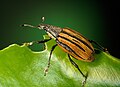 Adult citrus root weevil (Diaprepes abbreviatus)
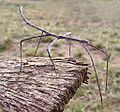 A stick insect (Ctenomorpha chronus)
 Water strider (Gerris najas)
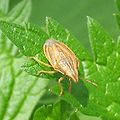 Bishop's mitre shield bug (Aelia acuminata)
 Beautiful Demoiselle (Calopteryx virgo)
 Common Earwig (Forficula auricularia)
 Cathedral termite mound
 A juvenile Patanga japonica
 A flower fly, Episyrphus balteatus
 Red Mason Bee (Osmia rufa)
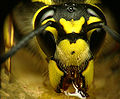 Wasp, drinking
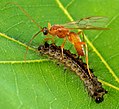 Aleiodes indiscretus parasitising a gypsy moth (Lymantria dispar) larva
 Ant
Ant Scarce swallowtail (Iphiclides podalirius)
 Giant Leopard Moth (Ecpantheria scribonia)
 Rosy Maple Moth (Dryocampa rubicunda)


.jpg)
.jpg)


If we can eliminate one more picture, we can put it in. - Samsara contrib talk 04:30, 1 March 2006 (UTC)
- How about Image:Haft.jpg, it seems very similar to the bug paristising the catarpillar, and is a lot lower quality and less interesting than it. I know there are two moths, but they are both such brilliant photos, I can't see either of them go! --liquidGhoul 04:35, 1 March 2006 (UTC)
If you cannot identify a species, ask at Wikipedia talk:WikiProject Tree of Life. They can sometimes come up with an answer. --liquidGhoul 11:20, 1 March 2006 (UTC)
Larvae gallery
WikiProject Insects?
Hello everyone. Is there a WikiProject about insects, or at least Arthropods? I couldn't find one in the list of WikiProjects... If there isn't one I think it should be created, and I will assist anyone who would decide to do so, or give it a try myself. Thanks, --IronChris 20:41, 8 April 2006 (UTC)
I have created the WikiProject Arthropods. Please visit the Project page and tell me what you think. And of course feel free to join! --IronChris 17:07, 12 April 2006 (UTC)
Viviparous
The page on insects state that some are viviaprous in reproduction. I am not an expert and do not know if this is true, but the link associated viviparous that leads to its definition does not metion insects as vaviparous. It is obvious that one of these pages needs to be edited by either adding insects as an example for viviparous or removing the information stating insects are viviparous.
Do insects feel pain?
I came to this article looking to see if insects feel pain.. If possible, someone please add it.
That's a tough question... certainly they are aware of damage to their body; you can see an insect scurrying away hurridly after it looses a leg or such. But pain may be a complex feeling that requires a more developed mind to experience. As far as I know, insects operate on a combination of stimulus-response and instinct, which would suggest that the sensation of pain would be meaningless to them. I assume that humans feel pain because we are capable of making decisions. If we have to, we can charge through a fire in order to escape a burning building. A roach could do no such thing, because the moment it knew it was damaged it would run in the opposite direction, because it is just operating on instinct.
All of this is just hypothesis, of course. Regardless, I think it's still wrong to squish a bug for no reason. Citizen Premier 04:32, 12 June 2006 (UTC)
what are groups...
what are groups of caterpillars called?
Pliny quote
The quote from Pliny the Elder seems out of place (and POV, though there isn't a lot of controversy around insects). Anyway, I'm removing it. Mo-Al 22:12, 23 June 2006 (UTC)
- I like it actually; it's just a poetic way of saying "There are more insects than there are vertebrates". Eluchil404 00:53, 24 June 2006 (UTC)
Two total species of insect?
"Estimates of the total number of current species, including those not yet known to science, range from two to thirty million, with most authorities favoring a figure midway between these extremes." Who seriously suggests there are only two total species of insects? Unless there are objections I'm going to remove that. --Nscheffey(T/C) 21:12, 28 July 2006 (UTC)
- Noone, it says a range of two million to thirty million. This is the shorter way of saying that, but it is obviously ambiguous. If you can write it in a way which in unambiguous, that would be good. --liquidGhoul 23:09, 28 July 2006 (UTC)
New External Link added
Added Livescience.com's insect page - page contains information from a number of studies, but also has user-submitted insect imagery (ants, butterflies, spiders, etc.) Starexplorer 20:46, 31 July 2006 (UTC)
Reproduction
there oughta be a section on insect reprduction. Bandgeek100 15:51, 1 August 2006 (UTC)
Locomotion
- Cockroaches are amongst the fastest insect runners and at full speed actually adopt a bipedal run to reach a velocity that, in proportion to their body size. As Cockroaches move extremely rapidly, they need recording at several hundred frames per second to reveal their gait. More sedate locomotion is also studied by scientists in stick insects Phasmatodea.
I think this part of the article needs to be copyedited. I'd do it myself, but I don't understand everything the paragraph seems to be saying. --Kjoonlee 19:02, 29 August 2006 (UTC)
Before reading this talk page I tidied up the sentence. Another editor had removed a statement that if cockroaches were the size of humans they would travel at 200mph, as they considered it unencyclopaedic. This left the sentence with an "orphaned" ending. Britmax 13:53, 2 September 2006 (UTC)
What are they
In the past week or so these large mosquito looking insects have been all over our neiborhood.I would like to know what they are?
- We really need a bit more than that to go on, don't you think? Location, appearance, size, or ideally a picture. Large insects that look more or less like mosquitos but are not might be craneflies, mayflies, midges, dixid midges, fungus gnats, dance flies, or wood gnats (Anisopodidae). See this page for pictures. - Nunh-huh 02:47, 18 September 2006 (UTC)
Primary photograph -- honey bee
Why is the headline photo for a topic as major as Insect so terrible? It's low resolution, grainy, terrible color and contrast, and only shows a top-down view of the insect. There are dozens of better photos on this very page, and several excellent honeybee photos in the bee article, if we want to maintain consistency.
Any objections to summarily replacing it with a better photo? Severnjc 22:09, 6 October 2006 (UTC)
- Not form me. Be bold! Eluchil404 23:27, 6 October 2006 (UTC)
- Duly noted and changed. In the interests of disclosure, I used one of my own photos -- if someone would like to replace it with a better one, that's fine by me. Severnjc 02:17, 7 October 2006 (UTC)
- Very nice picture. Actually as I think about it, given the numbver and diversity of insects it actually might make sense to use a montage in the taxbox (cf. Animal). Just a thought for others though, my image editing skills are rather limited. Eluchil404 21:59, 7 October 2006 (UTC)
Neural Map
If I wanted to post some info on the brain structure of certain insects (say a honey bee), where would it be most appropriate to do so? should I put it on the main site (honey bee), or should I make a new page for it? Paskari 13:56, 5 December 2006 (UTC)
Helpful Website
Here is an extremely helpful website with information on various living things:
http://www.ucmp.berkeley.edu/help/taxaform.htmlDarkArcher 03:14, 16 April 2007 (UTC)
Wikiquote
We should have a Wikiquote page on insects to go with the quotations section. There are so many out there. One of my favorites is "to a good approximation all species are insects" (Robert May). I don't even have an account there myself, but someone who works on this article might like to. Richard001 03:31, 14 October 2007 (UTC)
- Note:I've created such a page (q:Insect), but it needs a lot of work before it will be worth linking to from here. Richard001 (talk) 02:02, 2 February 2008 (UTC)
Unlikely
- Insects (Class Insecta) are a major group of arthropods and the most diverse group of animals on the Earth, with over a million described species—more than double the number of all other living organisms combined.[1]
This is the first sentence of the article, and I consider the numbers to be doubtful. Firstly, the source only seems to take multicellular organisms into account. Secondly, the article on Biodiversity states that estimates of the present global macroscopic species diversity vary from 2 million to 100 million species, with a best estimate of somewhere near 10 million. Even if the figure of two million were correct, the insects would only make up half the species. Burschik (talk) 12:59, 10 December 2007 (UTC)
- "Species" in unicellular organisms are defined using different criteria; if the same criteria were applied to multicellular organisms, the number of "species" would be multipled by several orders of magnitude. Second, that estimate of 2-100 million already assumes that 99% of the taxa are arthropods - in other words, if there are 100 million species on earth, then about 95 million are insects. There are indeed estimates of insect diversity in that range. In fact, all this points out is that someone needs to make that clear in the biodiversity article. Dyanega (talk) 17:53, 10 December 2007 (UTC)
- The numbers still don't add up. The new source referenced claims there are 751.000 thousand insect species, slightly more than half the number of known species (52%), whereas the first sentence of the article claims that the insects account for at least 66% of all species. There seems to be no consensus about the total number of species, and there seems to be no consensus how many of them are insects. Burschik (talk) 10:35, 11 December 2007 (UTC)
- 751K is an absurdly low figure (apparently that website uses figures from nearly a decade ago) - most numbers for described insects range between 950K - 1.3M, and even the most conservative of these put insects as comprising over 50% of the total described species. Maybe we should just go with a less ambitious phrasing to accommodate the lower value, and then add a clause regarding the estimated diversity. Dyanega (talk) 21:17, 11 December 2007 (UTC)
Mention the blood of the insects
Unlike other species, have glucose in their blood replaced by disaccaridhe called "trehalosis". ("Biokemiaa", Leena Turpeenoja 1999). It should be mentioned since it is also an explanation for seemingly endless stamina of insects and it is also wondrous detail in its own good. :) —Preceding unsigned comment added by 80.222.238.141 (talk) 08:10, 16 December 2007 (UTC)
A very unusual insect whose article could use expansion
I recently heard about Afrocimex constrictus. There was no article about it here so I created it. But it could use expansion from an expert. Grundle2600 (talk) 05:49, 4 January 2008 (UTC)
Latest "oldest flying insect" finding
The blurb about the latest oldest insect fossil discovery is not factually correct. The fossil is a trace fossil (sometimes known as an ichnofossil), which in this case is a full body impression made when the insect landed on a muddy substrate. That must be made clear in the blurb because there are fossils of flying insects older than this--even body parts (but mostly wings). However, this new find gives us insight into the whole body of what appears to have been a mayfly (ephemeropteran) relative. It is the oldest trace fossil of a flying insect. Oh, and it's about 310 my old, not 300. Westphalian B-C in the Pennsylvanian. Check other references to make sure, like the boston globe article.Istras (talk) 13:42, 22 October 2008 (UTC)
Care of young section
Perhaps this should be changed to "Care of offspring" because ants and termites care for their young and are not mentioned being as that most of the time the young they care for are not their offspring but their siblings. I think the point of the section is to talk about energy expended by adults to their offspring (nuptial gifts).--FUNKAMATIC ~talk 15:10, 10 March 2009 (UTC)
Notoptera
I have replaced Grylloblattodea and Mantophasmatodea sence they have been lowered to suborder, and are now under the order Notoptera. Bugboy52.4 | =-= 19:51, 8 July 2009 (UTC)
On e "see also" link-
The link to Satoyama doesn't seem entirely relevant to me. Maybe it's because the article doesn't do a good job of explaining it, but the only connection I can see is that satoyamas contain a lot of biodiversity. By this definition we could also include Amazon. What's the connection, or should the link be removed? A little insignificant talk to me! (please!) 14:56, 17 September 2009 (UTC)
Reproduction section
After reading the section on "reproduction" I think it should be renamed to "development". What the heck is going on? Who decided to write it that way?--FUNKAMATIC ~talk 17:27, 7 October 2009 (UTC)
- It talks about both. Bugboy52.4 | =-= 00:55, 19 October 2009 (UTC)
A few suggestions
You might find ideas, sources and images from a couple of articles I've worked on:
- Arthropod includes: how to distinguish tracheata (which includes insects) from opther arthropds (see also Arthropod head problem); exoskeleton; molting; phylogeny.
- Evolutionary history of life includes: almost all modern insects fly or are descended from fliers (in exchange I might "borrow" your item that insects may have been obscure before they got wings); more on social insects; pollinating insects seem to powered the very rapid rise of flowering plants. --Philcha (talk) 12:14, 23 October 2009 (UTC)
Re the points in the message to me, I might be less able to help than I thought, as my invertebrate zoology textbook gives only 27 pages on hexapods (which includes e.g. springtails as well as insects). Insects are too complex and diverse for 27 pages to give more thana general overview. So trying Google Books:
- In "Sound production and hearing" you have decent coverage of production and detecting ground vibrations, but nothing I can see on detection of sounds in air (? or water). Google Books came up with:
- The insects: an outline of entomology (2005), pp. 87-93 looks good, lots of mechanisms and examples.
 Done. Good call, BTW. Cliff smith talk 20:36, 7 November 2009 (UTC)
- Orientation and communication in arthropods (): bees hear sounds and can be trained to respond (pp. 279-281); leaf-cutter ants call colleagues to helk in cutting (p. 284); some stingless bees use sounds to help define the location of food sources (pp. 284); the dwarf bee Apis floreaappears to hear, tho the mechanism and purpose are uncertain; other examples in following pages; fair on examples,weak on mechanisms
- Sound source localization (2005): tympanum 1 of the 2 basic type of "ears" in insects, wide range of taxa that use this (pp. 7-9), get direction by operating in pairs; the other is "whiskers" (antennae, hairs, cerci), which seems to have intrinsic directionality (pp. 9-10)
- The acoustic sense of animals (1983): overview of mechanisms (p. 13); hairlike receptors (pp. 14-16), with exampes of mechanisms, capabilities and uses; tympanum type "ears" (pp. 19-20), with diagram of anatomy of tympanum and auditory nerve; moth detecting a bat may be able to give a 3-D map of the bat's location (pp.20-23); insect hearing systems usually simple and single-function, and emphasise fast response at the expnse of rich information (p. 26)
- Life's solution: inevitable humans in a lonely universe (): "sonar" in aquatic insects (p. 191)
- The insects: an outline of entomology (2005), pp. 87-93 looks good, lots of mechanisms and examples.
- Chemical senses - my search
- The insects: structure and function (1998) looks good for wide range (chemical types, uses, types of insect, etc.) if you can ignore all the chemistry formulae (pp. 704-735)
- The insects: an outline of entomology (2005) is noted for sound above. It also looks good for chemical senses and communication, but I hit my reading limit. If two of you check it, one looking for the "sounds" link snd the other for the "chemical" link, I think you'd avoid limits. --Philcha (talk) 21:14, 24 October 2009 (UTC)


I notice the reviewer had to fix a type in a citation. I recommend refTools, see link and instructions at User:Philcha#Tools. refTools provides a form into which you enter or (better!) paste the values, then refTools takes cares of the syntax. --Philcha (talk) 07:04, 26 October 2009 (UTC)
- Congratulations, I've enjoyed reading the article.
- Could you please check "Some insects may retain phenotypes and genotypes that are normally only seen in juveniles" in Insect#Reproduction_and_development. It suggests that the genotype changes between juvenile and adult. --Philcha (talk) 07:52, 14 November 2009 (UTC)
Classification sections & Taxonomy
- Moved from User_talk:Emw
Where does the classification section belong, near the top or near the bottom, and should it be called classification or taxonomy? One more thing, where should the subdivisions be, in the taxobox or in the classification/taxonomy section? Bugboy52.4 | =-= 03:27, 17 November 2009 (UTC)
- It's close, but I think 'Taxonomy' is a better heading for the section in question. Of the several high-level taxa FAs I know of -- Archaea, Bacteria, Fungus and Virus (perhaps the last one isn't a proper taxon, but close enough) -- I think Fungus conveys its Taxonomy/Classification-devoted section the best by a significant margin. Given that, I think that article would be the best to model Insect's newly-renamed 'Taxonomy' section on: use a paragraph structure rather than bullet points, make a sort of mini-lead within the section to give a high-level overview, and then in a 'Taxonomic groups' subsection devote a few sentences to a paragraph describing each order. I'm neither an entomologist nor a mycologist so perhaps I'm missing some factor that makes Fungus's 'Taxonomy' section an unsuitable template for Insect's 'Taxonomy' section, but at first glance doing so seems like a good idea.
- The relative position of the section seems fine as it is. Good point regarding placement of subdivision information. I think listing out the different orders of class Insecta would be appropriate for a taxobox in the lead, similar to how Bacteria lists phyla of that domain. Emw (talk) 05:48, 17 November 2009 (UTC)
Insect hormone
- Note to self: Add info on insect hormone and its job in molting and metamorphosis. 22:29, 7 December 2009 (UTC)
- ??? That statement implies that there is only one insect hormone, I'm confused. Did you mean to say: "...insect hormones and their job in molting and metamorphosis." and perhaps you should add " and pretty much every other physiological process."--FUNKAMATIC ~talk 16:50, 11 December 2009 (UTC)
- It looks like a quick note someone made to themselves. If it doesn't give a complete and comprehensive description of the task, I don't think it's a big deal. :) A little insignificant Giving thanks to all that is me 18:37, 11 December 2009 (UTC)
- Sorry it was just a reminder to myself for latter... Bugboy52.4 ¦ =-= 21:06, 11 December 2009 (UTC)
bees/wasps
can there be a wasp with a bees stripes —Preceding unsigned comment added by 71.60.110.49 (talk) 13:36, 27 July 2008 (UTC)
- Actually, there are very few bees that have black and yellow stripes, whereas there are thousands of wasps with that color pattern. It is far more common in wasps than in any other group of insects. Dyanega (talk) 19:11, 27 July 2008 (UTC)
- Bees are a type of wasp.--FUNKAMATIC ~talk 07:21, 18 May 2010 (UTC)
No Phylogeny ?
Would make a nice addition I think (internal systematics). I'm afraid I'm not in the know enough to add it myself though. The German page has something that might be useful as a starting point. Sean Heron (talk) 19:10, 14 July 2010 (UTC)
Hexapods: Superclass or Subphylum?
Which is it? On this page in the taxobox the Hexapods are listed as being a Superclass. Yet go to the Hexapoda page and they are classed as a Subphylum. I realise that taxonomic classification is a complex and still evolving system, but surely wikipedia should adopt a uniform system? I am not an expert so maybe I am missing something? Antarctic-adventurer (talk) 12:01, 11 December 2009 (UTC)
The issue here is that the current page uses the classifications used by Carl Linnaeus, which where very influential in setting the taxonomy tradition but may differ from newer classifications. I am starting a new discussion section addressing this. MathEconMajor (talk) 04:12, 29 July 2010 (UTC)
Taxonomy of groups to which insects belong
The current page uses the following taxonomy: Kingdom: Animalia Phylum: Arthropoda Subphylum: Mandibulata Superclass: Hexapoda Class: Insecta "Linnaeus, 1758" is cited as the source. This is a rather outdated, if influential, source. A look at other wikipedia articles suggests that a more modern and thorough classification would be: Kingdom: Animalia Subkingdom: Eumetazoa Unranked: Protostomia Superphylum: Ecdysozoa Unranked: Panarthropoda Phylum: Arthropoda Unranked: Tetraconata Subphylum: Hexapoda Class: Insecta If no one objects, I will probably update the classification in this article soon. MathEconMajor (talk) 04:23, 29 July 2010 (UTC)
- In that case, I object. The "Linnaeus, 1758" at the end is not a reference to a classification, but merely indicates the authorship of the taxon in question. Insecta (at whatever rank) was, according to the rules of the ICZN, erected by Linnaeus, so that authority should remain in the taxobox. You should also note that the number of taxa to be included in a taxobox is reasonably well constrained, as described at WP:TX. Adding half a dozen extra ranks is never going to be acceptable. We can discuss which to include out of Mandibulata and Tetraconata (I have no strong opinion), but the rest of your edits had to be reverted. --Stemonitis (talk) 07:31, 4 August 2010 (UTC)
Digestive system
I think the inclusion of a section on insect digestion is necessary Benleclair (talk) 02:03, 9 October 2008 (UTC)
I put a few images of insects defecating to help round out this section, as it only had a black and white diagram. I was thinking about including an image of an insect eating, but couldn't find an image in which the act of eating was obviously the subject once in thumbnail size. If someone finds an image like this, I think it would help the section.Anandamide305 (talk) 10:15, 21 August 2010 (UTC)
Middle leg pair used for other than locomotion?
An insect can firmly prop itself up on the rear and middle leg pair, and free up the front leg pair for digging, self-cleaning, etc.
Or it can alternately prop itself up on the front and middle leg pair, freeing up the back leg pair for similar uses.
Are there any insects that prop themselves up by their front and back leg pairs, using the middle leg pair to do something?
Spiders and related
Aren't the spiders at least in spoken language referred also as insects? I think I've seen that in english-language programs, can't be sure though. 82.141.66.243 (talk) 18:56, 3 August 2010 (UTC)
- That may be so but we need to taxonomically exact since this is an encyclopaedia. As such the mistaken usage does not appear noteworthy. AshLin (talk) 07:59, 4 August 2010 (UTC)
- by the way, the example of vibration sense uses a spider. someone should change that because it's misleading. —Preceding unsigned comment added by 81.74.40.71 (talk) 05:42, 17 October 2010 (UTC)
Differences in the number of species possible
In the first paragraph, it says: "...with estimates of undescribed species as high as 30 million..."
In the second paragraph, it says: "Estimates of the total number of current species, including those not yet known to science, range from two million to fifty million..." —Preceding unsigned comment added by 71.218.7.59 (talk) 19:53, 3 June 2008 (UTC)
- The problem is different sources. The "50 million" number is a well-known estimate from Terry Erwin of the Smithsonian Institution, based on canopy fogging studies in Peru, back in the 1980's. Some people have since come to feel that estimate is too high, and have subsequently said that 30 million is a more reasonable upper limit. So, if you look at sources that accept Erwin's estimate, it's 50, and if you look at sources that DON'T accept Erwin's estimate, they say 30. Of course, if the molecular systematists continue on their present path, and they redefine "species" so that they are based solely on DNA, then the estimate will jump to something on the order of 200 million "species" of insects. Dyanega (talk) 20:52, 3 June 2008 (UTC)
It mentions that insects represent ~90% of all the different animals on Earth. Does that mean individual animals, or species? The arthropod article claims that they represent only 80% of animal species. I know that there is probably much variation in the estimation of these values. but I was wondering if it was possible to have some clarity on what the numbers are measuring, even if it is too much to comment on how these estimates compare to others. Keepstherainoff (talk) 01:47, 14 November 2010 (UTC)
umm...
It says that 90% of life forms are insects. That is wrong, right? Maybe animals, but not organisms. The Antarctic Krill is the species that makes up the most biomass out of the animal kingdom. Also, logically, plants and bacterium would make up most of the life forms in the world. It can't be true that ninety percent of all living things are made up of insects. If it was, we would be running into them everywhere. Well, they are found everywhere, but not drastically. If somebody could either fix it, or inform me if I am wrong, then please do so.
- It's referring to the number of different species. That figure is correct. It's not referring to absolute numbers of individuals, or to biomass. Dyanega (talk) 16:04, 20 August 2008 (UTC)
- I've commented on this above. The arthropod article claims that they represent only 80% of animal species. I know that there is probably much variation in the estimation of these values. but I was wondering if it was possible to have some clarity on what the numbers are measuring, even if it is too much to comment on how these estimates compare to others.Keepstherainoff (talk) 01:49, 14 November 2010 (UTC)
Article is missing an early heading of Insect History or Evolution
Article is missing an early heading of Insect History or Evolution. In keeping with most article style a history section follows the intro. What do you think? Thanks, Daniel.Cardenas (talk) 22:23, 26 May 2011 (UTC)
File:Calliphora sp Portrait.jpg to appear as POTD soon
Hello! This is a note to let the editors of this article know that File:Calliphora sp Portrait.jpg will be appearing as picture of the day on September 3, 2011. You can view and edit the POTD blurb at Template:POTD/2011-09-03. If this article needs any attention or maintenance, it would be preferable if that could be done before its appearance on the Main Page so Wikipedia doesn't look bad. :) Thanks! howcheng {chat} 16:51, 1 September 2011 (UTC)


Can someone identify this insect?
They're quite common in the UK, i've seen them in bathrooms and kitchens. They are the size of ants. They do not appear to have legs but are nonetheless equally fast as ants. Their belly is white/silverish and their back is black/greyish. Their body moves somewhat like snakes. They get startled quite easily. They move in and out of holes in the walls. They have two tiny antennas on each side of the head. Their upper body is bigger and their lower body is pointy. Pass a Method talk 01:15, 14 October 2011 (UTC)
- Responded at user's talk-page. Haploidavey (talk) 11:25, 14 October 2011 (UTC)
Proposed paragraphs
Pszczola-osa has proposed that the following paragraph be added to the lead:
For many people the word insect associate with word pest, nevertheless, without insects to pollinate flowers, the human race would soon run out of food because many of the crop plants that we rely on would not be able to reproduce. For humans, pollination is by far the most useful activity that insects carry out. The most important crop pollinators are bees, of both social and solitary species, although visitors to flowers also include small beetles and a variety of flies. [ Microsoft Encarta 2000 ]
This is not appropriate because it duplicates the last paragraph of that section
Humans regard certain insects as pests and attempt to control them using insecticides and a host of other techniques. Some insects damage crops by feeding on sap, leaves or fruits, a few bite humans and livestock, alive and dead, to feed on blood and some are capable of transmitting diseases to humans, pets and livestock. Many other insects are considered ecologically beneficial as pollinators or predators and a few provide direct economic benefit. Silkworms and bees have been used extensively by humans for the production of silk and honey, respectively.
as well as information given in the "Relationship to humans" section. Furthermore it is bolded for emphasis which is not appropriate in a wikipedia article and is cited to encyclopedia's which are not preferred sources. As an encyclopedia ourselves we prefer to use secondary sources like books and articles rather than other encyclopedias.
I am just noting this for reference since there has been alot of discussion of the talk page in edit summaries but no one has yet actually made a comment here. Eluchil404 (talk) 05:01, 5 November 2011 (UTC)
The paragraph you mention above is upside down. It concentrate on bad site and mention marginally about the much more important - the beneficial one. If somebody edit the article for the sake of hatite to insect he should wake up. This is his own physiologic problem. Scientific insect are foundation of Earth ecology and it ought to be accepted. Psychological problems are to resolve at other place. Wikipedia is scentific edition. I will opt for keeping both section mine and the little fobian.
What are prefered sorces for you need not to be for others. The Ecyclopedias I mentioned are more relable then Wikipedia with the all public marginal tendences exprtessed by vandals and fobians. — Preceding unsigned comment added by Pszczola-osa (talk • contribs) 19:43, 5 November 2011 (UTC)
I have started a thread at Wikipedia:Administrators' noticeboard/Incidents#Edit war at Insect to discuss this issue. Not that content whch will be decided on this page but the content addition of it without discussion which is an edit war. Eluchil404 (talk) 22:48, 6 November 2011 (UTC)
I found nothing you are talking about on the Administrators' notice board. Let me disregard you uncoordinated actions and thoughts. — Preceding unsigned comment added by 174.114.37.58 (talk) 20:26, 15 November 2011 (UTC)
classification
What is the source for classification on wiki? I compared this page taxonomy with other sites and found this: www.itis.gov
- Class:Insecta
- subclass:Archaeognatha
- subclass:Dicondylia
- subclass:Pterygota
www.biolib.com
- Class:Insecta
- subclass:Pterygota
- subclass:Thysanura
www.faunaeur.org
- Class:Insecta
- Order Coleoptera
- order...
- ...
wiki
- Class:Insecta
- subclass:Monocondylia
- unranked:Dicondylia
- subclass:Dicondylia
How do you know which guild line to follow? — Preceding unsigned comment added by 79.183.7.102 (talk) 23:21, 21 December 2011 (UTC)
Four - legged, insect - like animals?
In terms of biological stability and using appendages as tools, a four footed insect-like organism would not be able to prop itself in midair very easily and be able to use two appendages together for digging, rubbing, etc.
At most it could only support itself on three legs and only lift one leg for some other use. It would tip over on just two legs, unless it can somehow adhere to a surface on two feet and not tip over.
Are there any insect-like organisms with a similar exoskeleton with only four legs? I would assume that any such organism would have long ago died out, in terms of evolutionary disadvantage compared to the six-legged insects.
DMahalko (talk) 05:01, 24 August 2010 (UTC)
- Interesting thought. Although I think most insect's legs are mostly undifferentiated, the one that they forelegs are (mantids, ect.) would not be able to do so with just 4. I very much doubt there were ever 4 legged insect relatives due to the fact that they came from arthropods of more legs, and insects secondarily lost their extra legs or rather the changed to serve another purpose beside ambulation (like the insect mouthparts, antenna, ect).--24.21.63.65 (talk) 03:57, 26 March 2012 (UTC)
expansion of "Social Behavior"
The first section is about eusociality exclusively, and there's a lot of other kinds of social most if not all having examples in the insects. The second paragraph is too specific. I'll probably write on it if no one else does eventually.--FUNKAMATIC ~talk 06:38, 26 March 2012 (UTC)
Taxonomy and Systematics needs attention
I've copy-edited Insect#Taxonomy and Systematics to improve clarity, but some issues need expert attention in this section:
- paragraph 2 is internally inconsistent, and partly inconsistent with the cladogram, as to whether the Archaeognatha are in Apterygota or not.
- paragraph 3 first sentence is unclear: what exactly is separated from what by the sclerites?
- the second part of paragraph 3 (beginning at "It has proved difficult to clarify ...") and the whole of paragraph 4 read like a list of arcane controversies/uncertainties that don't go well in an encyclopedia article. What is really noteworthy here?
--Stfg (talk) 14:07, 17 January 2011 (UTC)
- I fixed the inconsistency in the paragraph. For paragraph 3, the sclerites don't actually seperate any physical features, but defferentiate the two seperate genera. But just in case, I changed it. I don't understand what is so controversial about about any of paragraph 3, maybe you could clarifiy.Bugboy52.4 ¦ =-= 14:30, 15 February 2011 (UTC)
The cladogram is very confusing. I don't see any Hemiptera in there, either. — Preceding unsigned comment added by 72.211.155.248 (talk) 01:32, 20 May 2012 (UTC)
Animal controversy
My science teacher tells me that an insect is not an animal. I doubt he's correct but can anyone confirm this? — Preceding unsigned comment added by 24.36.130.109 (talk) 00:46, 27 December 2011 (UTC)
- He is correct. 71.57.152.172 (talk) 18:49, 28 December 2011 (UTC)
- Hmm, that would seem to directly contradict Wikipedia's articl on Animals, which lists insects as an Arthropod, under the superphylum of Ecdysozoa, under the Animalia Kingdom of species. However, this discussion probably belongs at Wikipedia:Reference desk/Science unless you are challenging the validity of the information found in the Insect article. 78.26 (talk) 19:25, 28 December 2011 (UTC)
- WOW this is really funny! Your science teacher?!?!?! Plus, on top of that mr/mrs. 71.57.152.172 seems to agree. Wow wow wow. This almost seems like a troll except that this is a common mistake...at least for non-science teachers. Funny funny funny. Just to make things clear: Insects are absolutely the most important and populous group of animals on this planet.--FUNKAMATIC ~talk 04:00, 26 March 2012 (UTC)
Yeah, it is pretty funny. Probably stems from the common misconception that "animal" and "mammal" are synonyms. As such, I've heard on occasion that not only insects and other invertebrates are not animals, but also that birds, reptiles, amphibians, and fish are not animals. Pretty ridiculous, but not an uncommon belief. — Preceding unsigned comment added by 24.36.130.109 (talk) 22:54, 28 January 2013 (UTC)
Age of existence of insects
The age range of existence of insects is put as 395 Mya - present day yet the universe is only 6000 years old so their must be some mistake here in the way the information is set out? — Preceding unsigned comment added by 86.185.122.141 (talk) 00:05, 12 August 2013 (UTC)
- The age of the universe is estimated at 13.798±0.037 billion years, not 6000 years. — Reatlas (talk) 08:59, 12 August 2013 (UTC)
Sound and Hearing
I'm not even sure what this paragraph is supposed to mean:
- Communication using surface-borne vibrational signals is more widespread among insects because of size constraints in producing air-borne sounds. When compared with the size of the insects, communication range can be up to 1000 times the length of the body. So in order to surface-borne vibrational signals, insects of smaller size will use surface-borne vibrational signals, but it is also less diffuse and the signal is confined within the surface and is therefore on one hand easier to locate, but on the other hand is also less likely to attract the predators
And can we call it "seismic communication"?
--Rosetta1207 (talk) 11:24, 12 June 2010 (UTC)
Since this edit https://en.wikipedia.org/w/index.php?title=Insect&diff=320784928&oldid=320783412 in 2009 the article has been listing the insect hearing range at 2 Mhz for mosquitos and 50 Mhz for grasshoppers the true frequencies are 1,000 times less. The edit in 2009 incorrectly used Mhz instead of Khz. This content can now be found in Google searches everwhere frequencies in the Mhz for sound cannot even propagate in air small distances: http://www.kayelaby.npl.co.uk/general_physics/2_4/2_4_1.html I have fixed the frequencies to Khz --Analognipple (talk) 18:26, 3 September 2013 (UTC)
Number of species
I checked the source that the editor has put it in there. The number of extant species in the whole world is estimated at between six and ten million. Without "in the whole world" part, it is misleading information into thinking insect has that many species. "And potentially represent over 90% of the differing animal life forms on Earth." doesn't make any sense so that's why I deleted it. What exactly is potentially represent over 90% of the differing animal life forms on Earth???? It is very obvious that insect can't be the answer. And the number of extant species in the whole world DOES NOT represent over 90%... This is stupid. I really wonder why is this a "good article" that I expect to have a high quality, but I'm very disappointed to see some non-senses right at the beginning of the article. I'm sure there are more stupid errors within the article, and I'm not interested in reading this article anymore!75.168.150.139 (talk) 05:12, 19 November 2013 (UTC)
- I don't quite understand what your objection is. If each species of animal is considered a different form of animal life, than yes Insects do represent potentially over 90% of the differing animal life forms on Earth. They are both common and highly diversified. Eluchil404 (talk) 11:02, 20 November 2013 (UTC)
Suggested addition - Remote control animal
To be honest, I know very little about this subject or the article itself, but may I suggest including at least a link to remote control animal in this article somewhere, as it seems to have a lot to do with insects - cockroaches in ability. The fact that insects are easy subjects for remote and robotic manipulation would seem like a relevant and interesting fact to add to this article. Thanks, Acather96 (click here to contact me) 18:05, 29 November 2013 (UTC)
What insect is this?
I took a picture of an insect (?) and want to know what it is. here is the picture, it's the green thing Thanks, Smuckers It has to be good 21:31, 11 August 2008 (UTC)
A silkworm, I believe. If it's not, then it must be the larva of some specie of beetle. —Preceding unsigned comment added by 201.74.105.81 (talk) 23:26, 13 November 2008 (UTC)
And What is this?
Does anyone know what this stranger is from Anja Community Reserve, Madagascar and I've also seen them at Berenty Private Reserve. The locals called it a "Leaf Bug" It is about 1cm long. I think the front/head is the orange "thing". If I knew what, I would rename the photo and add it to an article.

It would be nice if this article listed the main classes and families of insects, with descriptions and photos/diagrams to help aid identification. After all, that is what I expect from an encyclopedia! Thanks, SurreyJohn (Talk) 17:12, 17 October 2014 (UTC)
Error in phylogeny section
It appears as if results of the study "Phylogenomics resolves the timing and pattern of insect evolution" were represented wrongly in the article. The study focused on the internal phylogeny of insects, not the broader phylogeny of arthropods. The authors of paper do not claim myriapoda (centipedes & millipedes) are the closest relatives of insects.
Cladogram shown in the paper: http://www.sciencemag.org/content/346/6210/763/F1.large.jpg — Preceding unsigned comment added by 2A02:120B:C3CF:6DC0:F4F2:D69A:B68F:70FE (talk) 18:41, 3 January 2015 (UTC)
New images on insects by the Museum fuer Naturkunde Berlin under free licence
The Museum fuer Naturkunde has presented fresh images on insects and butterflies under free licenses. Please help to integrate them into Wikipedia. The donation took place in Coding da Vinci, the German art hackathon. More than 30 GLAM institutions presented open licensed data ready for integration to Wikimedia projects in Coding da Vinci. Some of these data sets have already been uploaded. Please feel free to do more uploading.--Barbara Fischer (WMDE) (talk) 09:43, 27 April 2015 (UTC)
Apparent discrepancy between the Phylum Arthropoda and one of its subordinate Classes, Insecta
I have not made any change to either of the pages linked below; I merely observe the following apparent discrepancy for the consideration of better-informed editors -
The Phylum Arthropoda states - https://en.wikipedia.org/wiki/Arthropod "They have over a million described species, making up more than 80% of all described living animal species ..."
But just one of its subordinate Classes, Insecta - https://en.wikipedia.org/wiki/Insect "The number of extant species is estimated at between six and ten million, and potentially represent over 90% of the differing animal life forms on Earth ..." — Preceding unsigned comment added by Glenn Oliver (talk • contribs) 12:36, 10 August 2015 (UTC)
- You have misinterpreted and confused estimate with number of described species; the latter means, roughly, morphological and thus taxonomic verification. Arthropods have over a million described species, which makes 80% of all known animals species described thus far. Independently, insects have been estimated to number in the order of six to ten million, potentially representing 90% of all life on this planet, described or not. In any case, sometimes there is confusion regarding estimates, particularly when these obviously have to rise the estimate of the number of species of higher taxa (e.g. Insecta-Arthropoda). Different sources/authors have different numbers for the estimates on insect diversity (and thus arthropod diversity). Snjón (talk) 16:29, 13 August 2015 (UTC)
- Yeah, as User:Snjón said, there's no discrepancy. "Described" and (estimated) "extant" are different counts. —Lowellian (reply) 03:31, 19 August 2015 (UTC)
How are caterpillars insects if they don't have 6 legs?
How are caterpillars insects if they don't have 6 legs? — Preceding unsigned comment added by 92.11.184.214 (talk) 17:59, 7 May 2015 (UTC)
- Because they are larvae. Burklemore1 (talk) 11:43, 8 October 2015 (UTC)
Insects as weapons in war
Could we have some mention of insects as weapons in human warfare? There is already an article for it, but I feel like this article could explain a bit of it. Burklemore1 (talk) 11:45, 8 October 2015 (UTC)
External links modified
Hello fellow Wikipedians,
I have just modified one external link on Insect. Please take a moment to review my edit. If you have any questions, or need the bot to ignore the links, or the page altogether, please visit this simple FaQ for additional information. I made the following changes:
- Corrected formatting/usage for http://www.fs.fed.us/wildflowers/pollinators/documents/factsheet_pollinator.pdf
When you have finished reviewing my changes, please set the checked parameter below to true or failed to let others know (documentation at {{Sourcecheck}}).
This message was posted before February 2018. After February 2018, "External links modified" talk page sections are no longer generated or monitored by InternetArchiveBot. No special action is required regarding these talk page notices, other than regular verification using the archive tool instructions below. Editors have permission to delete these "External links modified" talk page sections if they want to de-clutter talk pages, but see the RfC before doing mass systematic removals. This message is updated dynamically through the template {{source check}} (last update: 5 June 2024).
- If you have discovered URLs which were erroneously considered dead by the bot, you can report them with this tool.
- If you found an error with any archives or the URLs themselves, you can fix them with this tool.
Cheers.—cyberbot IITalk to my owner:Online 16:23, 31 March 2016 (UTC)
External links modified
Hello fellow Wikipedians,
I have just modified 5 external links on Insect. Please take a moment to review my edit. If you have any questions, or need the bot to ignore the links, or the page altogether, please visit this simple FaQ for additional information. I made the following changes:
- Added archive http://web.archive.org/web/20090430183230/http://biology.clc.uc.edu:80/Courses/bio303/coevolution.htm to http://biology.clc.uc.edu/courses/bio303/coevolution.htm
- Added archive http://web.archive.org/web/20090430183230/http://biology.clc.uc.edu:80/Courses/bio303/coevolution.htm to http://biology.clc.uc.edu/courses/bio303/coevolution.htm
- Added archive http://web.archive.org/web/20090602045832/http://www.insectzoo.msstate.edu:80/Students/basic.structure.html to http://insectzoo.msstate.edu/Students/basic.structure.html
- Added archive http://web.archive.org/web/20070710022624/http://www.cims.nyu.edu:80/~dhu/Pubweb/Bush_Hu_06.pdf to http://www.cims.nyu.edu/~dhu/Pubweb/Bush_Hu_06.pdf
- Added archive http://web.archive.org/web/20110303060627/http://www.entomology.umn.edu:80/cues/4015/morpology/ to http://www.entomology.umn.edu/cues/4015/morpology/
When you have finished reviewing my changes, please set the checked parameter below to true or failed to let others know (documentation at {{Sourcecheck}}).
This message was posted before February 2018. After February 2018, "External links modified" talk page sections are no longer generated or monitored by InternetArchiveBot. No special action is required regarding these talk page notices, other than regular verification using the archive tool instructions below. Editors have permission to delete these "External links modified" talk page sections if they want to de-clutter talk pages, but see the RfC before doing mass systematic removals. This message is updated dynamically through the template {{source check}} (last update: 5 June 2024).
- If you have discovered URLs which were erroneously considered dead by the bot, you can report them with this tool.
- If you found an error with any archives or the URLs themselves, you can fix them with this tool.
Cheers.—cyberbot IITalk to my owner:Online 23:31, 5 April 2016 (UTC)
small bugs
I need information on a small order less bug about the size of a grain of sand. The description of the bug is very small order less and very shinny. Please if you know of such a bug please let me know Thank You Lynne Perkins (talk) 19:39, 21 December 2016 (UTC)
- Have pointed user towards the Wikipedia:Reference desk/Science. Haploidavey (talk) 19:54, 21 December 2016 (UTC)
Diversity
First, while the section in this article on Diversity refers the reader to Insect biodiversity as the main article, that article is poor. Further critique belongs there, but it is not worthy of "main article" status.
Second, there are some confusing numbers that I am changing. I get that there is a big difference between catalogued and estimated numbers. This discrepancy, in two sentences, is not that.
- ... About 850,000–1,000,000 of all described species are insects. Of the 24 orders of insects, four dominate in terms of numbers of described species, with at least 3 million species included in Coleoptera, Diptera, Hymenoptera and Lepidoptera. ...
Based on the numbers in the chart that follows, the numbers of these four orders range from 670,000 to 855,000, I changed the "at least 3 million" to "at least 670,000". The "recent estimate" on number of beetles, now two years old, I shifted with a date replacing "recent" to its own paragraph following the chart.
Note that there are inconsistencies in the numbers in the different articles, with the Hymenoptera article giving a number of 150,000 described species and Diptera 125,000 described species. While I easily accept wild fluctuations in the number of estimated species, these huge discrepancies in described species is curious. None-the-less, for some consistency I have also changed the Hymenoptera chart # for a high to 150,000, to match somewhat better the article itself. The Diptera number I am leaving as is, as the article has a midrange number that fits ok with this chart.