Talk:Pi/Archive 15
From Wikipedia, the free encyclopedia
 | This is an archive of past discussions about Pi. Do not edit the contents of this page. If you wish to start a new discussion or revive an old one, please do so on the current talk page. |
| Archive 10 | ← | Archive 13 | Archive 14 | Archive 15 | Archive 16 | Archive 17 | Archive 18 |
Concerning the recent content dispute
I have no horse in this race, but my watchlist is showing this content being added and removed back and forth a lot today. Discussions via edit summary obviously aren't going to cut it, so I wanted to start a discussion and see if we can figure out some consensus on the material, one way or another. The edit summaries don't really explain the objection to the material, would one of the editors involved in adding or removing the content mind explaining why it should be added/removed? There's a lot of editing back and forth so try as I might it's hard to make sense of what the issue is exactly. - Aoidh (talk) 06:18, 5 May 2016 (UTC)
- I too would like to know more of Takahiro4's reasons for edit-warring to remove this material, since (1) they were not well explained in his edit summaries, (2) the additions look relevant and noteworthy to me, and (3) I am not convinced of Takahiro4's WP:COMPETENCE (see my talk). —David Eppstein (talk) 06:40, 5 May 2016 (UTC)
- Edits about applying pi or using pi is infinitive many materials.So except pure pi,I want to remove or move.--Takahiro4 (talk) 06:53, 5 May 2016 (UTC)
- I do not understand what you mean. As for the content it is an interesting and illuminating section on one way π arises in a series of problems, in ways which can be seen as generalising or extending more elementary problems. It is more advanced than other content in the article, but that is normal for an article. I am not sure it should appear where it does though. It is not so much part of the fundamentals of π, more a case of an area of mathematics where it is used.--JohnBlackburnewordsdeeds 07:52, 5 May 2016 (UTC)
- Although it involves more advanced concepts than the rest of the section it inhabits, I think it belongs there. Certainly, a fundamental role of π in modern mathematics is not so much its relation to geometry, but as an eigenvalue. I do not think this is any less fundamental than the geometric aspect; it is, in fact, Bourbaki's definition of π. And it is certainly more important, in terms of article real estate, than the masses of text that have been written about algorithms for calculating digits of π. Presumably that's influence of the pop math culture fetish for digits, as evidenced by the various pop science books that are referenced here. Sławomir
Biały 10:20, 5 May 2016 (UTC)
- Although it involves more advanced concepts than the rest of the section it inhabits, I think it belongs there. Certainly, a fundamental role of π in modern mathematics is not so much its relation to geometry, but as an eigenvalue. I do not think this is any less fundamental than the geometric aspect; it is, in fact, Bourbaki's definition of π. And it is certainly more important, in terms of article real estate, than the masses of text that have been written about algorithms for calculating digits of π. Presumably that's influence of the pop math culture fetish for digits, as evidenced by the various pop science books that are referenced here. Sławomir
- I do not understand what you mean. As for the content it is an interesting and illuminating section on one way π arises in a series of problems, in ways which can be seen as generalising or extending more elementary problems. It is more advanced than other content in the article, but that is normal for an article. I am not sure it should appear where it does though. It is not so much part of the fundamentals of π, more a case of an area of mathematics where it is used.--JohnBlackburnewordsdeeds 07:52, 5 May 2016 (UTC)
- Edits about applying pi or using pi is infinitive many materials.So except pure pi,I want to remove or move.--Takahiro4 (talk) 06:53, 5 May 2016 (UTC)
- About you,if you explain about your daughter, your mother, your father, your grandmother and your dog,can I know you?--Takahiro4 (talk) 08:57, 5 May 2016 (UTC)
- The content was added in response to #Reason why pi appears in many formulas. See the discussion that took place there. The article (and particularly the "fundamentals" section) was overly focused on the "geometry" of π. The new section discusses π's (arguably more fundamental) role as an eigenvalue. That is directly relevant, and important information for this article. Up until the recent addition, the word "eigenvalue" did not even appear (!) which was surely a grave omission for a mathematics featured article about a constant whose primary role in mathematics is as an eigenvalue! The isoperimetric inequality explains how the spectral aspect of π is related to geometry, but also is one of the most fundamental inequalities in modern analysis because of its relation to Poincare and Sobolev inequalities. Furthermore, although the article mentioned the Fourier transform already, it did not adequately explain why π must appear in the Fourier transform. Similarly, the Heisenberg uncertainty principle was stated, but the role of π was never explained. The current recent text of the article at least attempts to explain the appearance of π in these formulae. Regarding the "your daughter, your mother, your father" (etc), this is how eigenvalues are. They are only defined in relation to other things. (One knows an eigenvalue by knowing a linear transformation and a space on which that linear transformation acts.) Indeed, much of mathematics involves things that are characterized by their relation to other things in this way. Sławomir
Biały 10:16, 5 May 2016 (UTC)
- The content was added in response to #Reason why pi appears in many formulas. See the discussion that took place there. The article (and particularly the "fundamentals" section) was overly focused on the "geometry" of π. The new section discusses π's (arguably more fundamental) role as an eigenvalue. That is directly relevant, and important information for this article. Up until the recent addition, the word "eigenvalue" did not even appear (!) which was surely a grave omission for a mathematics featured article about a constant whose primary role in mathematics is as an eigenvalue! The isoperimetric inequality explains how the spectral aspect of π is related to geometry, but also is one of the most fundamental inequalities in modern analysis because of its relation to Poincare and Sobolev inequalities. Furthermore, although the article mentioned the Fourier transform already, it did not adequately explain why π must appear in the Fourier transform. Similarly, the Heisenberg uncertainty principle was stated, but the role of π was never explained. The current recent text of the article at least attempts to explain the appearance of π in these formulae. Regarding the "your daughter, your mother, your father" (etc), this is how eigenvalues are. They are only defined in relation to other things. (One knows an eigenvalue by knowing a linear transformation and a space on which that linear transformation acts.) Indeed, much of mathematics involves things that are characterized by their relation to other things in this way. Sławomir
This is just tit-for-tat disruptive editing. Takahiro4 added a template, which was against any known (to me) use of such templates. It was placed in such a way as to break the flow of text in the article and, furthermore, was unnecessary as we already Wikilink to the concept. I reverted the edit, and explained as much. Takahiro reverted back, with a cryptic, non-explaining edit summary. I reverted again, and told Takahiro to explain on the talk page why he thought this was a good idea. Instead of doing that, he proceeded to remove large well-sourced sections of text from the article (that I had recently written). He reverted this two more times , . His massive removal was reverted by three different editors. This is clearly a case of one editor acting disruptively. I suggest that the solution is not page protection, but just blocking the obviously disruptive editor. I note that Takahiro4 was the one who requested page protection, after he was over 3RR. That also seems like a disruptive abuse of process, and the kind of thing that protecting admins should look at before they decide to protect a page that is undergoing active revision (WP:TROUT might be relevant). I have pinged the protecting admin, but if I don't here back, I will raise the issue at ANI. Sławomir Biały (talk) 09:35, 5 May 2016 (UTC)
- How to write your comment is out of rule.My comment is reply for Johnblack.And your edit is like original research or view point for me.And this is not pointy to you,purely I thought those edits are some out of point at that time.Although I thought how I do this,your ugly behavior was enough for that decision.--Takahiro4 (talk) 10:46, 5 May 2016 (UTC)
- What is the rule that allows us to call other editors names? WHat rule am I breaking? The material I have added is well sourced. If there is a part of it you would like to see additional sources, then by all means request them. But "your ugly behavior" is not a justification for removing large portions of sourced text without giving adequate explanation, or attempting to engage in discussion about the text. Also, note that I have already explained in great detail immediately above why this content is important and directly relevant to this article. Failure to discuss the merits of these points shall be interpreted as assent. Sławomir
Biały 14:33, 5 May 2016 (UTC)
- What is the rule that allows us to call other editors names? WHat rule am I breaking? The material I have added is well sourced. If there is a part of it you would like to see additional sources, then by all means request them. But "your ugly behavior" is not a justification for removing large portions of sourced text without giving adequate explanation, or attempting to engage in discussion about the text. Also, note that I have already explained in great detail immediately above why this content is important and directly relevant to this article. Failure to discuss the merits of these points shall be interpreted as assent. Sławomir
Another reference (which I just added to area of a disk) that should be added to the discussion of the isoperimetric inequality here is: Isaac Chavel (2001), Isoperimetric inequalities, Cambridge University Press (especially the introduction). There are clear statements there about the isoperimetric functional and its minimizer. Also it shows in great depth how isoperimetry is related to Sobolev inequalities, so is a good secondary source for that entire paragraph. Sławomir
Biały 11:29, 5 May 2016 (UTC)
- I very much like the recent addition of material about π as an eigenvalue or optimal constant in certain inequalities. This helps emphasise the importance of π in modern mathematics. Detailed discussion of algorithms used to compute π seems less appropriate than the disputed content. —Kusma (t·c) 12:19, 5 May 2016 (UTC)
- It does not mean that the problem is solved by this comment.So your behavior caused this edit war. Remember this is collaborative project.If I said so,you broke the collaborative rule and manner.Why wasn't there fourier transform edit about pi until now? When I see your edit of fourier transform,as I think,I feel that your edits about pi are some original ,or out of main contents except that noteworthy and well-written.--Takahiro4 (talk) 12:41, 5 May 2016 (UTC)
- I edit other related articles, and that somehow suggests that what I add here should be viewed with suspicion? That's an interesting viewpoint! Also the suggestion that "there fourier transform edit about pi until now" (even if true) does not mean that there cannot be new content added. I fail to see how removing masses of text and lobbying to have the article protected when the text is out constitutes "collaborative editing". Also, calling other editors childish names does not seem to be in the spirit of "collaboration". Finally, from where I sit, your behavior is entirely to blame for this edit war. I was barely involved. Your edits were reverted by no less than four distinct editors. Certainly someone here doesn't seem willing to collaborate. But it isn't me. Sławomir
Biały 13:00, 5 May 2016 (UTC)
- I edit other related articles, and that somehow suggests that what I add here should be viewed with suspicion? That's an interesting viewpoint! Also the suggestion that "there fourier transform edit about pi until now" (even if true) does not mean that there cannot be new content added. I fail to see how removing masses of text and lobbying to have the article protected when the text is out constitutes "collaborative editing". Also, calling other editors childish names does not seem to be in the spirit of "collaboration". Finally, from where I sit, your behavior is entirely to blame for this edit war. I was barely involved. Your edits were reverted by no less than four distinct editors. Certainly someone here doesn't seem willing to collaborate. But it isn't me. Sławomir
Also you always say it isn't me."I am not involved at this edit."That is not possible.And david is involving with my discussion,unsuitable.And just other patrollers are automatically responded.Unfortunately your judge is not correct.But I thought about fourier.I think fourier transform is not good,but I feel fourier series are strong connected with pi.Because Fourier transform is just expressed using e^πi by euler's equation,clearly fourier series are connected with pi.I hope this suggestion. See you later.--Takahiro4 (talk) 05:54, 6 May 2016 (UTC)
- Yes, it also appears in Fourier series. But Fourier series are connected in a more obvious way with circles, while the Fourier transform is not. Both contain π. I don't see why the article should not mention both of them. Regarding the statement "because Fourier transform is just expressed using e^πi by euler's equation", while true, it misses the point. The Fourier transform must contain π. There is no "just" about it. In fact, any unitary operator from
to
to
must involve π. (See, for example, Stein and Weiss "Fourier analysis in Euclidean space.") This is to say, anything we can imagine that has the properties that the Fourier transform has of satisfying the Plancherel formula and converting convolution to multiplication, must involve π. The necessity of π in this setting is a deep fact about Fourier analysis. Sławomir Biały (talk) 09:55, 6 May 2016 (UTC)


Section on Fourier series and modular forms
A lot of new material has been added under the heading "Fourier series and modular forms". I don't believe most of this is directly relevant to pi. At most, there should be a brief mention of these topics, with links to the main articles. --Macrakis (talk) 17:39, 7 May 2016 (UTC)
- It is directly relevant to π. In fact, one of the definitions of π in the literature is half the magnitude of the derivative of the unique complex character that is an isomorphism on the circle group. This definition is of direct importance to the theory of Fourier series (which an editor above requested that we add information on). The application to modular forms is perhaps slightly more peripheral, but it does clearly show the appearance of π in non-abelian harmonic analysis as well. Sławomir Biały (talk) 18:02, 7 May 2016 (UTC)
- OK, let me rephrase what I mean by "directly relevant" in the context of the article. There are clearly connections between π and various areas of mathematics. These connections should be mentioned in this article. However, in the context of an encyclopedia like WP, we shouldn't be redundantly writing expositions of those other areas in multiple articles, but rather the minimal text that explains the connection, relying on the main articles on the topics for more detail. --Macrakis (talk) 19:43, 7 May 2016 (UTC)
- The written text seems precisely adequate to explain the essential role of π in mathematics. It's not clear to me what part of it could be removed without sacrificing comprehensibility. Much more of the article is dedicated to various algorithms for computing digits of π. What was missing was an explanation of the reason π appears in so many formulas of mathematics. The added text attempts to do that. Sławomir
Biały 19:57, 7 May 2016 (UTC)
- The written text seems precisely adequate to explain the essential role of π in mathematics. It's not clear to me what part of it could be removed without sacrificing comprehensibility. Much more of the article is dedicated to various algorithms for computing digits of π. What was missing was an explanation of the reason π appears in so many formulas of mathematics. The added text attempts to do that. Sławomir
- I agree that the article has too much material on computing π; most of it should probably be moved to a separate article. But that is orthogonal to this discussion.
- I am sure you could do a better job condensing this section than I can, but since I don't seem to have succeeded in communicating what I had in mind, let me try my hand at it.
Fourier series and modular forms
The constant π appears naturally in Fourier series.
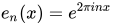
In harmonic analysis, periodic functions are often regarded as functions on the circle group T. The Fourier decomposition shows that a complex-valued function f on T can be written as an infinite linear superposition of complex exponentials
, each of which involves π. The complex exponentials, in turn, can be characterized by their transformation properties under T: they constitute a character of T, that is, a function from T to the group of unit modulus complex numbers, that is also a group homomorphism. Using the Haar measure on the circle group, the constant π is half the magnitude of the Radon–Nikodym derivative of this character. The other characters have derivatives whose magnitudes are positive integral multiples of 2π.[1] As a result, the constant π is the unique number such that the circle group, equipped with its Haar measure, is Pontrjagin dual to the lattice of integral multiples of 2π. This is a version of the one-dimensional Poisson summation formula.
Modular forms satisfy an invariance property under the modular group
(or its various subgroups), a lattice in the group
. Like the complex exponentials of Fourier series, modular forms are characterized by their transformation properties. They also involve π, once again because of the Stone–von Neumann theorem.


- I am certain that this can be improved, but my point here is that the text in the pi article should not include expository material about Fourier series or modular forms, but only refer to those articles and mention how they are relevant to the present article. --Macrakis (talk) 22:30, 7 May 2016 (UTC)
That's pretty good, but I think the article should at least include the form of the Fourier series, to show where π appears. Also, the text above does not connect Fourier series with periodic functions on the circle. Finally, there is no mention at all of the Jacobi theta function. Also, I really disagree that there should be no expository material here. There is plenty of expository material about other aspects of π throughout the article. It should be kept to a minimum, but it cannot be eliminated entirely. Sławomir Biały (talk) 11:23, 8 May 2016 (UTC)
- In both modular forms and in the Fourier series, π appears only in the context
, which is equal to
. So it is arguably the identity
about complex exponentiation that is more fundamental and "explains" the appearance of π. Your thoughts? --Macrakis (talk) 18:12, 8 May 2016 (UTC)


- Superficially, yes. A minor quibble is that one needs to be very careful in writing things like
, as this doesn't properly make sense due to the properties of the complex logarithm. What is more correct is possibly to say that π is the smallest positive real number for which
. Thus π is indeed connected in a fundamental way with the complex exponential.
- Fourier analysis is the study of the additive group
of real numbers under addition, where we identify two numbers if they differ by an integer. Although this is sometimes called a circle group, the definition is not immediately connected with any geometrical idea of "circle" that one might have. One needs to contend with this group throughout mathematics, even areas of mathematics where the concept of a "geometrical circle" is a very remote one (e.g., in algebraic number theory). The standard way groups are studied is via their unitary representations. The quantity π appears as an eigenvalue, without any reference to complex exponentials:
. The equation
is a true fact that can be proved, but it's not a definition of
, which is more primitive from this point of view. This is the perspective taken by Bourbaki's text.
- One might legitimately wonder if there is a version of Fourier analysis that is independent of π. Fourier series are uniquely characterized by certain properties having nothing to do with the complex exponential. The Fourier series associates to a function
a square-summable sequence of complex numbers
. This association is unitary and extends to a homomorphism of von Neumann algebras of
to
. It is a theorem of Fourier analysis that the Fourier series is the only such transformation. Thus anything that "behaves like" the Fourier series (for incredibly general values of the term "behaves like") must actually be the Fourier series. There is nothing in this description that involves complex exponentials. Yet nevertheless π always appears as an eigenvalue. Sławomir Biały (talk) 19:03, 8 May 2016 (UTC)
- Superficially, yes. A minor quibble is that one needs to be very careful in writing things like


It looks like Ozob did I nice job of clarifying the intended logic of things. I have streamlined it a bit more, in a way to clarify the sense in which π is essential to Fourier analysis, at the slight expense of leaving out some of the more familiar formulae of the subject, since these apparently distract from the main point. Sławomir Biały (talk) 20:42, 8 May 2016 (UTC)
Offtopic comment
- Pi and fourier transform is expecially not connected.See other wiki [][]my home wiki[],there is no fourier transform at any wiki.--Takahiro4 (talk) 04:19, 8 May 2016 (UTC)
- Thanks. I've already responded to you in detail in the previous section. Please post there, not here. Sławomir Biały (talk) 10:59, 8 May 2016 (UTC)
- Takahiro4, I have already responded to you in detail above. Please give a detailed response, written in proper English, above in the thread where you first raised this issue. I do not see the reason to repeat my arguments here, if you are just going to ignore them. It does not matter what open Wikis say on a subject. They are not reliable sources. Sławomir
Biały 14:57, 8 May 2016 (UTC)
Monte Carlo methods are very slow
I have concerns about the following statement in the article:
Monte Carlo methods for approximating π are very slow compared to other methods, and are never used to approximate π when speed or accuracy is desired.[1]
It is referenced to Arndt and Haenel (2006) and Posamentier and Lehmann (2004), neither of which is very awe inspiring as a reliable source for mathematical claims like this. Moreover, the assessment of Arndt and Haenel is that Monty Carlo methods converge slowly. This is clearly not even true, since every conventional method already is a Monty Carlo method (with a fairly boring probability distribution). Sławomir Biały (talk) 13:15, 13 May 2016 (UTC)
References
- Arndt & Haenel 2006, pp. 43 harvnb error: no target: CITEREFArndtHaenel2006 (help)
Posamentier & Lehmann 2004, pp. 105–108 harvnb error: no target: CITEREFPosamentierLehmann2004 (help)
- I take conventional methods to be computations using a series; for example arctangent. Some series converge very quickly. No random number draws are used.
- Monte Carlo methods use random number draws with accept/reject criteria. The samples are then averaged. Averages converge slowly; law of large numbers.
- Glrx (talk) 05:03, 18 May 2016 (UTC)
- What's going on here is that Monte-Carlo method means different things to different people. Glrx seems to be taking it in the "strict" sense, where you just run a bunch of simulations and count how many of them fall into a certain bucket. Sławomir is using the looser sense, meaning "any technique that uses random or pseudo-random numbers in an essential way". I suspect both viewpoints are defensible and represented in the literature; the article just needs to make clear what it's talking about. --Trovatore (talk) 06:33, 18 May 2016 (UTC)
Update: Apparently we have articles Monte Carlo method and Monte Carlo algorithm that are distinguished one from the other on this basis. Now that I seriously doubt is a distinction made clearly and consistently in the literature. I think that should probably be fixed. --Trovatore (talk) 06:38, 18 May 2016 (UTC)- The distinction is very clear in the literature. On one side one has Monte Carlo methods (which are not algorithms), consisting in running random samples for getting an approximation of the expected value of a random variable. In the article, they are applied to random variables for which the expected value may be exactly computed, and is related to π. It is almost an evidence that such a method is slow for getting an accurate result (that is a high number of digits for π). Moreover, they do not provide any way to certify the number of exact digits that are obtained. I am quite sure that the efficiency of Monte Carlo methods for computing π are discussed in Knuth's The Art of Computer Programming. On the other hand Monte Carlo algorithms and Las Vegas algorithms use auxiliary independent random numbers, that are independent of the input. I have never heard of the use of such algorithms for computing π.
- By the way, I do not understand the concern of Sławomir Biały, and I agree with Glrx: Monte Carlo methods, as well as Monte Carlo algorithms use randomness in some way, which is not the case for conventional (?) algorithms for computing π. D.Lazard (talk) 08:59, 18 May 2016 (UTC)
Typically isn't randomness an additional input to an algorithm that can be used for accelerating it? Compare with primality testing, where the fastest algorithms are the probabilistic algorithms. This is the reason Monte Carlo methods are used in the first place. Knuth defines a Monte Carlo method as "Any method that uses random numbers (possibly not producing a correct answer)." This distinguishes "method" from "algorithm" I guess. Anyway, it's trivial to construct a Monte Carlo method (in fact an "algorithm") that is at least as fast as conventional methods: just toss a coin to decide which of two reasonably fast algorithms to use. This does not use randomness in a very essential way that actually accelerates the convergence, but it also certainly doesn't hurt either.
On a related matter, we know that pi can be felt in spectra of random processes like Johnson noise. Is there any practical implementation of this? I'd be curious to know if there is an estimate of the marginal cost, in bits of entropy, to produce a digit of pi. It seems from the random walk example that convergence is very slow. I did another simulation, with comparable performance, that used Brownian local time. Sławomir
Biały 12:42, 18 May 2016 (UTC)
- Primality testing (which has a binary result) is a Monte Carlo algorithm rather than a Monte Carlo method. Glrx (talk) 14:22, 18 May 2016 (UTC)
- One would think that "method" includes "algorithm", in the sense that every algorithm is a method but not vice versa. But if we want to split hairs about nomenclature, are there any Monte Carlo algorithms for computing π? Do we infer from the text of the article that all Monte Carlo algorithms for computing π are slow compared to deterministic methods? Sławomir Biały (talk) 15:50, 18 May 2016 (UTC)
- I remain skeptical that this method–algorithm distinction is really as universal as claimed, but in any case, even if it is standard in computer science, casual readers are not going to know that; it should be explained inline. There's a lot of cases, in science in general, where some group tries to standardize terminology, but it doesn't necessarily work. Algorithm is a case in point — if you look it up in references that try to define it abstractly, they usually impose conditions, especially guaranteed termination, that don't really apply to the concept as encountered in the wild. As people actually use it, the real distinction is not algorithm–heuristic, but rather algorithm–implementation; that is, an algorithm is what's left of a program when you abstract away implementation details. But good luck finding that explicitly written down. --Trovatore (talk) 21:41, 18 May 2016 (UTC)
- One would think that "method" includes "algorithm", in the sense that every algorithm is a method but not vice versa. But if we want to split hairs about nomenclature, are there any Monte Carlo algorithms for computing π? Do we infer from the text of the article that all Monte Carlo algorithms for computing π are slow compared to deterministic methods? Sławomir Biały (talk) 15:50, 18 May 2016 (UTC)
Dubious and misleading information
In the lead section we find:
"The digits appear to be randomly distributed; however, to date, no proof of this has been discovered."
This is highly suspicious information. It is known that pi is infinite and never repeating. Someone needs to clarify this, as it will confuse the reader. EeeveeeFrost (talk) 01:26, 11 July 2016 (UTC)
- It is explained, in the section Irrationality and normality - normality being the formal mathematical term for a number with randomly distributed digits. Detailed explanations with references are not needed in the lead section; it is usual to have to look in the body of the article.--JohnBlackburnewordsdeeds 01:39, 11 July 2016 (UTC)
- I'm not exactly sure what you're talking about. I checked the irrationality and normality section and all I found was "Because π is irrational, it has an infinite number of digits in its decimal representation, and it does not settle into an infinitely repeating pattern of digits."
- In the next paragraph, normality is mentioned. However, it is highly misleading to say that "The digits appear to be randomly distributed; however, to date, no proof of this has been discovered." in the lead section! EeeveeeFrost (talk) 01:48, 11 July 2016 (UTC)
- Why is it misleading? It is correct, and is explained more fully in the section below, in particular at The conjecture that π is normal has not been proven or disproven. Again, that is how articles are written. The lead is a summary of the topic, so does not go into detail or even necessarily mention everything in the article.--JohnBlackburnewordsdeeds 01:59, 11 July 2016 (UTC)
- This discussion appears to conflate at least three things. First, having an infinite and never repeating decimal expansion is a necessary, but not a sufficient, condition for having randomly-distributed digits. However, also it's not clear that normality is a necessary or sufficient condition. What does "randomly distributed digits" mean? Does Champernowne constant have randomly distributed digits? Random sequence is not much help in this regard. Obviously, the digits of π are not actually random; they are the digits of π. So "random" actually means that the digits of π pass some statistical test of randomness, like normality. I believe in the article, we have implicitly taken normality as the definition of random, but there are numbers like the Champernowne constant that have a definite pattern, despite being normal in base 10 (and even satisfying other tests of randomness like Kolmogorov complexity). I think someone like User:Trovatore might have some insight into this conundrum. Sławomir Biały (talk) 13:17, 11 July 2016 (UTC)
- Why is it misleading? It is correct, and is explained more fully in the section below, in particular at The conjecture that π is normal has not been proven or disproven. Again, that is how articles are written. The lead is a summary of the topic, so does not go into detail or even necessarily mention everything in the article.--JohnBlackburnewordsdeeds 01:59, 11 July 2016 (UTC)
- It is misleading because it has more to do with statistics than mathematics. We all know that pi is infinite and "random" (in a sense that the digits are random). My suggestion is that we simply omit that information from the lead; at least for now. That sentence isn't necessary to make the paragraph coherent anyway. EeeveeeFrost (talk) 13:36, 11 July 2016 (UTC)
- I think it's important and worth discussing in the lead, which is supposed to summarize the most significant aspects of the article. But the sense in which the digits are (believed to be) "random" needs to be clarified I think, in the body of the article at least. Sławomir Biały (talk) 14:18, 11 July 2016 (UTC)
- Let's not say that pi is random in the lead. In my opinion, that first highlighted sentence above ("Because π is irrational etc...) is good enough to be put in the lead. EeeveeeFrost (talk) 14:30, 11 July 2016 (UTC)
- I just restored (and copy-edited) the lead bit about "randomness". Please do not remove it (i.e. preserve the status quo) unless you can get a consensus for this here. This is not likely to happen, because it is fairly clear you have not understood this: the relevant paragraph in the body starts: "The digits of π have no apparent pattern...", and this is what is meant by being "random". Read the paragraph What does "randomly distributed digits" mean? by Sławomir above very carefully... and notice the difference between the informal definition of rational as "not settling into a repeating pattern" and a number like 0.123456789101112131415161718192021... which is clearly irrational, but definitely not "random" in some sense. I think there could be a sensible discussion about whether "random" is the best word to use in the lead, but it is quite appropriate to refer somehow to this property. Imaginatorium (talk) 15:10, 11 July 2016 (UTC)
- I decided to just replace that sentence with another one. This new one is perfectly valid, it fits well in the context and there is no need to remove it. It is much more useful than the other one, which is a mere problem related to statistics. EeeveeeFrost (talk) 15:33, 11 July 2016 (UTC)
- The new sentence that you added does not clarify the content of the old sentence, so I have reverted it. It is already redundant with the first two sentences of that paragraph of the lead. One can take (for the sake of argument) the definition of "random" to mean that the frequency of any string of digits in the expansion of π depends only on the length of the string. (This is actually the definition of normal in base 10.) With that definition, it is much stronger than "never settles into a permanent repeating pattern". That is probably not a good definition of "random", which I think deserves to be clarified in the body of the article, but what we mean by "random" here should imply this statement about frequency. Sławomir Biały (talk) 15:44, 11 July 2016 (UTC)
- I decided to just replace that sentence with another one. This new one is perfectly valid, it fits well in the context and there is no need to remove it. It is much more useful than the other one, which is a mere problem related to statistics. EeeveeeFrost (talk) 15:33, 11 July 2016 (UTC)
- I just restored (and copy-edited) the lead bit about "randomness". Please do not remove it (i.e. preserve the status quo) unless you can get a consensus for this here. This is not likely to happen, because it is fairly clear you have not understood this: the relevant paragraph in the body starts: "The digits of π have no apparent pattern...", and this is what is meant by being "random". Read the paragraph What does "randomly distributed digits" mean? by Sławomir above very carefully... and notice the difference between the informal definition of rational as "not settling into a repeating pattern" and a number like 0.123456789101112131415161718192021... which is clearly irrational, but definitely not "random" in some sense. I think there could be a sensible discussion about whether "random" is the best word to use in the lead, but it is quite appropriate to refer somehow to this property. Imaginatorium (talk) 15:10, 11 July 2016 (UTC)
- Let's not say that pi is random in the lead. In my opinion, that first highlighted sentence above ("Because π is irrational etc...) is good enough to be put in the lead. EeeveeeFrost (talk) 14:30, 11 July 2016 (UTC)
@Sławomir Biały: Sure, I understand. Just let me ask you something: Don't you think that the sentence might confuse the average reader? Because when I read it for the first time, I understood that there is a possibility that pi is not just infinitely many numbers that are (or appear to be) random; and that made me feel confused at first. We know that pi is calculated using an infinite sum π/4 = 1 - 1/3 + 1/5 - 1/7..... and that obviously leads to non repeating and "random looking" numbers.
Anyway, if you don't think that the sentence might be misleading, then I'll just give up and leave the way it is. EeeveeeFrost (talk) 15:58, 11 July 2016 (UTC)
- There certainly is a possibility that the digits of π are not random (in whatever reasonable sense one might define random, which I think still should be clarified). For example, it is possible that the sequence "1423509876723" never actually appears as a sequence of digits in the decimal expansion of π, and that there is, therefore, a cosmic conspiracy to exclude this particular pattern of digits from appearing somewhere. The digits would then not be random. Sławomir Biały (talk) 16:01, 11 July 2016 (UTC)
- That's stretching random. By random, (I believe) we mean that there is no way to correctly predict a series of digits without actually calculating them. —Compassionate727 (T·C) 16:05, 11 July 2016 (UTC)
- Random implies normality, by the Borel-Cantelli lemma. So it isn't stretching random. It would, however, be nice if there were a clear mathematical statement. For now, I think we should link to the article random sequence. At least that gives a little context. Sławomir Biały (talk) 16:12, 11 July 2016 (UTC)
- That's stretching random. By random, (I believe) we mean that there is no way to correctly predict a series of digits without actually calculating them. —Compassionate727 (T·C) 16:05, 11 July 2016 (UTC)
- Responding to Sławomir's ping — it's a complicated question what "random" means for an individual sequence. In some sense I think it's misleading to speak of the concept at all without elaborating. A sequence can be drawn from a random distribution, but any particular sequence has the same probability as any other (namely zero), and no sequence can be completely random, because it is the sequence that it is.
- That said, there's a quasi-hierarchy of stronger and stronger notions of what it means for a fixed infinite sequence to be "random". All of these notions (as far as I'm aware anyway) can be expressed by identifying a family of measure-zero sets, and saying a sequence is "random" if it's not in any set in that family. In this context, the most common meaning for calling a sequence "random" without further elaboration is 1-randomness, where the family of measure-zero sets is "G-delta sets determined by a constructive null cover".
- The decimal representation of π, considered as a sequence of digits, is computable, so it's not even close to 1-random.
- As for normality, it does have this general form of a randomness criterion, because you can come up with a collection of measure-zero sets (actually just a single one in this case), and say a sequence is normal if it's not in any of them. But on the hierarchy of randomness notions, normality is either near the bottom or not on it at all, depending on how you look at it. I do think it's a bit misleading to refer to the decimal representation of π as "random", at least without inline elaboration. --Trovatore (talk) 18:20, 11 July 2016 (UTC)
- It seems like there is some notion of statistical randomness, that should imply normality (among other things), that roughly captures the notion that the distribution of digits "appears random". Word frequencies seem like a good way to do this. But I would like to get some clarity on exactly what sense we are entitled to say that the digits of π are random. Sławomir Biały (talk) 19:42, 11 July 2016 (UTC)
- I think normality is the strongest thing you're going to get that's limited to "distributions of digits". Stronger properties are going to involve subtler tests. So going that route, I think we should just talk about normality, not randomness.
- That said, normality is, if not a very weak kind of randomness, at least some sort of approximation to randomness. I can't see that statement being particularly controversial. And we would probably be remiss if we didn't say something about that, both because randomness is a lot more familiar to most readers than normality (even if they don't have a clear understanding of what it means), and because it's sort of the reason that we expect π to be normal, absent a reason why it shouldn't be.
- But I'm not happy with lies to children, and we also have to avoid original research, and between those two constraints it's going to be tricky to come up with appropriate wording. --Trovatore (talk) 19:48, 11 July 2016 (UTC)
- Meh. The empirical fact is that the digits of π are "random" in a way that the digits of other normal numbers do not seem to be. This is certainly not intended as a mathematically rigorous statement, but it does seem to be empirically true. I don't think many readers are likely to be misled by the statement as it currently exists in the article. Most readers are unlikely to go into deep philosophical waters, like trying to figure out exactly what "random" actually means. That's well outside the scope of this article.
- However, I think the statement in the article is not misleading in the "telling lies to children" sense that you are concerned with. Whatever the word "random" should mean in this setting, it must at least imply that the digits of π are normal. (Think of the word "random" really as an equivalence class of predicates, each of which is a normal sequence.) The distribution of digits of π being "random" is at least consistent with the article as stated. Now, since π is not known to be normal, it is also not known to have random digits in any sense in that equivalence class. So, we don't actually need to know what "random" means in order to make sense of the statement in the article. Sławomir Biały (talk) 21:50, 11 July 2016 (UTC)
- Well, my concern is that random-full-stop is too strong, because its default meaning in this context is 1-random, which π is definitely not.
- I don't think we should use the r-word directly and without elaboration as being a possible property of π. "Normal" is fine, and we can probably work in a defensible explanation of how normality is related to, or a weak version of, or an approximation to, randomness. --Trovatore (talk) 21:55, 11 July 2016 (UTC)
By the way, this is a little off-topic, but you seem to be interested in a criterion that would separate π from Champernowne's constant. I thought about it a little bit and I think I have one.- In Champernowne's constant up to the 10nth digit, successive blocks of n digits are highly correlated. If you keep n fixed and let the number of digits go to infinity, the correlation goes away, of course. But if you look at the sequence rn equals the correlation between successive blocks of n digits up to the 10nth place, that sequence is going to have very different asymptotic behavior in Champernowne's constant than in a random sequence, and presumably π will be more like the random sequence than like CC.
- But I doubt that can be sourced. --Trovatore (talk) 22:08, 11 July 2016 (UTC)
- It seems like there is some notion of statistical randomness, that should imply normality (among other things), that roughly captures the notion that the distribution of digits "appears random". Word frequencies seem like a good way to do this. But I would like to get some clarity on exactly what sense we are entitled to say that the digits of π are random. Sławomir Biały (talk) 19:42, 11 July 2016 (UTC)
I'm not certain I agree that 1-random is "the" default meaning of random here, but I'll accept that it might be in some circles. I've clarified the language in a way that hopefully settles that objection. Sławomir Biały (talk) 23:04, 11 July 2016 (UTC)
HTML comment
There used to be an HTML comment at the top of the article saying "Please note that Wikipedia is not the place to store millions of digits of pi." Somebody removed it. Why?? Georgia guy (talk) 23:19, 11 July 2016 (UTC)
- I don't know, but if no one's done that recently, then maybe we don't need the note. It's not like it's a lot of trouble to revert when it happens, as long as it doesn't happen frequently. --Trovatore (talk) 23:39, 11 July 2016 (UTC)
- The comment hasn't been in the article for more than four years. It was never effective, and the article was indefinitely semiprotected instead. Sławomir Biały (talk) 12:15, 12 July 2016 (UTC)
Section on Spigot Algorithms
The current text on spigot algorithms says that no such algorithm is known for decimal digits of pi.
Yet there's this article 'A Spigot Algorithm for the Digits of Pi', by Stanley Rabinowitz and Stan Wagon, to be found here: http://www.mathpropress.com/stan/bibliography/spigot.pdf that says how to do it.
Is this research discredited or should we alter the text on spigot algorithms? Dr. Crash (talk) 15:15, 10 October 2016 (UTC)
- Please put new talk page messages at the bottom of talk pages. Thanks.
- That does not look like a proper wp:reliable source in the Wikipedia sense. Book? Article in an established and relevant journal? - DVdm (talk) 15:32, 10 October 2016 (UTC)
Abuse of notation?
The article states: For example, one may compute directly the arc length of the top half of the unit circle given in Cartesian coordinates by x2 + y2 = 1, as the integral:
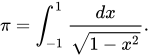
But at the same time, in abuse of notation it is explained: A related abuse of notation occurs when integrals like 


Am I missing something? --bender235 (talk) 23:06, 19 November 2016 (UTC)
- I have no problem with that notation, and so the abuse of notation article seems wrong here. This is not some odd, non-standard ways of writing integrals but is common, clear and unambiguous. It appears in other places in this article and seems properly sourced.--JohnBlackburnewordsdeeds 23:14, 19 November 2016 (UTC)
Digits
 | This edit request has been answered. Set the |answered= parameter to no to reactivate your request. |
We need to update the record number of digits, which has increased significantly in November. See http://www.pi2e.ch/ which is linked at your reference 3. The new values are: 22 459 157 718 361 decimal digits 18 651 926 753 033 hexadecimal digits There is an error in saying trillion is 10^13. It is 10^12.
The original text is:
extended the decimal representation of π to, as of 2015, over 13.3 trillion (10^13) digits.[3]
The new text should be"
extended the decimal representation of π to, as of November 2016, over 22.4 trillion (10^12) digits.[3]
A new footnote reference to http://www.pi2e.ch/ might be added, even though it is linked at reference 3.
agb — Preceding unsigned comment added by 143.43.206.244 (talk) 20:29, 22 December 2016 (UTC)
 Done Paine Ellsworth u/c 01:25, 26 December 2016 (UTC)

- Content like this should require reliable secondary sources. It was weakly sourced before too, so I don't think reversion is appropriate, but the sentence should be rewritten in a way that does not rely on the primary self-published literature. Sławomir Biały (talk) 03:07, 26 December 2016 (UTC)
- I went ahead and generalized the statement in the article, since I could not find any news sources that have yet reported on the new figure. It might show up in the December issue of the American Mathematical Monthly, and possibly in The Conversation as well. Paine Ellsworth u/c 22:03, 27 December 2016 (UTC)
- Interesting solution. I like it. Sławomir Biały (talk) 23:12, 27 December 2016 (UTC)
- Thank you, Sławomir Biały! I could be wrong, but it might be better to leave the specifics out of the lead. If and when the new record appears in a news source, it can be included in the lower content of the article. Paine Ellsworth u/c 11:38, 29 December 2016 (UTC)
- Interesting solution. I like it. Sławomir Biały (talk) 23:12, 27 December 2016 (UTC)
- I went ahead and generalized the statement in the article, since I could not find any news sources that have yet reported on the new figure. It might show up in the December issue of the American Mathematical Monthly, and possibly in The Conversation as well. Paine Ellsworth u/c 22:03, 27 December 2016 (UTC)
RS -- also history of the *concept* of the ratio of pi, rather than the numerical calculation or estimation
This looks like it might be some good WP:RS. I don't think I saw everything from it in this in the article, but I didn't look closely. Was trying to figure out how old the concept of PI is (not necessarily its computation -- it is after all a ratio, so you don't have to necessarily calculate to use it (i.e. if you have one circle of diameter d, and circumference c, then you can estimate the circumference of a circle of 2d to be 2c by proportion without ever calculating pi, but understanding that the ratio is fixed). I think our article is incomplete on dealing with the concept of Pi, but I'm no expert in this subject. --David Tornheim (talk) 14:56, 27 March 2017 (UTC)
- That looks like a student paper for a class, so not WP:RS. Also, based on the third paragraph, I would say that this source is factually very suspect. Sławomir Biały (talk) 16:56, 27 March 2017 (UTC)
- Ah, you are right, it is probably a student, not faculty. Pretty good writing for a student! Maybe a grad. student?
- I'm not clear: What is wrong with the third paragraph? Are you saying that the source "Blatner, David. The Joy of Pi. Walker Publishing Company, Inc. New York, 1997" or the source "Tsaban, Boaz and David Garber. "On the Rabbinical Approximation of pi." Historia Mathematica 25, Article HM972185. Academic Press, 1998." is suspect or that writer speaking about what was in one or both of these sources was suspect? If so what specifically do you find suspect? I did not check the quote to the Bible or think deeply about what was said in the paragraph and compare it to what is in the rest of our article and its sources. I just don't know enough about the history to PI to know what is or is not suspect in that paragraph. Maybe I missed something glaring? --David Tornheim (talk) 21:49, 29 March 2017 (UTC)
- That has been discussed before, and excluded per WP:FRINGE if I recall. In particular, the invocation of the gematria is particularly suspect. Sławomir Biały (talk) 22:41, 29 March 2017 (UTC)
Eigenvalue
Re this diff.
If my memory is correct, which it may not be, this was added by User:Sławomir Biały. At the time, I really didn't understand what it was supposed to mean, but I figured that was probably because I hadn't thought about it hard enough.
So now that it's come down to a showdown — Sławomir, what did you mean exactly? It sounds interesting. Would be good to have a cite. --Trovatore (talk) 08:57, 14 April 2017 (UTC)
- As detailed in the section on spectral characterizations, π is the smallest eigenvalue for a vibrating string with fixed endpoints. It is the best constant in the isoperimetric inequality, which is associated with eigenvalues of the Laplace operator and the Dirichlet energy. These two applications are detailed for example in Volume 1 of Courant and Hilbert. It appears as the best constant in the uncertainty principle. This can be obtained as a Rayleigh quotient for the symmetric form
, which the view taken in appendix I of Weyl (1931) "The theory of groups and quantum mechanics".
- Also, it is the unique constant making
equal to its own Fourier transform (which is referenced to the paper by Roger Howe on the Heinseberg group). Sławomir Biały (talk) 10:26, 14 April 2017 (UTC)
- This explanation is far too technical to appear in the lead. Moreover the point is not that π appears often as eigenvalues. The point is the WP:OR assertion that this is the cause of the ubiquity of π ("Because of its special role as an eigenvalue, π appears in areas ..."). IMO, this assertion is wrong, and the appearance of π as eigenvalue has the same cause as its appearance in so many scientific areas, namely its relation with every periodic phenomenon. Therefore, I'll replace the above phrase by
The number π appears generally in the mathematical analysis of any periodic phenomenon; it appears therefore in areas ...
. D.Lazard (talk) 12:07, 14 April 2017 (UTC)- I'm not suggesting that we give this explanation in the lead of the article. But there is an entire section dedicated to the role of π as an eigenvalue. These do not involve periodic phenomena, at least not directly (for example, in the central limit theorem, Gaussian functions, Wirtinger's inequality, and Heisenberg uncertainty principle). Anyway, seeing the edit in full, I suppose it's a reasonable compromise. Sławomir Biały (talk) 12:25, 14 April 2017 (UTC)
- I've left in the role in periodic phenomena. But the role of π in periodic phenomena arises exactly because π is an eigenvalue of the Sturm-Liouville problem. So I still think that deserves to be mentioned. Sławomir Biały (talk) 12:34, 14 April 2017 (UTC)
- I'm not really familiar with the notion of an "eigenvalue of a problem". What I see here is that −π2 is an eigenvalue of the second-derivative operator, and one that corresponds to a solution with the desired boundary values. Can we expect readers to know what an "eigenvalue of a problem" is? Is it explained in our eigenvalue article, and should there be a link to a specific anchor?
- I'm also a little skeptical that something as specific as Sturm–Liouville theory should be identified as "the" reason that π comes up in so many contexts. Is that really the consensus view in mathematics in general? --Trovatore (talk) 21:50, 14 April 2017 (UTC)
- I don't think the lead should point out that π is a Sturm-Liouville eigenvalue. But the Dirichlet boundary value problem for the derivative on the unit interval is the simplest eigenvalue problem that there is. This eigenvalue problem can be formulated in many ways: as a differential equation (i.e., "trigonometry"), variationally where π becomes associated with the best constant in Wirtinger's inequality (also the Heisenberg inequality), or group theoretically in terms of the spectrum of the group
- You still haven't said what an "eigenvalue of a problem" or a "Sturm–Liouville eigenvalue" is. I only know eigenvalues of operators, not problems. To keep it on topic, I'm concerned that the article explain this notion, as I think a lot of readers may be similarly confused. --Trovatore (talk) 23:22, 14 April 2017 (UTC)
- One eigenvalue problem is
for u a function in the Sobolev space
. This is formulated variationally, and we have
, the infinimum being over all nonzero
. Alternatively, another is the periodic eigenvalue problem
, with
. Sławomir Biały (talk) 23:54, 14 April 2017 (UTC)
- So in your first example there, exactly what operator is π an eigenvalue of? --Trovatore (talk) 00:11, 15 April 2017 (UTC)
is the largest eigenvalue of the second-derivative on the Sobolev space
itself is the smallest singular value of the derivative operator, on that same Sobolev space. The general subject of eigenvalue problems (for both Dirichlet and Neumann conditions) as typically understood in differential equations and calculus of variations is described in Courant and Hilbert. One can state these problems in terms of eigenvalues of some explicit operator on a Hilbert space, but this less common in the variationally formulation of these problems. Sławomir Biały (talk) 00:23, 15 April 2017 (UTC)
- So in your first example there, exactly what operator is π an eigenvalue of? --Trovatore (talk) 00:11, 15 April 2017 (UTC)
- One eigenvalue problem is
- You still haven't said what an "eigenvalue of a problem" or a "Sturm–Liouville eigenvalue" is. I only know eigenvalues of operators, not problems. To keep it on topic, I'm concerned that the article explain this notion, as I think a lot of readers may be similarly confused. --Trovatore (talk) 23:22, 14 April 2017 (UTC)
- I don't think the lead should point out that π is a Sturm-Liouville eigenvalue. But the Dirichlet boundary value problem for the derivative on the unit interval is the simplest eigenvalue problem that there is. This eigenvalue problem can be formulated in many ways: as a differential equation (i.e., "trigonometry"), variationally where π becomes associated with the best constant in Wirtinger's inequality (also the Heisenberg inequality), or group theoretically in terms of the spectrum of the group
- This explanation is far too technical to appear in the lead. Moreover the point is not that π appears often as eigenvalues. The point is the WP:OR assertion that this is the cause of the ubiquity of π ("Because of its special role as an eigenvalue, π appears in areas ..."). IMO, this assertion is wrong, and the appearance of π as eigenvalue has the same cause as its appearance in so many scientific areas, namely its relation with every periodic phenomenon. Therefore, I'll replace the above phrase by
![{\displaystyle \int x[{\overline {f}}f'+{\overline {f}}'f]}](http://wikimedia.org/api/rest_v1/media/math/render/svg/26fb0921851449a0849612405428cbb240da4f53)


![{\displaystyle H_{0}^{1}[0,1]}](http://wikimedia.org/api/rest_v1/media/math/render/svg/7113d194de39d54621e9da47782ad5263b9f1790)

![{\displaystyle u\in H_{0}^{1}[0,1]}](http://wikimedia.org/api/rest_v1/media/math/render/svg/29d90cb202c31eb44b4d9f020d8c1aae458d5acb)


I do not see anymore why this technical discussion is relevant for this article. After reading this discussion, I oppose to mention eigenvalues in the lead. In fact, most readers ignore what is an eigenvalue, and the link between π and eigenvalues is obscure for most of the others, including two experimented mathematics Wikipedia editors who have participated to this discussion (Trovatore and myself).
IMO, this discussion should be focused to the sections "Spectral characterization" and "Gaussian integral", which suffer of several issues. Firstly they appear as subsections of "Fundamentals", when they should appear in section "Use". Secondly, they present things from a non-neutral point of view, consisting in presenting eigenvalues as the most fundamental concept to which everything to be linked. This appear already in the title of the first section: Is there really any spectral characterization of π? Does exist any source talking of a "spectral characterization of π"? Thirdly, although the applications presented in these sections are fully relevant for the section "Use", the tentative to present them as specific cases of a general eigenvalue problem is a fundamental error. In fact, eigenvalues are not an object of study by themselves, there are a tool for studying (and classifying) various problems. Thus the fact that π occurs as an eigenvalue is not a property of eigenvalues, but a property of some underlying problem. I agree that this is a rather subtle distinction, but explained why a point of view is not neutral, is rarely easy.
My conclusion is that these sections should be moved, the first one should be renamed, and they should be rewritten for much less focusing on eigenvalues. D.Lazard (talk) 11:14, 15 April 2017 (UTC)
- There are a number of spectral characterizations of π in the literature: the first is Bourbaki, which defines π via the spectrum of the group
By finding the sides of all triangles given three angles only
It is said that


199.119.233.200 (talk) 12:12, 22 May 2017 (UTC)
- The equality
is well known, and its proof does not implies Taylor series. The result you are talking of is unclear, but, for such elementary questions, there is absolutely no hope to find any new result. D.Lazard (talk) 13:00, 22 May 2017 (UTC)
- I think it should also be pointed out that the arcsine is not an algebraic function. Sławomir Biały (talk) 15:10, 22 May 2017 (UTC)

I hope the following example will clarify the problem,and they are all angles in term of cos and sin.
For Lengths of a=x where x,y,z are the lengths of the sides of the triangle in terms of a,b,c.

For Lengths of b=y

For Lengths of c=z


199.119.233.150 (talk) 18:52, 22 May 2017 (UTC)
Adding a new topic
Can you add a topic on the digits of π The first 141 digits of π(not including the first 3) is: 3.14159265358979323846264338327950288419716939937510582097494459230781640628620899862803482534211706798214808651328230664709384460955058223172 Mug1wara (talk) 08:05, 2 June 2017 (UTC)
- Pi#Approximate value gives 50 digits. That seems sufficient. PrimeHunter (talk) 10:51, 2 June 2017 (UTC)
Missing dx?
The section Pi#Cauchy distribution and potential theory says
- The Hilbert transform H is the integral transform given by the Cauchy principal value of the singular integral

Am I correct in assuming that this should have a "dx" at the end? Loraof (talk) 16:39, 2 July 2017 (UTC)
Semi-protected edit request on 10 August 2017
| This edit request to Pi has been answered. Set the |answered= parameter to no to reactivate your request. |
At the beginning of the article, after the name of pi and the equivalent greek letter π, it would be useful to mention, as an addition, that "this letter is the initial of the greek word περιφέρεια, which stands for periphery, and that this was first introduced by Leonhard Euler in the 17th century". I don't think any reference or documentation is needed here - it is straightforward. Thanks. 37.6.21.2 (talk) 23:16, 10 August 2017 (UTC)
 Not done Perhaps some documentation is needed after all since you've gotten some of your "facts" wrong. See the history section of this article and in particular the subsection on the adoption of the symbol π. The lead of this article is already long and this factoid doesn't really add anything vital to the understanding of this concept, so I don't think that the correct version of this should be placed in the lead.--Bill Cherowitzo (talk) 23:46, 10 August 2017 (UTC)

Semi-protected edit request on 21 August 2017
| This edit request to Pi has been answered. Set the |answered= parameter to no to reactivate your request. |
2001:E68:540D:9DDD:99E:F815:EBCB:D24D (talk) 12:49, 21 August 2017 (UTC)
- Not done. No request actually made. --Deacon Vorbis (talk) 13:01, 21 August 2017 (UTC)
There is currently a discussion at Wikipedia:Administrators' noticeboard/Incidents regarding an issue with which you may have been involved.
There is currently a discussion at Wikipedia:Administrators' noticeboard/Incidents regarding an issue with which you may have been involved. The thread is Pi page. --Shirt58 (talk) 08:16, 17 September 2017 (UTC)
Side comment on relationship of pi to metric space
It has always bothered me that the definition of pi does not state that it is defined using the common metric. In other metric spaces the value of pi defined as the ratio of the circumference of a circle to its radius will vary. For instance, in the metric space used to measure distance in a city with regularly spaced orthogonal streets, the value of pi is 2*sqrt(2). If the coordinates are shifted by 45 degrees the metric becomes d = max(|x1-x2|,|y1-y2|) and we get a rational value for pi of 4. PetersRet (talk) 16:50, 2 August 2017 (UTC)
- π is a number, not a parameter of metric spaces. It has definitions that have nothing to do with distance, for instance in the solution to the Basel problem. It is incorrect to talk about "the value of pi in other metric spaces"; regardless of what metric space one is talking about, π is the same number. Also, not all metric spaces are two-dimensional and allow one to define the circumference of a disk, and not all two-dimensional geodesic metric spaces (the ones in which you can measure the lengths of curves) have a constant ratio of circumference to radius. But in the ones that do, you should still not make the mistake of calling the ratio of circumference to radius pi. —David Eppstein (talk) 18:09, 2 August 2017 (UTC)
That is true, but look at the first paragraph of the article in which it says pi is the ratio of the circumference to the radius. I was merely pointing out that this is not true in all metric spaces. PetersRet (talk) 18:21, 2 August 2017 (UTC)
- It's not really good to define pi as a ratio of geometric quantities. There are several more fundamental approaches covered in the article. That pi appears as an isoperimetric constant is a consequence, e.g., of best constants for Sobolev inequalities (which also make sense in general metric-measure spaces). Sławomir Biały (talk) 21:02, 2 August 2017 (UTC)
- For the above reasons, I'll edit the first sentence for saying that is is the original definition, but that it has now many equivalent definitions. D.Lazard (talk) 12:48, 18 September 2017 (UTC)
- Seems to me that the edit didn't solve the problem. The edit is confusing. "has many equivalent definitions" is ambiguous. Equivalent to WHAT?? The most obvious interpretation is "equivalent to the geometrical definition" which just returns us to the problem of what curvature the space we are considering has. The Euclidean geometry definition is just as valid as any other, of course. So, the problem is NOT that the geometrical definition is wrong, rather its context isn't clear (isn't explicit). I suggest an edit to include some qualifying term such as Euclidean, flat-2d, historically, or classically.
- For the above reasons, I'll edit the first sentence for saying that is is the original definition, but that it has now many equivalent definitions. D.Lazard (talk) 12:48, 18 September 2017 (UTC)
I'd also like to see more than 6 significant digits in the lead!! (Which states that the ancients knew it to 7.) I'm also slightly uncomfortable with the claim that it can't be exactly expressed as a fraction. It can be exactly expressed, as well as exactly defined, as a recurring fraction (which is not a ratio of two whole numbers). A minor point.98.21.70.161 (talk) 18:26, 24 October 2017 (UTC)
¶ Not quite related to this, but a few years ago on some other place on the internet (I have forgotten where), I was whining about the precision of calculations made with a value of pi that only went to ten decimal spaces, and someone responded that (and I probably have misremembered the exact details) that the value to ten decimal places was sufficient to calculate the volume of the entire galaxy to within a cubic inch, or something like that. Whatever the demonstration of the accuracy of a relatively short value of pi might be, I would be very appreciative if someone knowledgeable would add the appropriate statement and citation to the article. Sussmanbern (talk) 17:37, 6 November 2017 (UTC)
- It's already there, in the "Motives for computing π" section. —David Eppstein (talk) 17:47, 6 November 2017 (UTC)
- Thank you, Mr. Epstein, for your prompt response and especially for not calling me a jerk. Sussmanbern (talk) 04:05, 7 November 2017 (UTC)
Digits
"Digits" of pi has to include all digits, including the leading three. Thus the current article text:
"Decimal: The first 50 decimal digits are 3.14159265358979323846264338327950288419716939937510..."
"Hexadecimal: The base 16 approximation to 20 digits is 3.243F6A8885A308D31319..."
need to be changed to either
- count all digits
"Decimal: The first 51 decimal digits are 3.14159265358979323846264338327950288419716939937510..."
"Hexadecimal: The base 16 approximation to 21 digits is 3.243F6A8885A308D31319..."
- use amended wording
"Decimal: The first 50 decimal digits to the right of the decimal point are 3.14159265358979323846264338327950288419716939937510..."
"Hexadecimal: The base 16 approximation to 20 digits to the right of the decimal point is 3.243F6A8885A308D31319..."
—DIV (120.17.34.237 (talk) 13:29, 19 October 2017 (UTC))
- Agreed. Currently, all four approximations (decimal, binary, hexadecimal, and sexagesimal) ignore the leading digit '3'. — Loadmaster (talk) 21:41, 19 October 2017 (UTC)
Digit Groups
According to scientific rules, numbers are divided into groups of 3 digits to ease readability. ("Following the 9th CGPM (1948, Resolution 7) and the 22nd CGPM (2003, Resolution 10), for numbers with many digits the digits may be divided into groups of three by a thin space, in order to facilitate reading." https://www.bipm.org/utils/common/pdf/si_brochure_8_en.pdf 5.3.4). I will therefore change the groups of 5 into groups of 3. 2A03:2260:A:B:29EC:BFAD:2CF3:8941 (talk) 17:12, 17 November 2017 (UTC) Okay, I cannot edit right know, because the article is protected... 2A03:2260:A:B:29EC:BFAD:2CF3:8941 (talk) 17:15, 17 November 2017 (UTC)
- MOS:DIGITS allows groups of either three or five, so changing from one style to another should not be done without discussion. Sławomir Biały (talk) 17:41, 17 November 2017 (UTC)
- Not only that, but even the document you cited says "may be", not "should be". Moreover, these are not "scientific rules"; these are written style guidelines set out by a single (albeit important) body. Moremoreover, you neglected to quote a couple sentences later, where it says,
"The practice of grouping digits in this way is a matter of choice; it is not always followed in certain specialized applications such as..."
. --Deacon Vorbis (talk) 17:52, 17 November 2017 (UTC)
something like 1/2 in math tags is not right
something like 

- This is an issue for MOS:MATH, not this specific article, but
(or more usually just 1/2) is usually preferable for inline formulas. For displayed formulas,
- would be more likely to be correct, but even there the horizontal slashed form is often a better choice. —David Eppstein (talk) 09:24, 7 December 2017 (UTC)
Provide decimal digits of pi nearer the top?
Hi there, it seems to me that many users might come to this page looking for the first few digits of the decimal expansion of pi. To find these it is necessary to scroll to the sixth section, where they aren't particularly well sign-posted. Would it make sense to have more than the current 5 decimal places in the first paragraph? 82.150.96.2 (talk) 10:01, 4 January 2018 (UTC)
- I have added more digits to the infobox. Sławomir Biały (talk) 11:13, 4 January 2018 (UTC)
External links modified (January 2018)
Hello fellow Wikipedians,
I have just modified one external link on Pi. Please take a moment to review my edit. If you have any questions, or need the bot to ignore the links, or the page altogether, please visit this simple FaQ for additional information. I made the following changes:
- Added archive https://web.archive.org/web/20150122054610/http://gdz.sub.uni-goettingen.de/index.php?id=11&PPN=PPN235181684_0020&DMDID=DMDLOG_0031&L=1 to http://gdz.sub.uni-goettingen.de/index.php?id=11&PPN=PPN235181684_0020&DMDID=DMDLOG_0031&L=1
When you have finished reviewing my changes, you may follow the instructions on the template below to fix any issues with the URLs.
This message was posted before February 2018. After February 2018, "External links modified" talk page sections are no longer generated or monitored by InternetArchiveBot. No special action is required regarding these talk page notices, other than regular verification using the archive tool instructions below. Editors have permission to delete these "External links modified" talk page sections if they want to de-clutter talk pages, but see the RfC before doing mass systematic removals. This message is updated dynamically through the template {{source check}} (last update: 5 June 2024).
- If you have discovered URLs which were erroneously considered dead by the bot, you can report them with this tool.
- If you found an error with any archives or the URLs themselves, you can fix them with this tool.
Cheers.—InternetArchiveBot (Report bug) 22:57, 27 January 2018 (UTC)
Semi-protected edit request on 17 February 2018
| This edit request to Pi has been answered. Set the |answered= parameter to no to reactivate your request. |
Digits of Pi
100,000 digits of pi (again) |
|---|
|
3.14159 26535 89793 23846 26433 83279 50288 41971 69399 37510 58209 74944 59230 78164 06286 20899 86280 34825 34211 70679 82148 08651 32823 06647 09384 46095 50582 23172 53594 08128 48111 74502 84102 70193 85211 05559 64462 29489 54930 38196 44288 10975 66593 34461 28475 64823 37867 83165 27120 19091 45648 56692 34603 48610 45432 66482 13393 60726 02491 41273 72458 70066 06315 58817 48815 20920 96282 92540 91715 36436 78925 90360 01133 05305 48820 46652 13841 46951 94151 16094 33057 27036 57595 91953 09218 61173 81932 61179 31051 18548 07446 23799 62749 56735 18857 52724 89122 79381 83011 94912 98336 73362 44065 66430 86021 39494 63952 24737 19070 21798 60943 70277 05392 17176 29317 67523 84674 81846 76694 05132 00056 81271 45263 56082 77857 71342 75778 96091 73637 17872 14684 40901 22495 34301 46549 58537 10507 92279 68925 89235 42019 95611 21290 21960 86403 44181 59813 62977 47713 09960 51870 72113 49999 99837 29780 49951 05973 17328 16096 31859 50244 59455 34690 83026 42522 30825 33446 85035 26193 11881 71010 00313 78387 52886 58753 32083 81420 61717 76691 47303 59825 34904 28755 46873 11595 62863 88235 37875 93751 95778 18577 80532 17122 68066 13001 92787 66111 95909 21642 01989 38095 25720 10654 85863 27886 59361 53381 82796 82303 01952 03530 18529 68995 77362 25994 13891 24972 17752 83479 13151 55748 57242 45415 06959 50829 53311 68617 27855 88907 50983 81754 63746 49393 19255 06040 09277 01671 13900 98488 24012 85836 16035 63707 66010 47101 81942 95559 61989 46767 83744 94482 55379 77472 68471 04047 53464 62080 46684 25906 94912 93313 67702 89891 52104 75216 20569 66024 05803 81501 93511 25338 24300 35587 64024 74964 73263 91419 92726 04269 92279 67823 54781 63600 93417 21641 21992 45863 15030 28618 29745 55706 74983 85054 94588 58692 69956 90927 21079 75093 02955 32116 53449 87202 75596 02364 80665 49911 98818 34797 75356 63698 07426 54252 78625 51818 41757 46728 90977 77279 38000 81647 06001 61452 49192 17321 72147 72350 14144 19735 68548 16136 11573 52552 13347 57418 49468 43852 33239 07394 14333 45477 62416 86251 89835 69485 56209 92192 22184 27255 02542 56887 67179 04946 01653 46680 49886 27232 79178 60857 84383 82796 79766 81454 10095 38837 86360 95068 00642 25125 20511 73929 84896 08412 84886 26945 60424 19652 85022 21066 11863 06744 27862 20391 94945 04712 37137 86960 95636 43719 17287 46776 46575 73962 41389 08658 32645 99581 33904 78027 59009 94657 64078 95126 94683 98352 59570 98258 22620 52248 94077 26719 47826 84826 01476 99090 26401 36394 43745 53050 68203 49625 24517 49399 65143 14298 09190 65925 09372 21696 46151 57098 58387 41059 78859 59772 97549 89301 61753 92846 81382 68683 86894 27741 55991 85592 52459 53959 43104 99725 24680 84598 72736 44695 84865 38367 36222 62609 91246 08051 24388 43904 51244 13654 97627 80797 71569 14359 97700 12961 60894 41694 86855 58484 06353 42207 22258 28488 64815 84560 28506 01684 27394 52267 46767 88952 52138 52254 99546 66727 82398 64565 96116 35488 62305 77456 49803 55936 34568 17432 41125 15076 06947 94510 96596 09402 52288 79710 89314 56691 36867 22874 89405 60101 50330 86179 28680 92087 47609 17824 93858 90097 14909 67598 52613 65549 78189 31297 84821 68299 89487 22658 80485 75640 14270 47755 51323 79641 45152 37462 34364 54285 84447 95265 86782 10511 41354 73573 95231 13427 16610 21359 69536 23144 29524 84937 18711 01457 65403 59027 99344 03742 00731 05785 39062 19838 74478 08478 48968 33214 45713 86875 19435 06430 21845 31910 48481 00537 06146 80674 91927 81911 97939 95206 14196 63428 75444 06437 45123 71819 21799 98391 01591 95618 14675 14269 12397 48940 90718 64942 31961 56794 52080 95146 55022 52316 03881 93014 20937 62137 85595 66389 37787 08303 90697 92077 34672 21825 62599 66150 14215 03068 03844 77345 49202 60541 46659 25201 49744 28507 32518 66600 21324 34088 19071 04863 31734 64965 14539 05796 26856 10055 08106 65879 69981 63574 73638 40525 71459 10289 70641 40110 97120 62804 39039 75951 56771 57700 42033 78699 36007 23055 87631 76359 42187 31251 47120 53292 81918 26186 12586 73215 79198 41484 88291 64470 60957 52706 95722 09175 67116 72291 09816 90915 28017 35067 12748 58322 28718 35209 35396 57251 21083 57915 13698 82091 44421 00675 10334 67110 31412 67111 36990 86585 16398 31501 97016 51511 68517 14376 57618 35155 65088 49099 89859 98238 73455 28331 63550 76479 18535 89322 61854 89632 13293 30898 57064 20467 52590 70915 48141 65498 59461 63718 02709 81994 30992 44889 57571 28289 05923 23326 09729 97120 84433 57326 54893 82391 19325 97463 66730 58360 41428 13883 03203 82490 37589 85243 74417 02913 27656 18093 77344 40307 07469 21120 19130 20330 38019 76211 01100 44929 32151 60842 44485 96376 69838 95228 68478 31235 52658 21314 49576 85726 24334 41893 03968 64262 43410 77322 69780 28073 18915 44110 10446 82325 27162 01052 65227 21116 60396 66557 30925 47110 55785 37634 66820 65310 98965 26918 62056 47693 12570 58635 66201 85581 00729 36065 98764 86117 91045 33488 50346 11365 76867 53249 44166 80396 26579 78771 85560 84552 96541 26654 08530 61434 44318 58676 97514 56614 06800 70023 78776 59134 40171 27494 70420 56223 05389 94561 31407 11270 00407 85473 32699 39081 45466 46458 80797 27082 66830 63432 85878 56983 05235 80893 30657 57406 79545 71637 75254 20211 49557 61581 40025 01262 28594 13021 64715 50979 25923 09907 96547 37612 55176 56751 35751 78296 66454 77917 45011 29961 48903 04639 94713 29621 07340 43751 89573 59614 58901 93897 13111 79042 97828 56475 03203 19869 15140 28708 08599 04801 09412 14722 13179 47647 77262 24142 54854 54033 21571 85306 14228 81375 85043 06332 17518 29798 66223 71721 59160 77166 92547 48738 98665 49494 50114 65406 28433 66393 79003 97692 65672 14638 53067 36096 57120 91807 63832 71664 16274 88880 07869 25602 90228 47210 40317 21186 08204 19000 42296 61711 96377 92133 75751 14959 50156 60496 31862 94726 54736 42523 08177 03675 15906 73502 35072 83540 56704 03867 43513 62222 47715 89150 49530 98444 89333 09634 08780 76932 59939 78054 19341 44737 74418 42631 29860 80998 88687 41326 04721 56951 62396 58645 73021 63159 81931 95167 35381 29741 67729 47867 24229 24654 36680 09806 76928 23828 06899 64004 82435 40370 14163 14965 89794 09243 23789 69070 69779 42236 25082 21688 95738 37986 23001 59377 64716 51228 93578 60158 81617 55782 97352 33446 04281 51262 72037 34314 65319 77774 16031 99066 55418 76397 92933 44195 21541 34189 94854 44734 56738 31624 99341 91318 14809 27777 10386 38773 43177 20754 56545 32207 77092 12019 05166 09628 04909 26360 19759 88281 61332 31666 36528 61932 66863 36062 73567 63035 44776 28035 04507 77235 54710 58595 48702 79081 43562 40145 17180 62464 36267 94561 27531 81340 78330 33625 42327 83944 97538 24372 05835 31147 71199 26063 81334 67768 79695 97030 98339 13077 10987 04085 91337 46414 42822 77263 46594 70474 58784 77872 01927 71528 07317 67907 70715 72134 44730 60570 07334 92436 93113 83504 93163 12840 42512 19256 51798 06941 13528 01314 70130 47816 43788 51852 90928 54520 11658 39341 96562 13491 43415 95625 86586 55705 52690 49652 09858 03385 07224 26482 93972 85847 83163 05777 75606 88876 44624 82468 57926 03953 52773 48030 48029 00587 60758 25104 74709 16439 61362 67604 49256 27420 42083 20856 61190 62545 43372 13153 59584 50687 72460 29016 18766 79524 06163 42522 57719 54291 62991 93064 55377 99140 37340 43287 52628 88963 99587 94757 29174 64263 57455 25407 90914 51357 11136 94109 11939 32519 10760 20825 20261 87985 31887 70584 29725 91677 81314 96990 09019 21169 71737 27847 68472 68608 49003 37702 42429 16513 00500 51683 23364 35038 95170 29893 92233 45172 20138 12806 96501 17844 08745 19601 21228 59937 16231 30171 14448 46409 03890 64495 44400 61986 90754 85160 26327 50529 83491 87407 86680 88183 38510 22833 45085 04860 82503 93021 33219 71551 84306 35455 00766 82829 49304 13776 55279 39751 75461 39539 84683 39363 83047 46119 96653 85815 38420 56853 38621 86725 23340 28308 71123 28278 92125 07712 62946 32295 63989 89893 58211 67456 27010 21835 64622 01349 67151 88190 97303 81198 00497 34072 39610 36854 06643 19395 09790 19069 96395 52453 00545 05806 85501 95673 02292 19139 33918 56803 44903 98205 95510 02263 53536 19204 19947 45538 59381 02343 95544 95977 83779 02374 21617 27111 72364 34354 39478 22181 85286 24085 14006 66044 33258 88569 86705 43154 70696 57474 58550 33232 33421 07301 54594 05165 53790 68662 73337 99585 11562 57843 22988 27372 31989 87571 41595 78111 96358 33005 94087 30681 21602 87649 62867 44604 77464 91599 50549 73742 56269 01049 03778 19868 35938 14657 41268 04925 64879 85561 45372 34786 73303 90468 83834 36346 55379 49864 19270 56387 29317 48723 32083 76011 23029 91136 79386 27089 43879 93620 16295 15413 37142 48928 30722 01269 01475 46684 76535 76164 77379 46752 00490 75715 55278 19653 62132 39264 06160 13635 81559 07422 02020 31872 77605 27721 90055 61484 25551 87925 30343 51398 44253 22341 57623 36106 42506 39049 75008 65627 10953 59194 65897 51413 10348 22769 30624 74353 63256 91607 81547 81811 52843 66795 70611 08615 33150 44521 27473 92454 49454 23682 88606 13408 41486 37767 00961 20715 12491 40430 27253 86076 48236 34143 34623 51897 57664 52164 13767 96903 14950 19108 57598 44239 19862 91642 19399 49072 36234 64684 41173 94032 65918 40443 78051 33389 45257 42399 50829 65912 28508 55582 15725 03107 12570 12668 30240 29295 25220 11872 67675 62204 15420 51618 41634 84756 51699 98116 14101 00299 60783 86909 29160 30288 40026 91041 40792 88621 50784 24516 70908 70006 99282 12066 04183 71806 53556 72525 32567 53286 12910 42487 76182 58297 65157 95984 70356 22262 93486 00341 58722 98053 49896 50226 29174 87882 02734 20922 22453 39856 26476 69149 05562 84250 39127 57710 28402 79980 66365 82548 89264 88025 45661 01729 67026 64076 55904 29099 45681 50652 65305 37182 94127 03369 31378 51786 09040 70866 71149 65583 43434 76933 85781 71138 64558 73678 12301 45876 87126 60348 91390 95620 09939 36103 10291 61615 28813 84379 09904 23174 73363 94804 57593 14931 40529 76347 57481 19356 70911 01377 51721 00803 15590 24853 09066 92037 67192 20332 29094 33467 68514 22144 77379 39375 17034 43661 99104 03375 11173 54719 18550 46449 02636 55128 16228 82446 25759 16333 03910 72253 83742 18214 08835 08657 39177 15096 82887 47826 56995 99574 49066 17583 44137 52239 70968 34080 05355 98491 75417 38188 39994 46974 86762 65516 58276 58483 58845 31427 75687 90029 09517 02835 29716 34456 21296 40435 23117 60066 51012 41200 65975 58512 76178 58382 92041 97484 42360 80071 93045 76189 32349 22927 96501 98751 87212 72675 07981 25547 09589 04556 35792 12210 33346 69749 92356 30254 94780 24901 14195 21238 28153 09114 07907 38602 51522 74299 58180 72471 62591 66854 51333 12394 80494 70791 19153 26734 30282 44186 04142 63639 54800 04480 02670 49624 82017 92896 47669 75831 83271 31425 17029 69234 88962 76684 40323 26092 75249 60357 99646 92565 04936 81836 09003 23809 29345 95889 70695 36534 94060 34021 66544 37558 90045 63288 22505 45255 64056 44824 65151 87547 11962 18443 96582 53375 43885 69094 11303 15095 26179 37800 29741 20766 51479 39425 90298 96959 46995 56576 12186 56196 73378 62362 56125 21632 08628 69222 10327 48892 18654 36480 22967 80705 76561 51446 32046 92790 68212 07388 37781 42335 62823 60896 32080 68222 46801 22482 61177 18589 63814 09183 90367 36722 20888 32151 37556 00372 79839 40041 52970 02878 30766 70944 47456 01345 56417 25437 09069 79396 12257 14298 94671 54357 84687 88614 44581 23145 93571 98492 25284 71605 04922 12424 70141 21478 05734 55105 00801 90869 96033 02763 47870 81081 75450 11930 71412 23390 86639 38339 52942 57869 05076 43100 63835 19834 38934 15961 31854 34754 64955 69781 03829 30971 64651 43840 70070 73604 11237 35998 43452 25161 05070 27056 23526 60127 64848 30840 76118 30130 52793 20542 74628 65403 60367 45328 65105 70658 74882 25698 15793 67897 66974 22057 50596 83440 86973 50201 41020 67235 85020 07245 22563 26513 41055 92401 90274 21624 84391 40359 98953 53945 90944 07046 91209 14093 87001 26456 00162 37428 80210 92764 57931 06579 22955 24988 72758 46101 26483 69998 92256 95968 81592 05600 10165 52563 7567 ... |
107.194.6.189 (talk) 02:38, 17 February 2018 (UTC)
 Not done: it's not clear what changes you want to be made. Please mention the specific changes in a "change X to Y" format and provide a reliable source if appropriate. JTP (talk • contribs) 03:28, 17 February 2018 (UTC)

Approximations vs. truncations
In the Approximate value section, would someone change "approximation" to "truncation" in several places? These are not the value of pi rounded to the specified number of places, but the value of pi truncated to the specified number of places. Please consider also adding "3.8Ti0l" as an alternate sexagesimal representation. 64.132.59.226 (talk) 19:25, 14 February 2018 (UTC)
Actually, should we have 50 places in the fractional part for each representation? These truncations would be:
- Binary: 11.00100100001111110110101010001000100001011010001100
- Hexadecimal: 3.243F6A8885A308D313198A2E03707344A4093822299F31D008
- Sexagesimal: 3.8Ti0lPr7OvaHh4T7A3fHqaCEaipoFX7Nx9DmMCLjMuldiSbwNL
64.132.59.226 (talk) 19:32, 14 February 2018 (UTC)
- I don't see that any of these changes would improve the article. A truncation, just like a rounding is an approximation. The values to various bases are given to roughly the same precision, and the numeric format for sexagesimal is surely more readable than yours... (I'm not Babylonian, so I may be missing local knowledge here.) Imaginatorium (talk) 06:04, 17 February 2018 (UTC)
- There's no harm in referring to the truncations as truncations. But there's also no reason to include lots of sexagesimal, hexadecimal, or binary digits. Sławomir Biały (talk) 13:11, 17 February 2018 (UTC)
- I think there is a (small) harm: using "truncation" to refer to the thing that has been truncated, rather than the process of truncation, is not very natural. "Approximation" (which is also correct) is much more usual, particularly in terms of readability for non-technical readers who, though they are native speakers unlike you, do not have your mathematical fluency, and would have to cogitate slightly to see the meaning. I agree with you about non-decimal representations; frankly I do not think they are notable at all. Imaginatorium (talk) 14:35, 17 February 2018 (UTC)
- This is a standard usage of the English word "truncation": in the same way that "approximation" can refer both to the process of approximating a result, so may "truncation" refer both to the process and result. Approximation suggests rounding rather than truncation. Sławomir Biały (talk) 15:14, 17 February 2018 (UTC)
- What if we change the likes of "The base 2 approximation to 48 digits" to "The first 48 binary digits"? To me the former (incorrectly) says "rounding" where the latter (correctly) says "truncation". 64.132.59.226 (talk) 15:05, 20 February 2018 (UTC)
- Yes, it is possible to write something like "the first so many digits". But does it actually help the typical (not very mathematically fluent) reader? The claim that "approximation means rounding (and truncation is not rounding)" is plainly false: another term for truncation is "rounding down". And anyway, the difference between truncation to 20 digits and (some particular form, e.g. "banker's rounding") of rounding to 20 digits is much smaller than the difference between showing 20 digits or 18 digits. And this is supremely irrelevant to the point, which is simply to show a number of approximations (as they are) to pi in different bases. Imaginatorium (talk) 18:32, 20 February 2018 (UTC)
- If we're going to argue that there are different approximations of a number to a certain number of digits, then surely the definite article "The base 2 approximation to 48 digits" and "The base 16 approximation" is not in accord with this viewpoint. Sławomir Biały (talk) 19:02, 20 February 2018 (UTC)
- Yes, it is possible to write something like "the first so many digits". But does it actually help the typical (not very mathematically fluent) reader? The claim that "approximation means rounding (and truncation is not rounding)" is plainly false: another term for truncation is "rounding down". And anyway, the difference between truncation to 20 digits and (some particular form, e.g. "banker's rounding") of rounding to 20 digits is much smaller than the difference between showing 20 digits or 18 digits. And this is supremely irrelevant to the point, which is simply to show a number of approximations (as they are) to pi in different bases. Imaginatorium (talk) 18:32, 20 February 2018 (UTC)
- What if we change the likes of "The base 2 approximation to 48 digits" to "The first 48 binary digits"? To me the former (incorrectly) says "rounding" where the latter (correctly) says "truncation". 64.132.59.226 (talk) 15:05, 20 February 2018 (UTC)
- I get that there are levels of understanding and that we wish to avoid drowning a non-technical reader with details that are too technical. But it is even better if we can achieve that AND also avoid making false statements, even statements that are false merely on a technicality. If "The first 50 digits are" and "The approximation to 50 digits is" are indistinguishable to the novice, but the latter is objectionable to some technical readers then let us go with the former. 64.132.59.226 (talk) 19:39, 20 February 2018 (UTC)
Is the GIF in header is wrong?
The animation use the circle's diameter (and not the the radius) and finishes by labeling the full rotation of the circle as being pi and (not 2 times pi) — Preceding unsigned comment added by NicolasLefebvre54 (talk • contribs) 04:06, 20 March 2018 (UTC)
- The GIF is correct: it shows the diameter as 1, and as the circle rolls we see the circumference is pi. Imaginatorium (talk) 04:17, 20 March 2018 (UTC)
Definition of pi without using integral calculus
The article states that: differential calculus typically precedes integral calculus in the university curriculum, so it is desirable to have a definition of π that does not rely on the latter. One such definition, due to Richard Baltzer, and popularized by Edmund Landau, is the following: π is twice the smallest positive number at which the cosine function equals 0.
I have looked into one of the citations "Walter Rudin - Principle of Mathematical Analysis" (p 182-183), and found out that the existence of such constant is proved using an integral. Is there another proof that doesn't uses integral calculus at all? Otherwise this statement seems to be false. — Preceding unsigned comment added by 109.67.101.82 (talk) 08:53, 23 March 2018 (UTC)
- There's a difference between using a definition and proving that the definition is well-defined. The former doesn't require integral calculus while the latter most certainly does. Elementary calculus students do not typically have the mathematical maturity to explore any rigorous proofs of the existence of pi from any of these definitions (even for the arc length formula, they need to know how to prove that it works for continuously differentiable curves).--Jasper Deng (talk) 09:17, 23 March 2018 (UTC)
- The cosine can be defined as the solution of a differential equation
with the initial condition
. This avoids using an integral. A proof of periodicity that completely avoids integration can be found in the second volume of Bourbaki's topology. Sławomir Biały (talk) 09:53, 23 March 2018 (UTC)
- I'm curious though; is there an elementary proof that the cosine function has roots? Establishing periodicity isn't enough; for all we know, it could be periodic without ever crossing the x-axis.--Jasper Deng (talk) 09:58, 23 March 2018 (UTC)
- π is defined there in terms of a period. But they also relate the periods to the zeros of the cosine. (Though I wouldn't call Bourbaki's treatment "elementary".) An elementary argument using only the Mean Value Theorem can be found in Ahlfors. Sławomir Biały (talk) 10:19, 23 March 2018 (UTC)
- I'm curious though; is there an elementary proof that the cosine function has roots? Establishing periodicity isn't enough; for all we know, it could be periodic without ever crossing the x-axis.--Jasper Deng (talk) 09:58, 23 March 2018 (UTC)
- (edit conflict) (all this discussion was published when I wrote the following answer): Landau's definition supposes that one has a definition of the cosine that is independent from π. Therefore I would prefer the (almost equivalent) definition: π is half of the smallest period of any solution of the differential equation
This definition does not uses anything else than derivative. I do not know whether there is an elementary proof that the solutions are periodic and have all the same period, but I guess so. Here are some hints. At least, the solutions are bounded (hint: at a point where the function is positive and increasing, the derivative decreases, and decreases more and more quickly when y increases, so, the derivative must reach zero). As translating and scaling a solution gives another solution, there is a solution such that y(0)=1 and y'(0)=0, and this solution is unique, as the values of the of y and y' at 0 define the Taylor expansion at any order. If one call cosine this solution, it must have the value 0 for some x, because
the function is boundedbetween two local extrema, the second derivative, and thus the function must have a zero. It remains to prove that cosine is periodic, but the existence of Landau's constant is proved (up to technical details). D.Lazard (talk) 10:22, 23 March 2018 (UTC)


wrong values of pi
Question; Why does this keep getting deleted for "unsourced"? It is clearly stated that this is engraved in stone at the Washington Park MAX station (Portland, Oregon). I took that picture. What else would make it "sourced"?
As for "trivial", a wrong value engraved in stone at a very public location is "trivial"??? Then, what about the one right above it about Knuth's silly version numbers? Would you delete that as well? Williampfeifer (talk) 21:24, 14 April 2018 (UTC)
- It needs a reliable source. See finding reliable sources for a guide, but by any criteria a photo taken by an editor is not a reliable source. And I agree it is trivial. An embarrassing mistake by someone but, like other similar mistakes where someone spells a name wrong in a sign, hardly significant. Finally the text you added to explain it, "The digits displayed are digits 1 to 10, 101 to 110, 201 to 210 and so on", did not make sense on their own. You cannot assume someone can see the image – someone might be using a screen reader or be browsing WP over a connection to slow to load images – so article text should make sense without seeing the image.--JohnBlackburnewordsdeeds 21:39, 14 April 2018 (UTC)
The article should not contain a lengthy decimal representation of a number that isn't π. In fact, the added text
3.1415926535 821480865144 288109757245 870066330572 703698336733 620005681271 420199561150 244594555982 534904897932
has more digits of non-π than the article has of the digits of π itself! Sławomir Biały (talk) 22:33, 14 April 2018 (UTC)
Would this count as a reliable source?:
https://blog.plover.com/math/wrong-pi.html
I agree, a simple mistake is trivial. What makes it non-trivial is that it's engraved in stone in a very public place, for about 20 years now, and isn't been fixed. (Yes, the city knows about it; there was an article in the Oregonian newspaper about it back then, but I can't figure out how to access old articles on that paper)
I'm aware that someone could not see that picture. That is why I added the numbers as text. However, this text addition itself is being objected to. So I'm caught between a rock and a hard place. Williampfeifer (talk) 01:44, 15 April 2018 (UTC)
- If a reliable source can be added, I am somewhat neutral on the image. I do not think the text of the engraving should be included in the article however. The caption can be clarified to resolve JohnBlackburne's concern. Sławomir Biały (talk) 01:59, 15 April 2018 (UTC)
How about something like this:
At the Washington Park MAX station (Portland, Oregon) are granite plaques honoring various attributes of Oregon. One plaque, intending to honor the science sector, supposedly bears the engraved value of pi. However, the digits are incorrect, beginning at the 12th place after the decimal[1]. Instead of 3.14159265358979323846..., it shows 3.1415926535821480865144..., and so on. In fact, the digits, as engraved on the plaque are pi's digits 1 to 10, followed by digits 101 to 110, then the digits 201 to 210 and so on. Williampfeifer (talk) 02:55, 15 April 2018 (UTC)
- Again, this sort of thing is common, where an error somewhere along the line leads to a sign with an embarrassing error. It’s carved into stone, but they could pay someone to do it again – there is always a cost to fix something like this. A blog is not a reliable source. If as it seems there are no reliable sources it confirms it is too trivial for mainstream coverage. Wikipedia is based on reliable sources, we cannot base an article on a blog or on an editors personal observations.--JohnBlackburnewordsdeeds 03:10, 15 April 2018 (UTC)
- It was covered in the mainstream The_Oregonian paper back then. Mostly because someone happened to notice it and call the paper. They were astonished and wondered how many people would have noticed that. They contacted the artist, who admitted the mistake and promised he would fix it at his expense. However, nothing has happened so far. Unfortunately, I cannot get at the article in The Oregonian. They don't appear to allow access to 20 year old articles any longer. Oh, well, at least I'm learning about Wikipedia formatting and conventions. Williampfeifer (talk) 03:59, 15 April 2018 (UTC)
It's pure trivia. HiLo48 (talk) 03:33, 15 April 2018 (UTC)
- Ah, yes. And the one about Donald Knuth's silly version numbers is very deep and profound. Williampfeifer (talk) 03:59, 15 April 2018 (UTC)
- Please read Wikipedia:Other stuff exists. HiLo48 (talk) 05:41, 15 April 2018 (UTC)
Fact is
- There is an engraving in stone, involving up to the 910-th decimal of π, which suggests a wrong value of π.
- It is hard to argue that a sequence of twelve or whatever decimals is not from π.
- The claim "... then the digits 201 to 210 and so on" is wrong as its stands, since after the decimals #901-910 the decimals #11-15 are engraved (I gave a scenario reasoning this in my edit).
- This memorial is not for an algorithm calculating selected digits, but is intended to celebrate π, in a similarly superficial way as Pi-day.
- Referring to Knuth's version numbering refers to this article, as would be "Indiana Pi Law".
My opinion is
- You have not the slightest chance to establish this petitesse in WP against the opinion of at least FOUR WP-editors in good standing, and almost no chance if it were important.
- It is of no importance that I would want to have a trimmed version in the article, that requesting additional sources and mentioning WP:OR here is ridiculous, and that I consider personal valuations of what is trivial as non-neutral POV (every proven theorem is a (?trivial?) tautology).
- Walking away might be the best solution.
Sorry, Williampfeifer. Purgy (talk) 07:54, 15 April 2018 (UTC)
- You're right; will do. I think i'll also just walk away from trying to contribute anything to WP. Wikipedia:Other stuff exists shows that one cannot use existing precedence of what is acceptable and what is "trivia"; one is completely at the mercy of the pettiness of the in-crowd. Williampfeifer (talk) 20:12, 15 April 2018 (UTC)
References
- Mark Dominus, "It's not pi" The Universe of Discourse, Tue, 17 Oct 2006
Pi Formula in 21st Century
| This edit request to Pi has been answered. Set the |answered= parameter to no to reactivate your request. |
No formula was derived to calculate pi in 21st century until 2017. In 2017 a young Indian Mathematician Karthikeya Gounder alias Karthik(18 years old) had derived a new formula to calculate the value of pi upto infinite digits in the paper " π-The Transcendental Number"[1]. In that paper,Pi is expressed in a new way rather than a series converging to the exact value. It relates the mathematical constant pi with Trignometric tan.
References 1.Karthikeya Gounder: π-The Transcendental Number
MAT-KOL(BanjaLuka)
ISSN:0354-6969(p),ISSN:1986-5228(o)
Vol.XXIII(1)(2017),61-66 DOI:10.7251/MK1701061G
Paper link: http://www.imvibl.org/dmbl/meso/mat_kol_23_1_2017/mat_kol_23_1_2017_61_66.pdf
Additional reference 1.http://www.academia.edu/32137897/Karthikeya_Gounder_π-THE_TRANSCENDENTAL_NUMBER_MAT-KOL_XXIII_1_2017_61-66 Karthikeyagounderr (talk) 05:08, 29 April 2018 (UTC)
- Not done @Karthikeyagounderr: This is nothing remarkable. The Leibniz series and associated trigonometric formula has been known for ages; Ramanujan found many numerically faster formulae decades ago. Your method is also nothing new, see Area of a circle#Archimedes' proof. And finally, you committed clear and blatant plagiarism of the lead section of the Wikipedia article. Also your formula is basically useless; to do calculus with degrees rather than radians one must multiply the argument by
in any case. Using this we obtain for your expression, with
,
. This is a true statement but one not useful for calculations, since the numerical value of
involves the evaluation of just one trigonometric function rather than many. And above all, even disregarding how poorly written this is, this looks like your own self publication and original research, and therefore cannot be included. If you think my comment is harsh, then you should do your research and get some more formal training before you attempt to publish papers.--Jasper Deng (talk) 05:32, 29 April 2018 (UTC)


Request for adding a new calculus for pi
There is a new type of

Please not that the
proof confirmation by StackExchange geeks. — Preceding unsigned comment added by Pw2iur (talk • contribs) 18:31, 10 April 2018 (UTC)
- Neither of your links is a reliable source, and your formula has nothing to do with pi (plug any other number in place of pi on the left hand side and you will get the same number on the right hand side). —David Eppstein (talk) 19:03, 10 April 2018 (UTC)
- Thank you for your review. First of all this proof is not a series typed proof. Have you please read the
in that article for regular polygons? I think this should be a new and exiting declaration of
(
the count of the sides in polygon). I suggest read
- I'm the author of this article; The source urls truly are not reliable and because this theory is new and is in the way of being an academic article. But i think the best sources for this method of
- @Pw2iur: What do you mean by "the
- Thank you for reply. I've changed the reference to article. please read the true Regular rule article @Jasper Deng:.
- @Pw2iur: What do you mean by "the


Digits
Does anybody think it would be appropriate to include a section with pi written out to 1,000 decimal places? DangleSnipeCelly (talk) 20:43, 4 May 2018 (UTC)DangleSnipeCelly1
- There has been a lot of discussion in the archive. The consensus is that it is not appropriate to include lots of digits in the article. Sławomir Biały (talk) 20:48, 4 May 2018 (UTC)
OK. Thank you. DangleSnipeCelly (talk) 23:48, 4 May 2018 (UTC)DangleSnipeCelly1