Talk:Pi/Archive 16
From Wikipedia, the free encyclopedia
 | This is an archive of past discussions about Pi. Do not edit the contents of this page. If you wish to start a new discussion or revive an old one, please do so on the current talk page. |
| Archive 10 | ← | Archive 14 | Archive 15 | Archive 16 | Archive 17 | Archive 18 |
Pi Day
The following comment was placed on my talk page. I've moved it here since it involves a discussion about the article, and since there was at least one other editor involved. My reply follows:
Your certainty is misplaced. I teach in high schools in Australia. Around Pi Day this year I had to explain it to several classes, because they had no idea what it meant. On several occasions the response from students was "But that's stupid". That is the audience the Pi article should address if you insist on mentioning Pi Day in it. Do not make the world's learners work so hard to comprehend the date. And perhaps find a way to help them think that such date format isn't stupid. (Not my choice of word.) HiLo48 (talk) 00:33, 29 June 2018 (UTC)
- @HiLo48: I'm not sure what about my comment you thought reflected misplaced certainty. However, as this was in the lead of the article, it's just a brief mention of something which is discussed in a bit more detail later in the article, and which also links to a dedicated article. Both places mention that month/day is used. The US and Canada are not the only places that use month/day, which I noted in my edit summary. Just because a place doesn't use month/day doesn't mean that Pi Day is automatically unknown and unrecognized, which was also in my edit summary. –Deacon Vorbis (carbon • videos) 01:29, 29 June 2018 (UTC)
The problem, or at least one problem, with saying "in the US" or "in the US and Canada" is that it makes it sound like some sort of official American/Canadian thing, which (notwithstanding the nonbinding House Resolution) it really isn't. It's just a silly little bit of popular culture, not particularly specific to national borders.- I wouldn't object to an explanatory footnote mentioning the different date conventions and the fact that "π day" is specific to the month/day convention. --Trovatore (talk) 01:59, 29 June 2018 (UTC)
- A fairly full explanation is clearly needed. And don't expect teenagers to follows Wikilinks. They may well call them stupid too. HiLo48 (talk) 02:10, 29 June 2018 (UTC)
- I didn't say a wikilink; I said an explanatory footnote. But I don't really think "a fairly full explanation" is needed, mainly because the whole thing is so trivial. If we just didn't mention Pi Day at all, that would be OK with me. Assuming we do mention it, we should avoid going on about it. --Trovatore (talk) 02:13, 29 June 2018 (UTC)
- Ah, but it was just such "minor" mentions, with no explanation, that led me to have to explain it to Australian students, and to them saying "That's stupid". HiLo48 (talk) 02:43, 29 June 2018 (UTC)
- Unfortunately it is not really part of Wikipedia's mission statement to make life easier for teachers. Many things in this life are stupid; many things that appear stupid make at least a little more sense, even if not much, if you understand them a little better — but usually you have to find that out for yourself. Could be a good opportunity for your students to figure that out. In any case none of it has much to do with π. --Trovatore (talk) 03:38, 29 June 2018 (UTC)
- It has everything to do with how we write articles. Americans (and maybe Canadians) seemingly don't recognise that people who never use the M-D-Y date format (most of the world) don't easily accept both it, and the fact that some countries use it, given its lack of logic. This is a global encyclopaedia. We must write for that larger audience. HiLo48 (talk) 03:47, 29 June 2018 (UTC)
- (edit conflict) I tend to agree that a mention of Pi Day should include some context or a short explanation of the non-standard date format. ~Awilley (talk) 03:50, 29 June 2018 (UTC)
- Unfortunately it is not really part of Wikipedia's mission statement to make life easier for teachers. Many things in this life are stupid; many things that appear stupid make at least a little more sense, even if not much, if you understand them a little better — but usually you have to find that out for yourself. Could be a good opportunity for your students to figure that out. In any case none of it has much to do with π. --Trovatore (talk) 03:38, 29 June 2018 (UTC)
- Ah, but it was just such "minor" mentions, with no explanation, that led me to have to explain it to Australian students, and to them saying "That's stupid". HiLo48 (talk) 02:43, 29 June 2018 (UTC)
- I didn't say a wikilink; I said an explanatory footnote. But I don't really think "a fairly full explanation" is needed, mainly because the whole thing is so trivial. If we just didn't mention Pi Day at all, that would be OK with me. Assuming we do mention it, we should avoid going on about it. --Trovatore (talk) 02:13, 29 June 2018 (UTC)
- A fairly full explanation is clearly needed. And don't expect teenagers to follows Wikilinks. They may well call them stupid too. HiLo48 (talk) 02:10, 29 June 2018 (UTC)
I've made a different attempt to fix the problem with this diff. power~enwiki (π, ν) 03:55, 29 June 2018 (UTC)
- Whoops, I edit conflicted with you in this edit, taking a different approach of briefly explaining the date format. ~Awilley (talk) 04:07, 29 June 2018 (UTC)
- I'm in no rush to restore my change, but I don't think that explaining how dates work in the United States is reasonable content for the lead section of this article. power~enwiki (π, ν) 04:46, 29 June 2018 (UTC)
- So you don't care about the vast majority of the world's population who won't have a clue what the article is talking about? That reminds me of the edits I had to revert a couple of weeks ago where an American had changed the spelling in Australian English to US English. Not sure whether it was ignorance or arrogance. I have certainly encountered American editors who think when they see UK (or Australian) English spelling that is simply a mistake. Please realise that American exceptionalism is not a complimentary article. We must consider the total audience, not just what one editor feels is reasonable from whatever narrow perspective they have. HiLo48 (talk) 08:10, 29 June 2018 (UTC)
- I'm in no rush to restore my change, but I don't think that explaining how dates work in the United States is reasonable content for the lead section of this article. power~enwiki (π, ν) 04:46, 29 June 2018 (UTC)
All this just makes my π-day discussion- day. PARTY ! Purgy (talk) 07:39, 29 June 2018 (UTC)
- More seriously, may I suggest to include in the lead an only very small remark about the high presence of π in popular culture, and to be less restrictive in the chapter "Outside mathematics" wrt to, e.g., recently removed typos, engraved in stone. For the records, I oppose to having formulas from physics as outside of math. Purgy (talk) 07:59, 29 June 2018 (UTC)
Break
This all seems to have gotten a bit derailed. Right now, the popular culture stuff is gone from the lead. I'm not sure I'm crazy about doing that; it sort of feels like the easy way out. It was a short blurb summarizing a whole section of the article, and that's generally what the lead is for. Either way, as I mentioned, there are other places around the world that use month/day, so this isn't exactly a US-centric thing. An anecdote with confused students is not a basis on which to make decisions about the article, though. Anyway, none of this is really relevant, because in the lead, it simply noted that Pi Day is celebrated – it doesn't say what day it's celebrated on or why, so there's no way it can be confusing with respect to differing date formats, because it doesn't even give the date. –Deacon Vorbis (carbon • videos) 11:48, 29 June 2018 (UTC)
- I agree with this. I think the brief summary of the section, including Pi day, is warranted in the lead. Sławomir Biały (talk) 12:16, 29 June 2018 (UTC)
- Agreed. "Some high school students think it is stupid" is hardly a reason to remove material. By that standard I'm sure we could justify removing most of Wikipedia. Perhaps the incident could have been used as an educational opportunity to point to the students out that not everyone does things the same way (Oxford commas, "our" vs "or" spellings, "ise" vs "ize" spellings, etc). The month-first numerical standard used in the US appears to be just the numerical equivalent of the common "June 29th" style of spoken dates. Nothing stupid about that. Canada's acceptance of both day-month-year and month-day-year formats is confusingly stupid, though. I've seen official forms that used both formats on the same sheet. Meters (talk) 17:52, 29 June 2018 (UTC)
- It might be the "easy way out" but so little is lost that I think I'm OK with that. The pop-culture stuff in general, and Pi Day in particular, is pretty unimportant in my estimation. The memorization records have a long history, so they might be worth a brief mention in the lead (maybe along with the calculational records, which have a similar character).
- I am not fond of qualifying Pi Day (wherever it winds up being mentioned, if at all) with "in the United States". It's not an official US observance (the House Resolution notwithstanding), and it's not clear that it's not observed elsewhere, though I also don't know specifically that it is observed elsewhere. The linked article presumably explains the date issue. --Trovatore (talk) 18:38, 29 June 2018 (UTC)
- The ref I provided in my summary as an example when I undid the edit that started this thread clearly shows that Pi Day is celebrated in Canada.. https://www.cbc.ca/news/technology/pi-day-facts-1.4572534 While I wouldn't use the ref's use of "International Pi Day" as evidence of the existence of Pi Day anywhere but Canada, CBC is very reliable source for the existence of Pi Day in Canada. Meters (talk) 18:51, 29 June 2018 (UTC)
- I'm fine with this revision, that includes cultural stuff, but excludes Pi day. I still think Pi day should be included, not so much because Pi day is important, but because it attests the cultural significance in a way thar is easy to reference. Sławomir Biały (talk) 10:53, 30 June 2018 (UTC)
- Why include an item that is obscure to most of the world's population? HiLo48 (talk) 23:09, 30 June 2018 (UTC)
- Most articles on Wikipedia are about things which are obscure to most of the world's population. –Deacon Vorbis (carbon • videos) 00:57, 1 July 2018 (UTC)
- And you like it that way? My comment was in response to User:Sławomir Biały saying "it attests the cultural significance in a way that is easy to reference." HiLo48 (talk) 02:06, 1 July 2018 (UTC)
- It is explained in the linked article, and in this article. But, as others have noted, the lead does not contain the peculiar North American date format that you initially seemed to object to. In any case, if your students are confused by different global date formats, this is obviously a teaching moment. Or do you mean to suggest that a teacher's goal should be only to teach things that students are already familiar with? Sławomir Biały (talk) 11:15, 1 July 2018 (UTC)
- You have either not properly read or are deliberately misrepresenting what I wrote earlier. I cannot be bothered with this crap. HiLo48 (talk) 11:21, 1 July 2018 (UTC)
- I did read it. You're concern appears to stem from the fact that students find what you're teaching them is "stupid". Also, you seem to feel that well-referenced material on the cultural significance of pi shouldn't be in the article if it is not something that references the culture of your own students. I don't think either of these factors should weigh on whether to include something in an encyclopedia article. Wikipedia is a multicultural place. Sławomir Biały (talk) 11:27, 1 July 2018 (UTC)
- Nope. That's a serious misrepresentation of what I have written. Try again. HiLo48 (talk) 11:43, 1 July 2018 (UTC)
- You've several times articulated concern that teenagers find things "stupid". At other times, you've expressed concern that the date format for pi day is unknown to 95% of the world's population. Neither of these observations has any bearing on what an article should cover. Dismissing others' responses as "serious misrepresentations", without clarifying, is not likely to lead to representations that you will find more favorable. Sławomir Biały (talk) 12:30, 1 July 2018 (UTC)
- Nope. That's a serious misrepresentation of what I have written. Try again. HiLo48 (talk) 11:43, 1 July 2018 (UTC)
- I did read it. You're concern appears to stem from the fact that students find what you're teaching them is "stupid". Also, you seem to feel that well-referenced material on the cultural significance of pi shouldn't be in the article if it is not something that references the culture of your own students. I don't think either of these factors should weigh on whether to include something in an encyclopedia article. Wikipedia is a multicultural place. Sławomir Biały (talk) 11:27, 1 July 2018 (UTC)
- You have either not properly read or are deliberately misrepresenting what I wrote earlier. I cannot be bothered with this crap. HiLo48 (talk) 11:21, 1 July 2018 (UTC)
- It is explained in the linked article, and in this article. But, as others have noted, the lead does not contain the peculiar North American date format that you initially seemed to object to. In any case, if your students are confused by different global date formats, this is obviously a teaching moment. Or do you mean to suggest that a teacher's goal should be only to teach things that students are already familiar with? Sławomir Biały (talk) 11:15, 1 July 2018 (UTC)
- And you like it that way? My comment was in response to User:Sławomir Biały saying "it attests the cultural significance in a way that is easy to reference." HiLo48 (talk) 02:06, 1 July 2018 (UTC)
- Most articles on Wikipedia are about things which are obscure to most of the world's population. –Deacon Vorbis (carbon • videos) 00:57, 1 July 2018 (UTC)
- Why include an item that is obscure to most of the world's population? HiLo48 (talk) 23:09, 30 June 2018 (UTC)
- I'm fine with this revision, that includes cultural stuff, but excludes Pi day. I still think Pi day should be included, not so much because Pi day is important, but because it attests the cultural significance in a way thar is easy to reference. Sławomir Biały (talk) 10:53, 30 June 2018 (UTC)
- I raised this issue. My position has now been completely misrepresented, now with big put-downs. I find that quite insulting. I can't be bothered rewriting all of what I have said. Some of you just need to look both a bit more closely at what that was. and a bit more broadly at how the other 95% of the world (our audience) works. HiLo48 (talk) 23:18, 29 June 2018 (UTC)
pi changes with size of circle
The raison d'être for this thread is gone:
A picture, showing Homer Simpson currently nibbling a previously toroidal pie (note to WM: pun attempted), was removed for reasons of copy right.
SPAM, kept for a |
|---|
|
It is time for Wikipedia to declare that pi changes according to the real size of the circle. When the diameter of the circle approaches zero mm, the pi value is approaching 3.16 When the circle diameter approaches infinity mm, the pi value approaches 3.14. Since the days of ancient Greece, mathematics is wrong with the idea of a single pie that fits all circles. — Preceding unsigned comment added by Aetzbarr (talk • contribs) 10:09, 14 September 2018 (UTC)
Science waits for 2000 years for the discovery of the variable pi number. Since the days of ancient Greece, mathematicians believe in the idea of a fixed pi number The number of pi changes in a tiny area, and mathematics can not detect it. Click on "The pi revolution" — Preceding unsigned comment added by Aetzbarr (talk • contribs) 05:20, 15 September 2018 (UTC) Try to describe what happens in science when Wikipedia changes the value of pi — Preceding unsigned comment added by Aetzbarr (talk • contribs) 05:32, 15 September 2018 (UTC)
Thank you for your response. I suggest patience until a scientific institution repeats the aetzbar proves experiment Do not rush to determine that this is spam. There is a new geometry here that has waited patiently for 2000 years. — Preceding unsigned comment added by Aetzbarr (talk • contribs) 11:30, 15 September 2018 (UTC) I hope you are convinced that I am not a troll. I present an original idea, which has not yet been accepted by science. I am convinced that the idea will be accepted soon. Be patient, the result will be amazing. — Preceding unsigned comment added by Aetzbarr (talk • contribs) 12:04, 15 September 2018 (UTC) |
Incorrect information and grammer
In the section of ‘Irrationality and normality’, a bracket is not closed and in the rapidly convergent series it has been mentioned that Srinivasa Ramanujan is working in isolation even when he is dead . ARK Mforwiki (talk) 03:45, 29 September 2018 (UTC)
- He's dead? Why didn't anybody tell me!? No, but seriously, everything looks okay here. For future reference, if you see something wrong, you can always just go ahead and fix it. But not these things, because they're actually okay. –Deacon Vorbis (carbon • videos) 04:06, 29 September 2018 (UTC)
Integral definition of pi
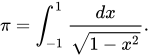
Why starting with the strange formula

instead of a natural one

? — Preceding unsigned comment added by 193.48.71.230 (talk) 13:28, 4 October 2018 (UTC)
- Straight from the article (refs removed):
Here, the circumference of a circle is the arc length around the perimeter of the circle, a quantity which can be formally defined independently of geometry using limits, a concept in calculus. For example, one may compute directly the arc length of the top half of the unit circle given in Cartesian coordinates by x2 + y2 = 1, as the integral:
- So if one thinks of π as the ratio of the circumference to the diameter, that's the integral that pops out. –Deacon Vorbis (carbon • videos) 13:43, 4 October 2018 (UTC)
Semi-protected edit request on 11 October 2018
 | This edit request to Pi has been answered. Set the |answered= parameter to no to reactivate your request. |
The pronunciation at the top is wrong. The /p/ in the word pi is aspirated, so it should be /pʰaɪ/, not /paɪ/. Nvidovic (talk) 22:14, 11 October 2018 (UTC)
 Not done. I'm not an expert on IPA stuff, but as far as I can tell (such as at Help:IPA/English, the aspiration mark isn't used, as any p in English is more or less the same. –Deacon Vorbis (carbon • videos) 23:26, 11 October 2018 (UTC)

- Afaik, the "p" in the relevant phonem is always considered to have an aspirated "p". However, I do not know whether linguists unanimously agree on the existence of aspirated plosives, and I am ignorant about the pertinent WP-rules, probably claiming what non est in actis non est in mundo. May an expert in both take care of this? Purgy (talk) 05:39, 12 October 2018 (UTC)
- English does not use aspiration to distinguish between consonants like /p/ and /b/, it uses voicing. /p/ is aspirated, though not as much as languages which use aspiration as the main way of distinguishing between such pairs of consonants. Chinese for example.--JohnBlackburnewordsdeeds 13:13, 12 October 2018 (UTC)
The answer, in broad strokes, is that WP uses a "phonemic" rather than "phonetic" transcription for English. Sometimes unfortunately, it uses a notional "phonetic" transcription for other languages, which leads to some renderings, like changing n to m before consonants in Italian, that give an entirely misleading impression, but that's not important right now. At the phonemic level, there is no need to mark aspiration, at least not in English. --Trovatore (talk) 02:15, 13 October 2018 (UTC)
Semi-protected edit request on 18 October 2018
| This edit request to Pi has been answered. Set the |answered= parameter to no to reactivate your request. |
Please update the approximate value of PI from 3.1415 to ACTUAL VALUE of (9sqrt2)/4 based on S^2=4Ci. This value is derived by squaring 4 circles, not one, as can be demonstrated in the link from Numberphile. Please remember this is 1:4 not 1:1, as 1:1(squaring a single circle) has NEVER worked to give the actual value. Before you throw off the idea, the question must be asked, "What prevents the approximate value, when increasing accuracy, be bound to the thousandths place and exclude the hundreths onward."
Explanation of why it is 1:4 not 1:1:
Unexpected Shapes (Part 1) - Numberphile
Proof: Unequivocally Expressing PI as a Fraction
Actual value: sqrt(9^2+9^2)-4((9sqrt2)/4)
Approximate value: sqrt(9^2+9^2)-4pi
Thank you for taking the time to verify each link as this is a groundbreaking discovery. Perpetualinput (talk) 03:58, 18 October 2018 (UTC)
- Not done π is a transcendental number, but the expression you give is an algebraic number, and therefore cannot equal π. Also, you would need to provide a reliable source. --Trovatore (talk) 04:10, 18 October 2018 (UTC)
- (edit conflict) Not done @Perpetualinput: Please take your pseudomathematics elsewhere. The Numberphile video does not at all claim to be squaring the circle (or even "four circles"). Plus, you seem incapable of the most basic arithmetic: . I will not waste my precious studying time explaining to you the blatant inaccuracies in your so-called "publication".--Jasper Deng (talk) 04:12, 18 October 2018 (UTC)

Semi-protected edit request on 18 October 2018
| This edit request to Pi has been answered. Set the |answered= parameter to no to reactivate your request. |
This edit request has been answered. Set the Perpetualinput (talk) 04:24, 18 October 2018 (UTC)
- @Perpetualinput: You can consider your edit requests to insert your so-called "value of π" to be categorically and automatically declined, please do not waste any more of our time.--Jasper Deng (talk) 04:27, 18 October 2018 (UTC)
Semi-protected edit request on 15 November 2018
| This edit request to Pi has been answered. Set the |answered= parameter to no to reactivate your request. |
How Pi might have come about? Humans might have wanted to know about the direct path to a point on earth exactly opposite to where they are. To find out, once it is known Earth is a sphere, they would have measured a cylindrical object's length of the circumference and the diamter. Using these measurements, they would have calculated the ratio and used it to derive the diameter of the earth by the known distance between the points. Thus, the Pi (22/7) might have come about. Wearewithyou (talk) 02:48, 15 November 2018 (UTC)
- Not done. Edit request templates are not for making wild speculations. –Deacon Vorbis (carbon • videos) 02:58, 15 November 2018 (UTC)


