Talk:Spacetime/Archive 23
From Wikipedia, the free encyclopedia
 | This is an archive of past discussions about Spacetime. Do not edit the contents of this page. If you wish to start a new discussion or revive an old one, please do so on the current talk page. |
| Archive 20 | Archive 21 | Archive 22 | Archive 23 | Archive 24 | Archive 25 | Archive 26 |
Updated Transverse Doppler effect diagram

While I work on animation, I did my best to improve the static picture.
1) I have added “bulbs” with arrows. These arrows demonstrate direction of emission or perception of light pulse. Due to aberration moving source emits “transverse” light pulse backward, moving observer sees transverse light pulse coming from the front,
2) I have added “apparent” positions of the source for all cases.
3) I tried to vividly demonstrate the identity of rotating and inertial observers, the same interpretation of frequency shifts, the same amounts of frequency shift.
Sure, the diagram must be followed by proper explanation in the article.
This analysis is solidly backed by the primary and secondary sources: A. Einstein 1905 article (&7), Kevin S. Brown (Doppler effect at Mathpages) and a number of papers considering Mossbauer rotor experiments, papers and articles on relativistic aberration. Animated will look like that: Observer with laser pointer in the origin emits green light pulse straight up, mirror movies parallel to the x axis, light pulse hits mirror, mirror measures blueshift (blue flash), light pulse comes back to origin (redshifts) and appears to the observer at the same green color.
I believe that diagram makes clear, that:
1) Angle of emission always has corresponding angle of reception; these angles cannot be arbitrary. So, a reference frame is not a private property of observer but mutual. If one is “at rest”, the other will definitely be “moving”.
2) Reciprocal time dilation is two mixed "by force" special cases, when each observer is “at rest” (looks at right angle and one - way speed of light in “his” frame is isotropic). Sure, it is nonsense.
If there is will be no objection, in several days I will replace the diagram.Albert Gartinger (talk) 08:01, 4 October 2018 (UTC)
- I object. You continue to illustrate the distinction between scenarios (a) and (b) as between moving observer versus moving source. The distinction rather is between the receiver and source at their closest points to each other, versus the receiver seeing the source as closest. In addition, you continue to mix elements of multiple frames in a single diagram. Prokaryotic Caspase Homolog (talk) 12:56, 4 October 2018 (UTC)
- Of course, we are in no hurry. I think your arguments are clear in the text. Before starting any dispute resolutions, could you please clarify exactly which diagram you think is appropriate? That which is now or do you have some kind of improved version? What do you think of the animation scenario that I have proposed?Albert Gartinger (talk) 13:58, 4 October 2018 (UTC)
- The principle of relativity dictates that for a given physical scenario, it makes absolutely no difference whether one considers the scenario from the frame of the source or the frame of the receiver. Your diagram misleads the viewer into thinking that choice of frame (moving observer versus moving source) makes a difference in the outcome of otherwise identical physical scenarios. Choice of frame cannot make any such difference. The reason why (a) results in the receiver observing a blueshift, while (b) results in the receiver observing a redshift, is that the physical scenarios are different in the two diagrams. Your illustration is therefore misleading and unacceptable. Prokaryotic Caspase Homolog (talk) 16:45, 4 October 2018 (UTC)
- Dear Sir,
- The principle of relativity dictates that for a given physical scenario, it makes absolutely no difference whether one considers the scenario from the frame of the source or the frame of the receiver. Your diagram misleads the viewer into thinking that choice of frame (moving observer versus moving source) makes a difference in the outcome of otherwise identical physical scenarios. Choice of frame cannot make any such difference. The reason why (a) results in the receiver observing a blueshift, while (b) results in the receiver observing a redshift, is that the physical scenarios are different in the two diagrams. Your illustration is therefore misleading and unacceptable. Prokaryotic Caspase Homolog (talk) 16:45, 4 October 2018 (UTC)
- Of course, we are in no hurry. I think your arguments are clear in the text. Before starting any dispute resolutions, could you please clarify exactly which diagram you think is appropriate? That which is now or do you have some kind of improved version? What do you think of the animation scenario that I have proposed?Albert Gartinger (talk) 13:58, 4 October 2018 (UTC)
- You have already expressed several different versions why my diagram “misleads the viewer”. In my opinion, it is your diagram misleads the viewer, so we have some sort of conflict. I am ready to go far, far, far away to defend my diagram. I will be most thankful for reducing our dialogue to discussing exact features of the diagram instead of exchange of philosophical interpretations. Yes, it is clear, that these diagrams describe different physical scenarios (light emitted at closest approach redshifts, light received of closest approach blueshifts), different angles of perception. In regard of the case a - you mentioned yourself that it is “best analyzed from the frame of receiver”, so I feel completely lost and confused. I have already mentioned that I wish to start dispute resolution procedures and to involve as many people as possible inside or outside Wikipedia. If you think, that this diagram is misleading, could you please to provide yours. I haven’t got any answer yet, which diagram according to you is “acceptable“, so will you please:
- 1) To make clear, whether you wish to leave existing diagram and explanation “as it is” and to reject mine;
- 2) Should you wish to provide your improved “acceptable” design instead of mine,
- 3) What is your opinion towards my scenario of dynamic presentation?
- Looking forward to your reply, Albert Gartinger (talk) 18:04, 4 October 2018 (UTC)
- @Albert Gartinger:
- regarding your statement "I am ready to go far, far, far away to defend my diagram": note that without a reliable wp:secondary source in which the diagram appears, together with the text of the article, there is no way that it will be taken on board in Wikipedia. The farther you go—without such a source—the more time you will waste, mostly your time, but as soon as editors see that you are wasting their time, someone will take action to stop you. As you already are on final warning level for talk page abuse, not much is needed to get you blocked.
- regarding your statement "...to involve as many people as possible inside or outside Wikipedia...": be aware of wp:canvassing with people inside Wikipedia, and, lacking internal consensus, new people from outside Wikipedia are likely to be regarded as wp:meat puppets.
- - DVdm (talk) 18:56, 4 October 2018 (UTC)
- DVdm (talk), thank you very much for you note, I will take it into account. I mentioned reliable wp:secondary source behind my analysis. they may seem unreliable to you, but they may seem reliable to others. I am looking for exact answer from another Wikipedia editor towards design of my diagram to start dispute resolutions Albert Gartinger (talk) 19:08, 4 October 2018 (UTC)
- Before you start that, it would be a good idea to have a source that clearly, directly and visually supports the diagram itself. Good luck. - DVdm (talk) 19:18, 4 October 2018 (UTC)
- Dear DVdm (talk), thank you very much for your kind words!!! Sadly, my interlocutor only complains that something wrong is with the diagram, but doesn't want to give exact answer exactly what. I don't even understand what exactly scenario is wrong and why and how this scenario should look like. Albert Gartinger (talk) 19:27, 4 October 2018 (UTC)
- Before you start that, it would be a good idea to have a source that clearly, directly and visually supports the diagram itself. Good luck. - DVdm (talk) 19:18, 4 October 2018 (UTC)
- DVdm (talk), thank you very much for you note, I will take it into account. I mentioned reliable wp:secondary source behind my analysis. they may seem unreliable to you, but they may seem reliable to others. I am looking for exact answer from another Wikipedia editor towards design of my diagram to start dispute resolutions Albert Gartinger (talk) 19:08, 4 October 2018 (UTC)
- @Albert Gartinger:
Citations in support of my diagram
Should someone wishes I to provide quotes, in support of scenario (a) I would like to quote celebrated A. Einstein’s work “On the Electrodynamic of Moving Bodies”, &7, Theory of Doppler Principle and Aberration:
http://hermes.ffn.ub.es/luisnavarro/nuevo_maletin/Einstein_1905_relativity.pdf
From the equation for it follows that if an observer is moving with velocity relatively to an infinitely distant source of light of frequency , in such a way that the connecting line “source-observer” makes the angle with the velocity of the observer referred to a system of co-ordinates which is at rest relatively to the source of light, the frequency of the light perceived by the observer is given by the equation


Mr. Einstein clearly speaks that "an observer is moving with velocity " and that "with the velocity of the observer referred to a system of co-ordinates which is at rest relatively to the source of light"
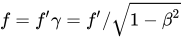
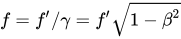
That exactly what my diagram case a demonstrates. It is clear, that at the moment when "the connecting line “source-observer” makes the angle with the velocity of the observer" makes angle that formula reduces to:


That exactly what my diagram demonstrates. Sure, I have plenty of sources in support of any other scenario. Albert Gartinger (talk) 20:29, 4 October 2018 (UTC)
I believe that it would be very fair to perpetuate the great teachings of Mr. Einstein in my diagram Albert Gartinger (talk) 20:41, 4 October 2018 (UTC)
- Since there doesn't seem to be any means of getting a permalink to the current version of any figure, I am temporarily using a copy of your figure from my drive account. I will switch the link to an permanent archive link on Commons when/if one becomes available.
- The question is not whether Albert Einstein understood the theory of relativity. The question is whether your figure as of 7:54, 4 October 2018 provides a clear and understandable interpretation of the scenarios discussed in the text.
- Unfortunately, as I have repeatedly pointed out, the figures that you have presented to date are totally baffling because
- They mix up elements of multiple frames in a single image
- They imply that shifting frames from moving observer to moving source makes all the difference as to whether the observer sees blueshift or redshift.
- Consider scenario (a) of your figure.
- In this one figure, you show the observer as moving in the frame of the source. With a bubble arrow around the source, you show light being emitted from the source perpendicular to the path of the observer. Likewise, with the squiggly green arrow, you show light being emitted from the source perpendicular to the path of the observer.
- On the other hand, you illustrate the apparent position of the source from the viewpoint of the observer, and you have a bubble arrow pointing to the apparent position of the source.
- In other words, you have mixed up elements from multiple frames into a single diagram.
- Your legend indicates that "the arrow indicates direction of the light pulse". In some situations, you use bubble arrows to indicate the direction of the light, in other situations, you use bubble arrows to indicate directions to the light. You are inconsistent in your use of the bubble arrows.
- Consider scenario (b) of your figure.
- You label this scenario as "Moving source" to distinguish it from scenario (a), "Moving observer". As I have indicated above, whether an observer sees the light as blueshifted or redshifted cannot depend on the frame in which the scenario is analyzed. Your figure is therefore totally misleading.
- You use bubble arrows inconsistently. From the apparent position of the source as seen by the observer, you have a bubble arrow shooting off to the left, heading off to nowhere. From the observer, you have a bubble arrow pointing to the apparent position of the source.
- The figures that you have presented to date are all completely unacceptable because of these confusing elements. Until you learn how to present things clearly, you are wasting everybody's time here. Any attempt by you to replace the existing figure in the article with your version will be immediately reverted. Prokaryotic Caspase Homolog (talk) 09:33, 5 October 2018 (UTC)
- Dear Prokaryotic Caspase Homolog (talk), thank you very much for your message and your valuable opinion. I will post on your talk page some other secondary sources in regard of the diagram. Surely I do not intend to go into edit wars, I wish to seek consensus. I can recommend you to learn a little bit more about the aberration of light. Light emitted in the frame of the source (Case a) at right angle will approach receiver at oblique angle . Yes, this theory is quite difficult and diagrams my appear confusing, they require some mental efforts indeed. Let's postpone our further talks until dynamic animation is ready. Again, could you please to make it clear, do you wish to leave the current figure with moving sources? Albert Gartinger (talk) 10:47, 5 October 2018 (UTC)
- I have offered compromise to my interlocutor on his page - adjust this figure according to his understanding, just to draw two TRANSVERSE effects - in the rest frame of the observer and in the rest frame of the source.Albert Gartinger (talk) 12:05, 5 October 2018 (UTC)